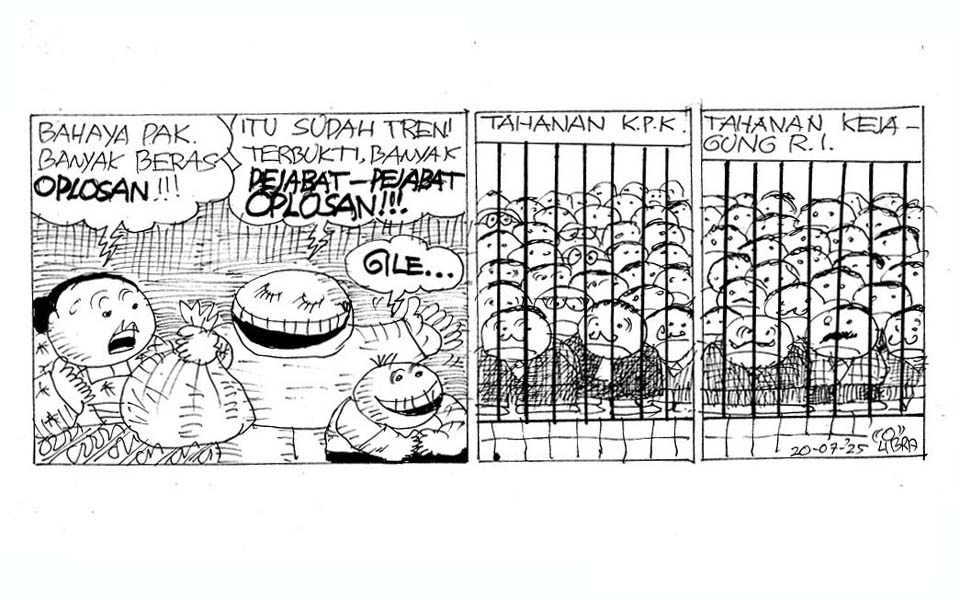


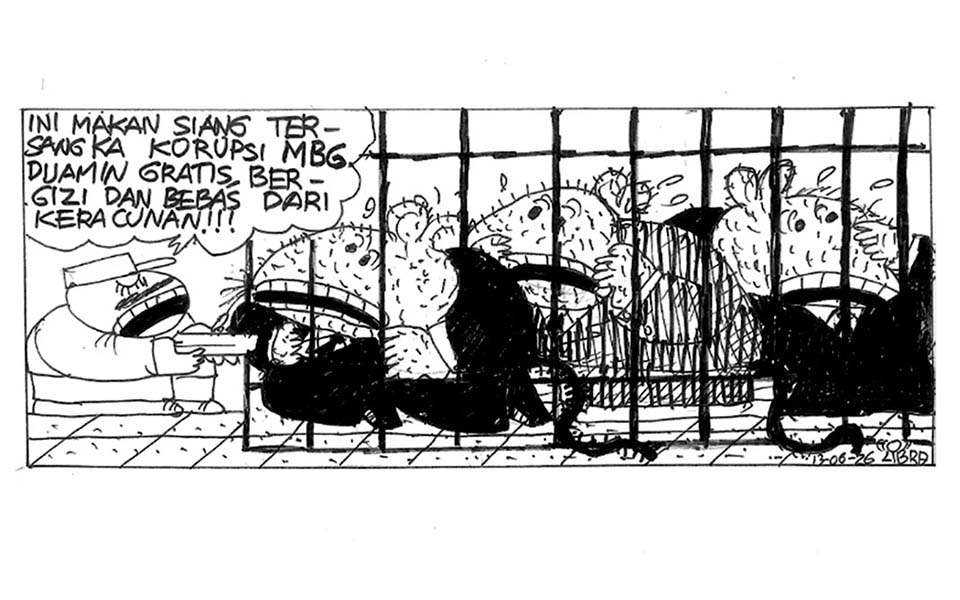
Guard: This is lunch for MBG corruption suspects. Guaranteed to be free, nutritious and free of poison.
The National Human Rights Commission (Komnas HAM) says that it had found "strong indications" of human rights violations in the implementation of President Prabowo Subianto's flagship free nutritious meals (MBG) program, including food-poisoning incidents that have affected tens of thousands of beneficiaries nationwide.
The findings were reported only a week after the after the arrest on corruption charges of Dadan Hindayana, the former head of the National Nutrition Agency (BGN), which oversees the MBG program, along with his two deputies, Sony Sonjaya and Lodewyk Pusung. The three are alleged to have approved unqualified Nutrition Fulfillment Service Units (SPPG) and inflated prices when procuring goods and services for the BGN.
Speaking at a press conference in Jakarta, Commissioner Uli Parulian Sihombing said the findings were based on field studies conducted in West Kalimantan, West Java and East Java, as well as consultations with nutrition experts, public-policy specialists and civil society organisations.
"Based on our preliminary findings, Komnas HAM has identified strong indications of human rights violations in the implementation of the free nutritious meals program, including violations of the rights to health, food, information, freedom of expression, decent work, children's rights, and the right to remedies for victims", Sihombing was quoted as saying by the Jakarta Globe.
According to Komnas HAM, the most serious concern is the high number of food-poisoning incidents. Citing Health Ministry data as of May 11, 2026, Sihombing said there had been 449 reported cases of mass food poisoning affecting 38,023 people across 36 provinces and 221 regencies and municipalities.
He also criticised "inadequate responses" to food-poisoning incidents and noted that only 15,728 of the 27,649 operational SPPG had obtained hygiene and sanitation certification, representing just 57% of all facilities.
The commission argued that the target population – which includes all schoolchildren, pregnant women, breastfeeding mothers and toddlers – is too broad, and the program would be more effective if focused on the most vulnerable groups, particularly low-income communities in disadvantaged and remote regions.
In addition, Komnas HAM raised concerns about reports that law-enforcement had been used in response to public criticism of the program. "The use of litigation or criminal complaints to respond to criticism has the potential to undermine the rights to freedom of opinion and expression", said Sihombing.
Based on its findings, the Commission called on the government to conduct a comprehensive review of the program to ensure that its implementation is consistent with human-rights principles, properly targeted, transparent and capable of protecting both beneficiaries and workers involved in the initiative.
[Abridged from a Jakarta Globe article titled Rights Commission finds 'strong indications' of human rights violations in free meals program.]