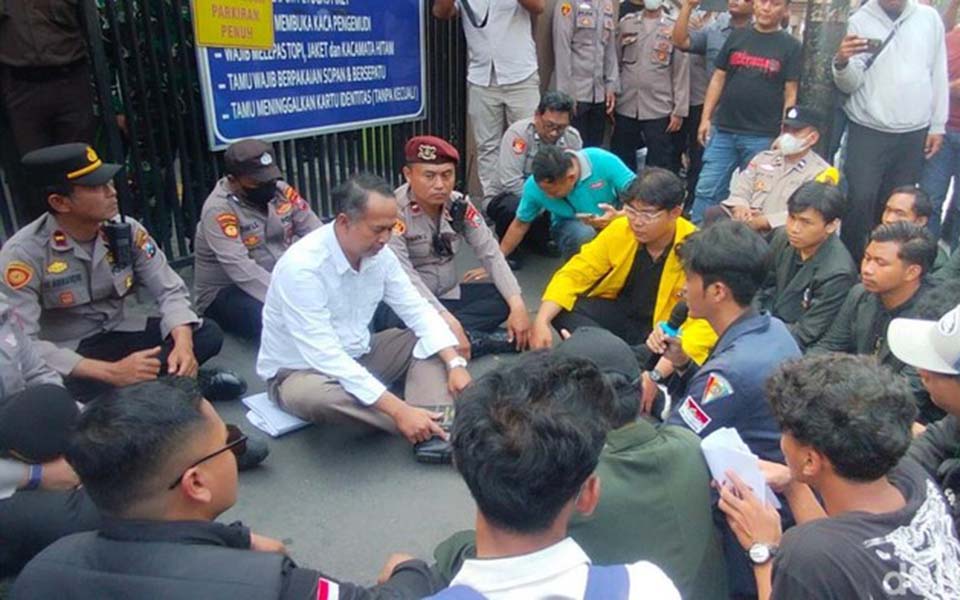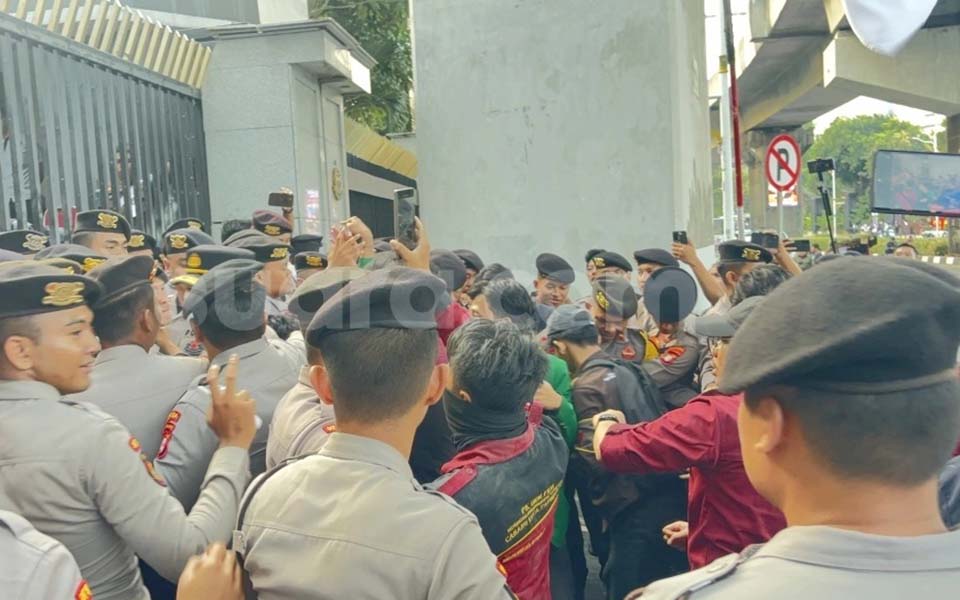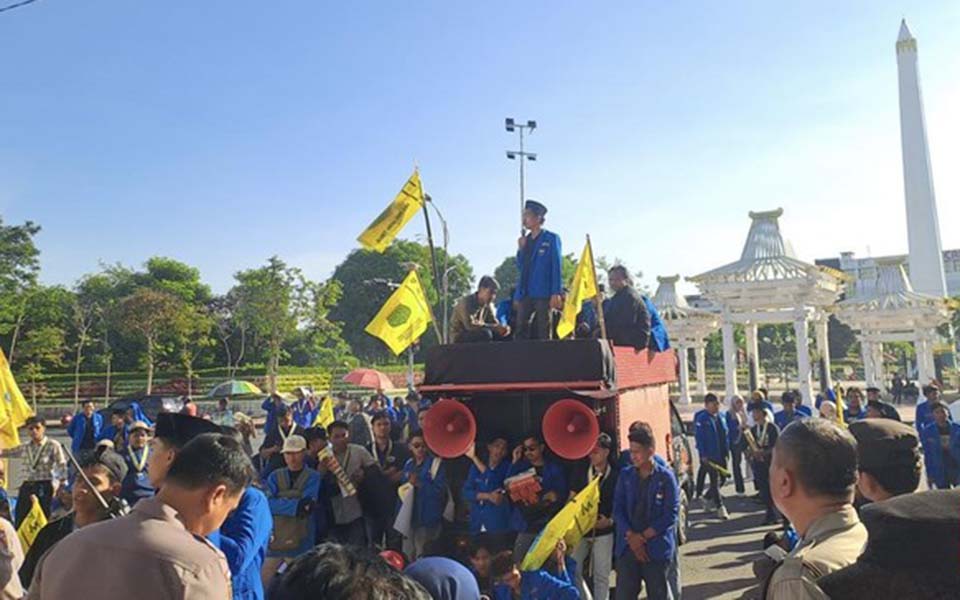


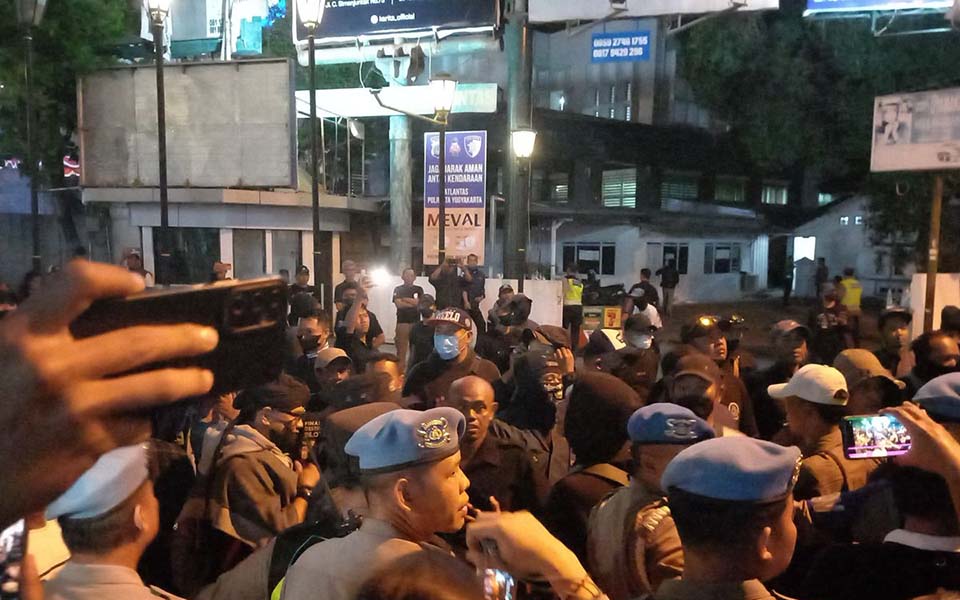
Ki Ageng Begawan Reksa – On the afternoon of Tuesday September 1, hundreds of students organised under the Gajah Mada University (UGM) Student Alliance and joined by various civil society elements marched from Wisma Kagama to the Gramedia Intersection on Jalan Jenderal Sudirman in Yogyakarta, Central Java.
This action was a form of solidarity with victims of the repression that occurred in Jakarta during the protests on August 27, as well as a critique of the administration of President Prabowo Subianto and Vice President Gibran Rakabuming Raka. The crowd arrived around 5.30 pm carrying banners listing their demands, and the protest proceeded in an orderly fashion until nightfall.
Around 7 pm there was a provocation that sparked tensions, which then calmed down, but heated up again several hours later until the crowd was forced to retreat around at 10 pm. Six students from the UGM and the Yogyakarta State University (UNY) were rushed to Panti Rapih Hospital suffering from lacerations, bruises on their heads and temples, shortness of breath and trauma.
Police said that the clash occurred between the protesters and a group of residents calling themselves "Jaga Warga" (Neighbourhood Guardians), a term that is misleading, as explained below, given that the group that was active that night was actually part of a network of reactionary civil militias cultivated and funded by the state and controlled by political elites.
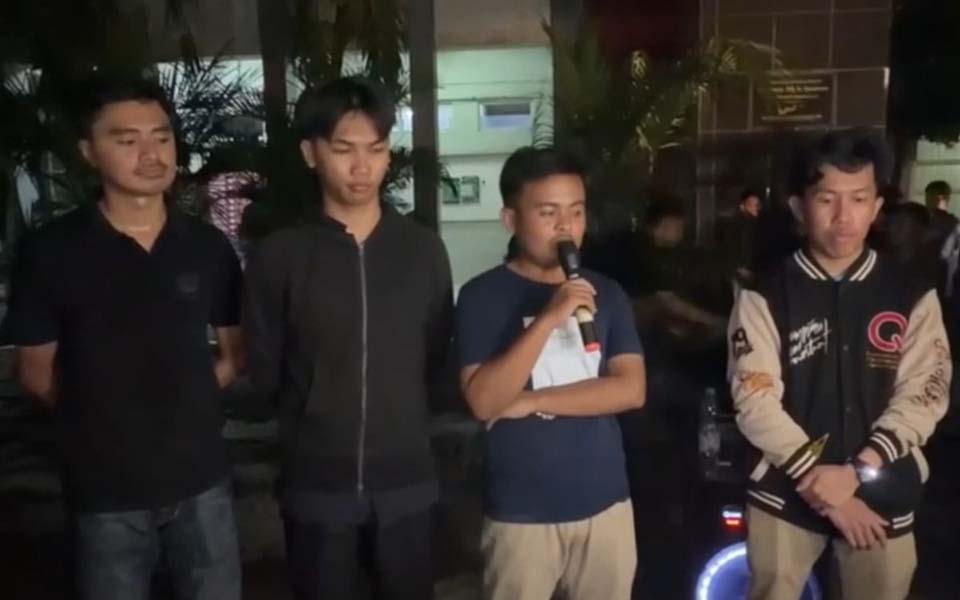
Three days later, the students held an open briefing at the UGM traffic circle to refute the police narrative which accused protesters of spraying pepper spray at officers, dismissing the claim as a deliberate attempt to distort the facts on the ground.
This event was not an isolated incident but a repetition of a pattern frequently seen in Yogyakarta; furthermore, it took place exactly five days after a far bloodier escalation in Jakarta.
On August 27, protesters from the United Pati Community Alliance (AMPB) led by Supriyono alias Botok joined the United Indonesian People's Alliance (Aliansi Rakyat Indonesia Bersatu) to stage a protest outside the Senayan parliamentary complex, demanding the passage of the Asset Recovery Bill and the death penalty for corruptors. Around 600 people turned out, joined by student elements from the People's Movement Challenge Alliance (Aliansi Gerakan Rakyat Menggugat).
The protest proceeded peacefully through the day and dispersed in an orderly fashion following an agreement with House of Representatives (DPR) leaders. However, chaos erupted that night in the Slipi-Pejompongan area of West Jakarta. Trucks were set on fire and facilities vandalised. Bambang Setiyawan (59), a resident of Bendungan Hilir in Tanah Abang, who was not part of the protest, was beaten to death by a group of people in the middle of the street.
Rosario de Marshal alias Hercules, the chairperson of the Greater United Indonesian People's Movement (GRIB Jaya), admitted to being at the scene that night, claiming his presence was part of a "voluntary security" effort to assist authorities in protecting public facilities. GRIB Jaya denied any involvement in Setiyawan's killing. But what remains indisputable is the underlying pattern: the state, controlled by the political elite, permits and even facilitates the presence of armed reactionary civilian militias at flashpoints of repression, only to hide behind the language of "maintaining order" when such violence claims lives.
The same pattern, with a local face, had already been established in Yogyakarta, where the roots of the incident can be traced back to the death of a university student a year earlier.
Rheza Sendy Pratama, a 21-year-old fifth-semester Communication Science student at Amikom University Yogyakarta, died on the morning of Sunday August 31, 2025, after participating in a protest in front of the DIY (Yogyakarta Special Region) Regional Police Headquarters. The motorcycle he was riding stalled as he attempted to turn around amidst a volatile situation. Security forces fired tear gas, Pratama fell, his companion managed to escape and Pratama was approached by officers while lying on the ground. He was rushed to Dr. Sardjito General Hospital in critical condition and was pronounced dead due to cardiac arrest. His father, Yoyon Surono, found his son's body covered in bruises, including marks on the abdomen suspected to be from heavy-duty police boots, as well as lacerations, a head wound and a face whitened by tear gas residue.
The DIY Regional Police Chief at the time, Inspector General Anggoro Sukartono, visited the funeral home and offered to facilitate an exhumation and an investigation through the National Police's Internal Affairs Division (Propam Polri). The family declined, choosing instead to accept the loss with resignation, as they could not bear the thought of their son's grave being disturbed.
Julian Dwi Prasetia, director of the Yogyakarta Legal Aid Foundation (LBH), asserted that the family's stance should not halt legal proceedings; Pratama's death was not a complaint-based offense requiring family consent for investigation, but rather a standard offense that state authorities were obligated to pursue on their own initiative. LBH suspects that the violence against Pratama was perpetrated by security forces and views the case as a dark stain on the democratic process, and emphasised that Rhesa was not the first victim. To this day, there is no record indicating that this legal obligation was actually fulfilled. State authorities have a duty to investigate, yet they chose to hide behind the family's resignation – the words of a family exhausted by grief.
It was at this point that the Jogja Peace Forum (Forum Jogja Damai) was born, according to one of its own founders. Waljito, who is frequently cited by the media as the forum's initiator, explained to Inilah Jogja in June 2026 that the forum was "formed several months ago following the incident at the DIY Regional Police Headquarters, amidst concerns that follow-up protests might shift to the DPRD [Regional House of Representatives]".
Waljito established the forum along with Hasan (chairperson of Merkids), Benche (chairperson of Merkade) and Erwin (chairperson of the Yogyakarta City Young Generation of the Communication Forum for Children of Retired Police and Military Officers, GM FKPPI), and claims the support of over 85 mass organisations across DIY. From the outset, the historical function of the Jogja Peace Forum has been to quell the continuing wave of public outrage over Pratama's death, rather than merely maintaining an abstract state of "conduciveness" as touted in its official press release.
It is important to uncover who Waljito is, because he serves as the nexus uniting nearly all the reactionary civilian militia groups that have appeared alternately in Yogyakarta over the years as if they are distinct organisations. He is the chairperson of the DIY Madani Social Front (FMM). He also heads the United People's Front Movement for Justice and Humanity (GeBUKK), a coalition of mass organisations (ormas) officially formed in February 2026 comprising the FMM, Sniper, Merkade, Atmo5 and GRS, which within the same week held an audience with the commander of the Yogyakarta District Military Command (Kodim 0734) to declare its readiness to "assist security forces, particularly the Indonesian Military (TNI)".
At the same time he is on the DIY GRIB Jaya Regional Leadership Board (DPD), a role which he acknowledged himself while clarifying his presence at the Gramedia intersection, where he denied "wearing DPD KSPSI or GRIB insignia" that night, a statement that actually confirmed his affiliation with both organisations. The Confederation of the All Indonesian Trade Unions (KSPSI) itself is a trade union confederation that has long been aligned with the powers that be, rather than a trade union independent of the regime's interests.
One person, four organisational hats, one function. A meeting between civil society organisations and the commander of the Kodim 0732/Sleman in May 2021 revealed a network far more extensive and long-standing than the coverage of the Gramedia intersection incident alone suggested. Groups such as FMM (Waljito), Jogja Little Tigers (Macan Kecil Jogja, Fendi Ahmad), Merkade (Dwi Purwanto), GRS (Rusli), the 9 Star Brigade (Brigade Bintang 9, Gus Zaroh), Merkids (Hasan), Atmo 5 (Raka Yudistira), the National Defence Forum (Forum Bela Negara, Erwin) and the Bantul Palace Security Section Association (Paksi Katon Bantul, Santoso) gathered in a forum with the TNI territorial commander, pledging their commitment to the "Unitary State of the Republic of Indonesia (NKRI) as a non-negotiable imperative" and vowing to maintain "regional stability". These same names, in slightly different configurations, re-emerged as the Jogja Peace Forum in 2026 and mobilised as Neighbourhood Guardians at the Gramedia intersection.
Paksi Katon is not a new name to anyone following the history of the suppression of democratic space in Yogyakarta. In July 2016, police officers, alongside hundreds of members from reactionary civilian militias such as Paksi Katon, the Jogja Militia (Laskar Jogja), Pancasila Youth (Pemuda Pancasila, PP) and the FKPPI blockaded the Kamasan I Papuan student dormitory in order break up a solidarity gathering of Papuan students demanding the right to self-determination. In May 2016, within the span of a single week, three discussion forums were successively attacked or intimidated by this same network. In April 2016, the LadyFast festival was shut down by reactionary civilian militias, while the police effectively cleared the way for them. Ten years later, the key actors remain; they have simply changed the names of their coalitions while continuing to be nurtured by the same Territorial Command and Regional Police (Polda).
This is where the sharpest irony lies. The very same group, today wearing "Jaga Warga" uniforms and claiming to be ordinary citizens maintaining neighbourhood law and order, is the group that reacts with the most fury precisely when Papuans in Yogyakarta take to the streets to demand their right to self-determination as a nation. Those most eager to pass judgment on who may speak in Yogyakarta based on place of origin and ID card details, are the very ones who vehemently oppose it when another people within this republic question the status of their own origins and sovereignty over their own land. The primordialism they invoke is not an expression of love for their birthplace, rather it is a bludgeon whose direction is dictated entirely by the interests of the powers they serve.
The police's language referred the clash at the Gramedia intersection as a misunderstanding between the protesters and local residents. This framing casts the students as disruptive outsiders and the locals as victims of that disruption, yet the majority of the protesters are students who reside, study, rent accommodation and live their daily lives in Yogyakarta. This is not a new trend. The phrase "Where's your ID card?" (KTPmu ngendi) has long circulated in Yogyakarta's digital spaces; it is a rhetorical question used to challenge a person's right to speak on city issues based solely on where their identity card was issued. While the phrase may seem casual or even humorous on the surface, it functions according to the same logic used by authorities to frame students as outsiders who disrupt the peace of the indigenous people.
The function of this framing is clear, and there lies its falseness as a defence of national unity. Equating university students with outsiders obscures the reality that students, labourers, small-scale traders and indigenous residents all stand on the losing side of the corruption targeted by the Asset Recovery Bill, the repression that killed Pratama, and the poverty that keeps the minimum wage in DIY among the lowest in Java. The framing of Yogyakarta residents versus newcomers, the framing of Yogyakarta ID cards versus non-local ID cards, is a truly divisive ideology, even though the very regime and reactionary civil militias employing it are the ones fond of accusing the Papuan liberation movement of being the source of division. Those who defend "Indonesian unity" by dividing the people based on their ID card are actually practicing the very logic of division they have long accused others.
Yogyakarta is not a city that is peaceful by accident. Its peace is manufactured through concrete instruments: The TNI"s territorial commands (Kodim and Koramil) that routinely co-opt reactionary civil militias, the Regional Police, which treats these militias as official partners in combating street crime while also using them to break up demonstrations, and individuals like Waljito, who wears the hats of four or five organisations simultaneously to ensure that street violence always appears to originate from ordinary citizens, not from the state apparatus.
Jaga Warga itself is not a spontaneous, grassroots civil society initiative; rather, it is an official state program controlled by political elites. It rests on a three-tiered legal foundation, DIY Governor Regulation Number 28/2021, revised by Number 59/2022, and subsequently updated by Number 41/2023, which explicitly governs the establishment, guidance, duties, functions and authority of Jaga Warga as a government partner. As of 2024, the DIY Regional Government claims to have established 4,677 Jaga Warga groups covering 100 percent of hamlets in the region, with a total of 106,570 members, who are given regular guidance from the DIY Public Order Agency (Satpol PP) and are coordinated by the DIY Regional Police (specifically the Special Criminal Investigation Directorate) regarding efforts to combat klitih (street gang violence). The Special Regional Fund directly finances these operations and a sum of 2.05 billion rupiah was allocated specifically for forty-one Omah Jaga Warga (Community Guard Posts) in a single fiscal year alone, alongside provisions for operational vehicles and new uniforms for the DIY Satpol PP.
When Jaga Warga was deployed to confront university students at the Gramedia intersection, the group facing the protesters was not composed of ordinary citizens inconvenienced by road closures, but rather they were reactionary civilian militias organised within a state-fostered and state-funded security structure that is controlled by the political elite through three successive generations of gubernatorial regulations. Jaga Warga is part of the state apparatus serving the political elite, wearing the uniform of the ordinary people.
Many in Yogyakarta itself have actually long questioned where the Special Region Fund totalling over ten trillion rupiah in the last decade have actually gone, and who most felt the benefits. This line of questioning ought to be broadened to not just infrastructure and culture and ask how much of that special funding is actually being used to maintain an apparatus that ultimately serves to silence the critical voices of its own people.
The armed capitalist framework that defines GRIB Jaya nationally is precisely the same framework defining Jaga Warga and the Jogja Peace Forum locally, an accumulation of power through violence where the allocation is determined by who holds the ultimate coercive power, the TNI's Territorial Commands and the Regional Police, not reactionary civil militias themselves who are independent. Waljito, serving as both the DIY DPD GRIB Jaya and the initiator of the Jogja Peace Forum, acts as the concrete link uniting these two faces of the same instrument.
Resisting this requires more than condemning a single incident and stopping there. First, there must be a flat rejection of the framing of the ordinary people verses protesters, local ID cards verses new arrivals, because it is this very framework itself serves as a tool for division. Second, there must be a demand for an open audit of the Special Regional Fund that finance Jaga Warga. Third, the police must be compelled to fulfill their legal obligations by investigating the death of Rheza Sendy Pratama as a standard criminal offense, regardless of the family's decision to accept the loss, and by investigating the death of Bambang Setiyawan in Jakarta.
Fourth, building solidarity across campuses and cities without relying on the benevolence of the authorities; as was one proven by the Democracy Struggle Solidarity (Solidaritas Perjuangan Demokrasi) in 2016 when the united popular mobilisation vastly outnumbered the reactionary civil militias attacking them. This also means establishing organised and trained grassroots self-defence units from the ordinary people themselves, organised and trained, because as long as the monopoly on street violence remains in the hands of the Territorial Command and the militias it has created, the safety of protestors will continue to depend on the goodwill of the very authorities who harbor their attackers.
The peaceful Yogyakarta envisioned by the Kodim and Jaga Warga is nothing more than a graveyard for the right to freedom of expression and the ordinary Yogyakarta people, whether they be students or traders, newcomers or local ID holders, have no need for such peace. They need justice for Pratama, for Setiyawan, and for everyone else who will follow if this pattern is allowed to keep repeating.
– Ki Ageng Begawan Reksa is a member of the Socialist Study Circle (LSS). Arah Juang is the newspaper of the Socialist Union (PS).
[Translated by James Balowski. The original title of the article was ""Warga" yang Diperintah Aparat: Bagaimana Milisi Sipil Reaksioner Dipelihara untuk Membungkam Yogyakarta".]
Source: https://www.arahjuang.com/2026/09/09/warga-yang-diperintah-aparat/