

Father: Our country's on a military alert? What up?
Poki: Why are we on alert? Is it war?
Father: But we're not currently at war. On alert against what threat?
Poki: Perhaps we're on alert over the threat of chili prices [going up] for the [Lebaran] holidays?
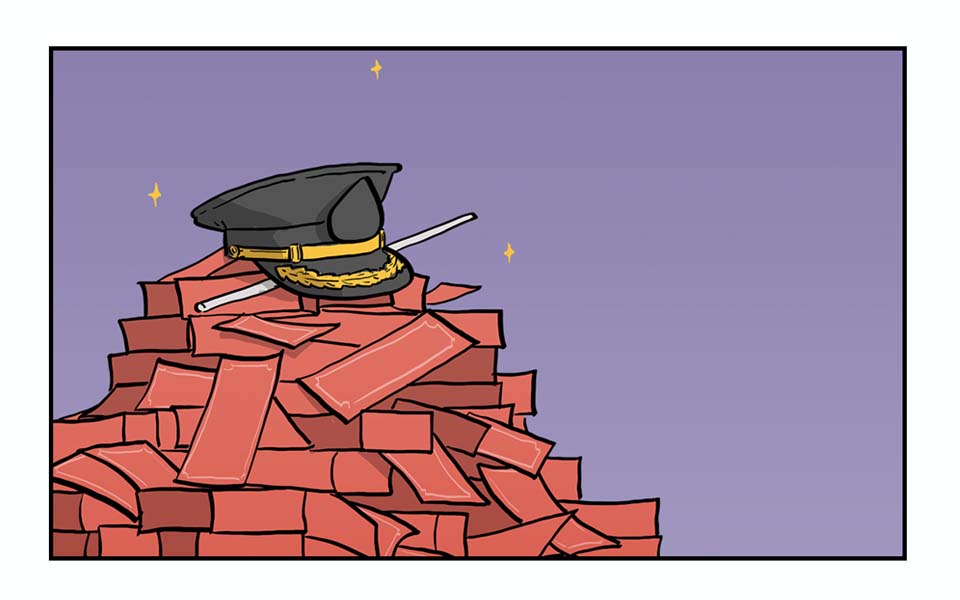
Democracy and civil supremacy took a troubling turn on March 1 when Indonesian Military (TNI) commander General Agus Subiyanto placed the armed forces on high alert for an indefinite period, citing the escalating conflict in the Middle East.
Acting on the commander's order, the Jakarta Military Command initiated early detection and prevention measures against groups that might exploit the Middle Eastern situation, creating a conspicuous military presence across several parts of the capital city.
A polemic quickly surfaced on social media, with many accusing the TNI chief of overstepping the president's authority as the supreme commander. Notably, President Prabowo Subianto has not publicly addressed the specific alert status, and the media only recently gained access to the TNI chief's official letter of order.
Regardless of the rationale behind the high-alert status, the TNI's unilateral move sets a dangerous precedent. The commander's order and the ensuing troop deployment have sparked widespread anxiety rather than the sense of security the policy was supposably intended to promote.
This move also comes amid lingering fears regarding the return of the military's dwi-fungsi (dual function) as demonstrated by the frequent appointment of active and retired officers to ministries, state agencies and state-run enterprises.
The TNI chief's order is also cause for serious concern because it lacks a clear constitutional basis. Under the Constitution the mobilisation of military force is a power vested solely in the president. This is further codified under the law on the TNI which stipulates that the authority to deploy military forces resides with the president, acting in coordination with the House of Representatives (DPR).
Consequently, the responsibility for assessing national security and geopolitical dynamics, and the subsequent decision to deploy troops, must be shared by the president and the DPR. Under this framework of civilian supremacy, the TNI lacks the legal standing to independently evaluate national threats for the purpose of mobilizing forces.
And add insult to injury, no official explanation followed the commander's instruction, which should have remained an internal military matter. Without clarification, speculation will continue to mount as to whether Indonesia faces an imminent external threat or if the TNI is navigating internal rivalries.
[Abridged from a Jakarta Post Editorial titled Indonesia President Prabowo and the military.]