

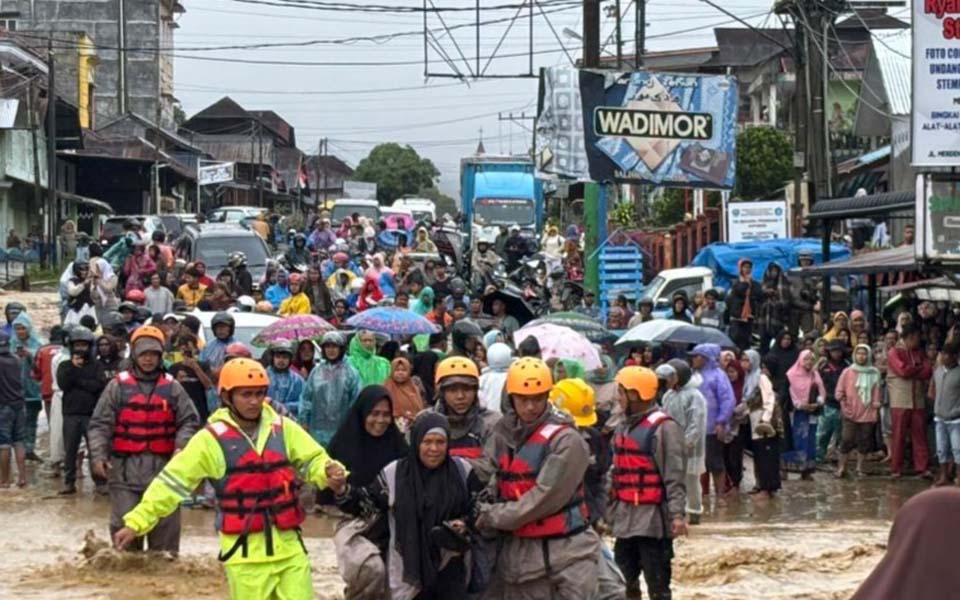
Ranny Supusepa, Asrul Rizal – The North Sumatra chapter of the Indonesian Forum for the Environment (Walhi) says that the ecological disaster in the form of flooding and landslides that occurred in Batang Toru in the regencies of South Tapanuli (Tapsel), Central Tapanuli (Tapteng) and North Tapanuli (Taput), were allegedly caused by seven companies.
The seven companies operate in or around the Batang Toru ecosystem, the habitat of the Tapanuli orangutan, Sumatran tiger, tapir, and other protected species.
The seven companies include PT Agincourt Resources (the Martabe gold mine), PT North Sumatera Hydro Energy (NSHE, hydroelectric power plant), PT Pahae Julu Micro-Hydro Power (the Pahae Julu micro-hydro power plant), PT SOL Geothermal Indonesia (geothermal) and PT Toba Pulp Lestari Tbk (TPL, PKR unit).
Then Walhi (Walhi) also named PT Sago Nauli Plantation (palm oil plantation) and PTPN III Batang Toru Estate (palm oil plantation) as the culprits behind the ecological disaster in North Sumatra.
Walhi North Sumatra Executive Director Rianda Purba revealed that it is the operations by these companies that led to the flooding and landslides in Tapanuli. Purba first touched on PT Agincourt Resources' operations from 2015-2024.
"This company reduced forest and land cover by approximately 300 hectares in the Batang Toru watershed. The TMF (Tailing Management Facility) is located very close to the Aek Pahu River, which flows through Sumuran Village. Residents reported that since the Ramba Joring PIT began operating, the river water has often become murky during the rainy season", he explained in a written statement on Saturday November 29.
Specifically, continued Purba, PT Agincourt Resources produces 6 million tons of gold per year and plans to increase capacity to 7 million tons by clearing 583 hectares of new land for the tailings facility, including the felling of 185,884 trees. This, he emphasised, is based on the environmental impact analysis (Amdal).
"Walhi's investigation found that approximately 120 hectares have already been cleared. The company's own environmental impact document lists risks such as changes in river flow patterns, increased runoff, decreased water quality, loss of vegetation and destruction of wildlife habitat", he explained.
Next, said Purba, is the Batang Toru Hydroelectric Power Plant (PT NSHE). According to Purba, the hydroelectric power plant project has caused the loss of more than 350 hectares of forest cover along a 13-kilometer stretch of the river, disrupting river flow fluctuations.
"High sedimentation is caused by the disposal of waste from tunnel excavations and dam construction. There's potential for river pollution if the excavation waste contains toxic elements," explained Rianda.
Furthermore, Purba revealed that the viral video of the Batang Toru River overflowing at the Trikora Bridge, showing large quantities of logs, is suspected to have originated from the hydroelectric power plant infrastructure construction area.
Purba continued explaining that PT Toba Pulp Lestari (PKR) has caused thousands of hectares of forest in the Batang Toru watershed to be converted into Community Timber Plantations (PKR). "Planted with eucalyptus, especially in Sipirok district, South Tapanuli", said Purba.
Purba also revealed that the Natural Wood Utilisation (PHAT) scheme is one of the triggers for flash floods. The wildlife corridor connecting Dolok Sibualbuali and the Batang Toru West Block Protected Forest has been degraded by at least 1,500 hectares over the past three years.
"Every flood brings large logs, and satellite imagery shows deforested areas around the site. This is evidence of human intervention through policies that allow for forest clearing. This is an ecological disaster resulting from the government's failure to control environmental damage", said Purba.
Separately, PT Agincourt Resources (PTAR) has responded to the accusations emphasising that the flash flood in Garoga Village was located in the Garoga/Aek Ngado River Basin. This location is separate from and not connected to the Aek Pahu River Basin, where PTAR operates.
"Our monitoring also found no wood material in the Aek Pahu River Basin that could be linked to the findings in the flooded area", PTAR stated, as quoted on the company's official website on Friday November 28.
"PTAR fully supports a comprehensive study being done by the government into all the factors causing this disaster and is ready to cooperate transparently", the company added.
The company also expressed its deepest condolences to the communities affected by the flash floods and landslides caused by extreme weather in Central Tapanuli, Sibolga, South Tapanuli and Padangsidimpuan.
PTAR expresses its condolences to the families of the victims, those experiencing health problems and injuries, and those forced to evacuate due to this disaster.
[Translated by James Balowski. The original title of the article was "Walhi Sumut Beberkan Dosa Perusahaan Diduga Penyebab Bencana Ekologis di Tapanuli".]