

Aida Ulim, Jayapura – A Draft Presidential Regulation (Ranperpres) on the involvement of the Indonesian Military (TNI) in combating terrorism is seen as further strengthening suspicions by various groups that the state is adopting a military approach to various problems in the country.
Indonesian Human Rights Watch (Imparsial) Director Ardi Manto Adiputra said that in the context of Papua, this draft presidential regulation has the potential to worsen the conflict, the humanitarian situation and democracy in Papua.
This is despite the prolonged conflict that has never been resolved peacefully, an armed conflict that has been going on for around 70 years. Furthermore, this draft presidential regulation is still being legally challenged.
According to Adiputra, the regulation is extremely dangerous if linked to the situation in Papua, as it labels certain groups in Papua as terrorists.
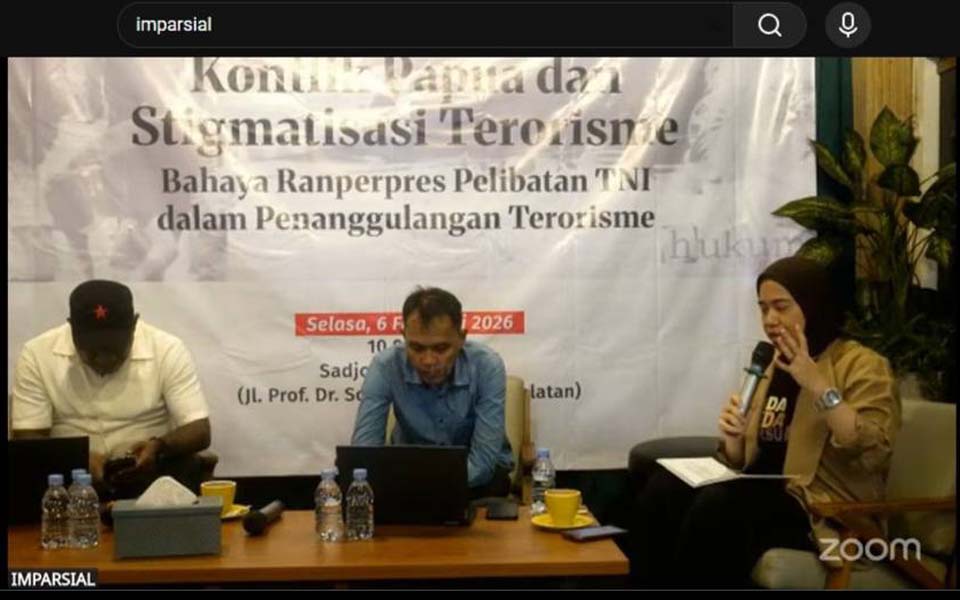
This statement was conveyed by Adiputra during a public discussion held by Imparsial on the Papuan conflict and the stigmatisation of terrorism titled "The Dangers of the Ranperpres and the Involvement of the TNI and Counterterrorism", which was broadcast online through Imparsial's YouTube channel on Tuesday February 10.
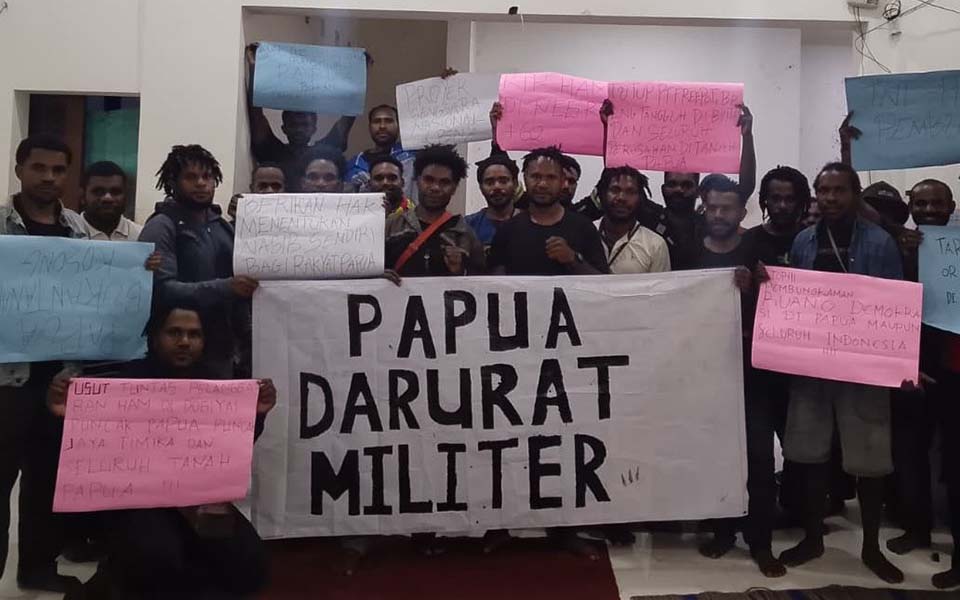
He said that the community's opposition in the land of Papua national strategic projects (PSN) shows that the problem there is not only development and armed conflict. It also involves humanitarian issues and the abrogation indigenous peoples' rights.
"Amid these conditions, the government has issued a draft Ranperpres that regulates the TNI's role in countering acts of terrorism", said Adiputra.
Imparsial noted that there are currently more than 14,000 TNI personnel in Papua. This number is considered very significant compared to the population ratio in Indonesia's easternmost region.
Therefore, a security approach that relies on troop deployment is seen as prolonging the conflict and distancing Papua from a peaceful resolution.
"Moreover, this Ranperpres will expand the TNI's authority to include prevention, enforcement and recovery, with a definition that is very broad and open to multiple interpretation", he said.
One of the points most highlighted by Adiputra was the definition of terrorism in the draft regulation, which covers actions deemed to threaten the state ideology of Pancasila.
This definition is considered highly vulnerable to abuse in Papua, bearing in mind the right to peacefully express political opinions and aspirations, which represent part of human rights, is not fully allowed.
"Not only that, the deployment of TNI troops to (the land of) Papua has not been based on a state political decision as mandated under Law Number 34/2004 on the TNI. This has resulted in military deployments taking place without clear measures and accountability", he said.
If the draft presidential regulation is ratified, it is feared that civil space in Papua will shrink further, the risk of human rights violations will increase and peace efforts that have been promoted by civil society, religious leaders, academics and other parties will be further obstructed.
"Resolving the conflict in Papua must be done by addressing the root of the problem, including human rights violations that have never been resolved. A coercive and military approach will only prolong the cycle of violence. A peaceful path through dialogue is the only way to resolve the Papuan conflict justly and with dignity", he said.
On the other hand, the draft regulation is also seen as confusing the military's function with law enforcement. Indonesia's handling of terrorism has traditionally used a law enforcement approach.
If the regulation is ratified, there are concerns that this approach will shift to a war approach or war model. Because previous experience has shown that various human rights violations have already occurred in with just the police handling of terrorism, including cases of wrongful arrest and deaths during law enforcement.
The military's involvement is seen as further increasing the risk of the use of excessive force, especially given the persistent issues of impunity and minimal accountability within the military justice system.
Law Number 2/2018 on Criminal Acts of Terrorism, continued Adiputra, does indeed mandates the creation of a presidential regulation or Perpres on the involvement of the TNI.
However, the requirement is that there must first be consultation with the House of Representatives (DPR). In contrast, the revised TNI Law Number 3/2025 does not require such consultation.
"We are concerned that the government will refer to the 2025 TNI Law and ignore the obligation to consult with the DPR as stipulated under the Terrorism Law. If that happens, then the Ranperpres will formally contradict the law", said Adiputra.
Meanwhile, Cenderawasih University academic Bernarda Meteray said that Papua is a region with social, cultural and historical complexities that cannot be compared to other regions in Indonesia.
The security approach, which prioritises military force from the Trikora (the 1961 Triple Commands of the People) era to the present, has failed to address the root of the problems in the land of Papua and has instead exacerbated the cycle of violence.
"Various policies have increasingly positioned the Papuan people as objects, rather than as dignified human beings", said Meteray.
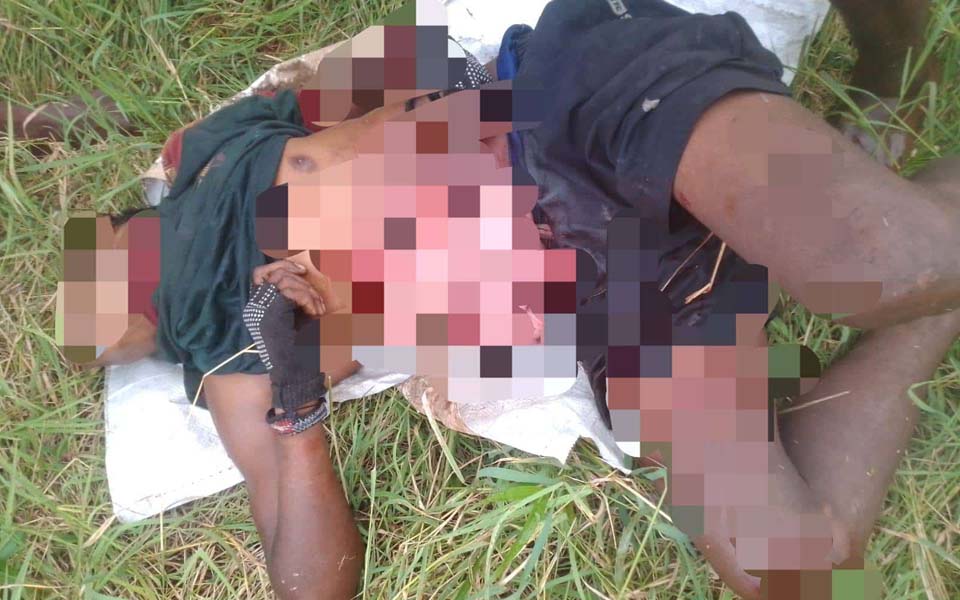
He said that violence, murder and arson are recurring events that have been imprinted on the collective memory of the Papuan people for generations.
According to Meteray, academics have long identified the roots of the conflict in Papua, ranging from the failure to uphold human rights, corruption, the marginalisation of indigenous Papuans, to the failure of political dialogue.
The results of these studies however have not yet become the primary reference in state policy making.
He said that the social impact of this, which is directly felt by the people of Papua today, includes mutual suspicion between indigenous Papuans and non-Papuans, identity polarisation between coastal and highland communities and shrinking space for freedom of expression, including on campus.
"This situation shows that the security approach has not brought a sense of security to civilians, so the military approach through the Ranperpres actually risks obstructing peace efforts", he said.
The government is urged to halt deliberations on the draft presidential regulation and instead prioritise inclusive, dignified dialogue and the resolution of human rights violations as a solution to the conflict in the land of Papua.
"Without addressing the root causes, security policies will only leave wounds and recurring conflicts", he said.
[Translated by James Balowski. The original title of the article was "Ranperpres Pelibatan TNI Menguatkan Dugaan Pemerintah Melakukan Pendekatan Militer".]