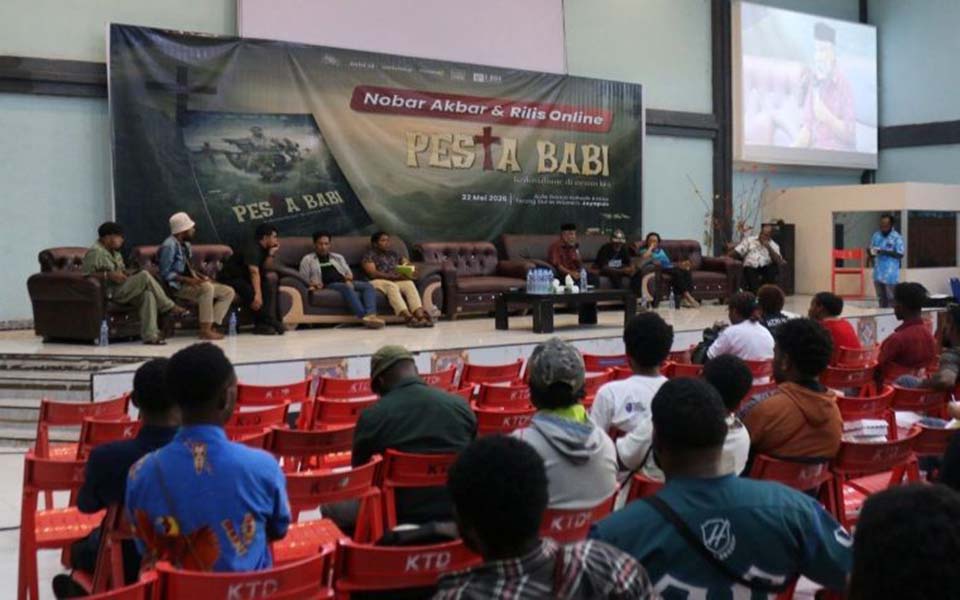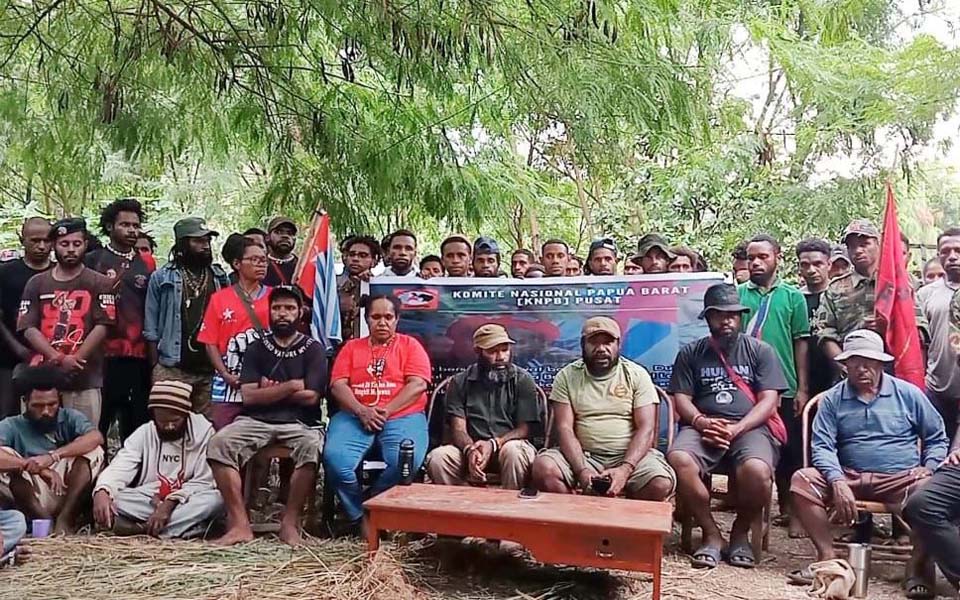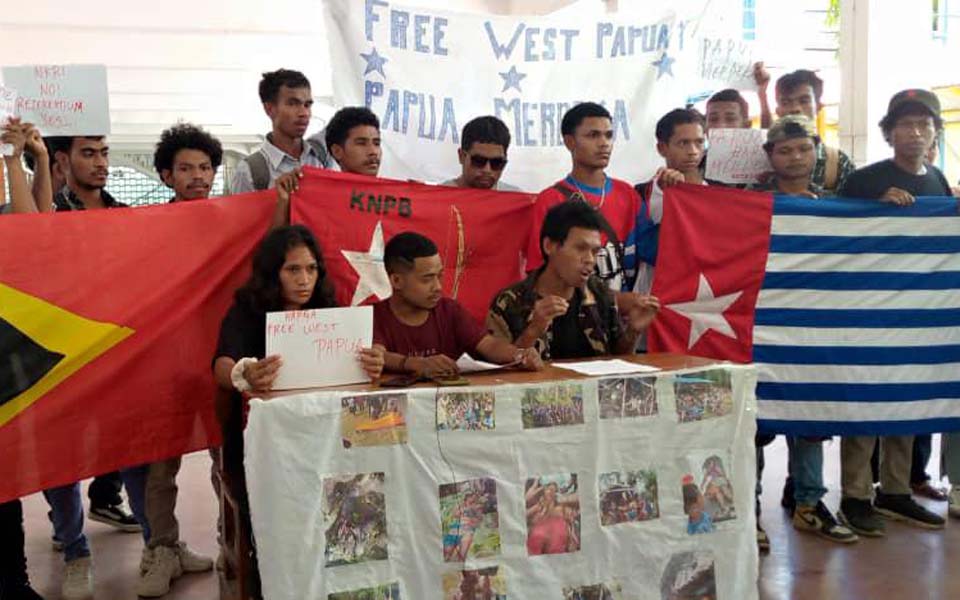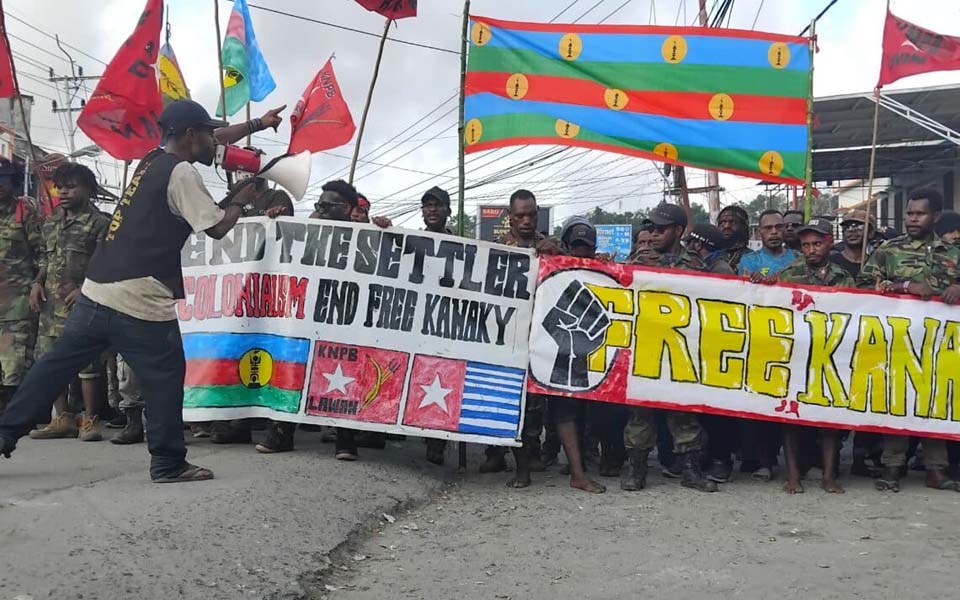


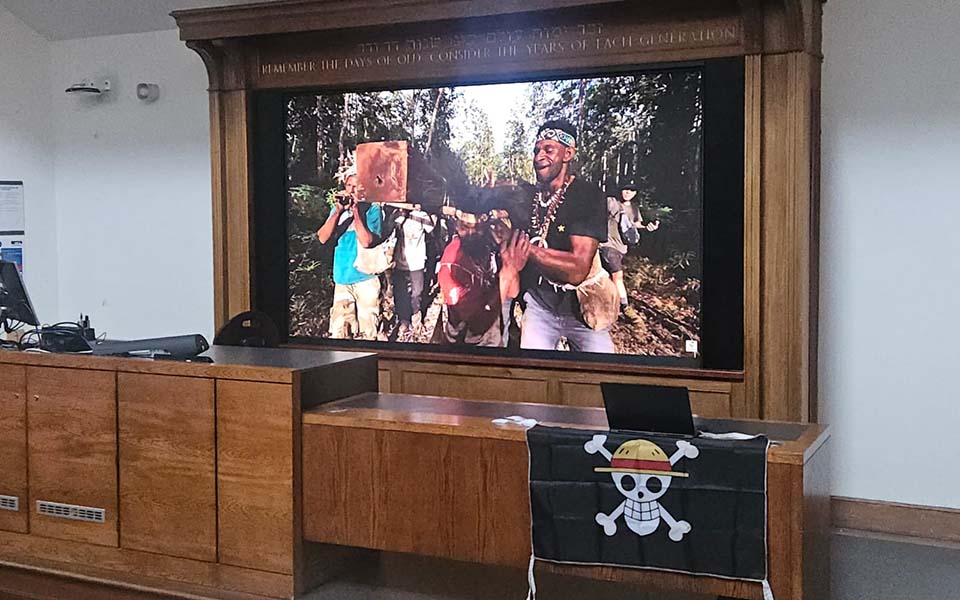
Dodunias A. Mampioper, Jayapura – Even though the documentary film Pig Feast: Colonialism in Our Time (Pesta Babi: Kolonialisme di Zaman Kita) can be accessed directly and watched for free on YouTube, this has not dampened the enthusiasm of people to hold joint viewings (nobar) and discussions, including Indonesian students in London, England.
The film by journalist and film-maker Dandhy Laksono and anthropologist Dr. Cypri Jehan Paju Dale has been posted online through the collaboration of various channels such as Jubi TV, WatchDoc and Greenpeace Indonesia
Even though it has created controversy and attracted negative responses, the documentary continues to attract the interest of viewers both from within the country and abroad. Starting from neighbouring countries Malaysia, Myanmar, Australia, New Zealand and Germany.
This time, Sofie Syarief, a former Kompas TV journalist who is continuing her doctoral studies in London, also reported the enthusiasm of Indonesian students there watching a joint screening of Pesta Babi.
"Today on Friday May 29 as many as 150 students watched", said Syarief, a PhD student from Goldsmiths, University of London, a WhatsApp message to Jubi on Saturday May 30.
According to Syarief, the interest of Indonesian students in London is so high that next week, on June 6, a second screening will be added for those who want to watch it again.
"So we are here, watching together on Friday May 29, and next week on June 6, there's a second nobar in London", she said.
The documentary film Pesta Babi directed by Laksono and Dale has officially been broadcast for free since Friday May 22.
The 95-minute film can be watched directly via the Jubi TV Editorial YouTube channel. In one week, this film was watched more than 10 million times.
Meanwhile, while watching Pesta Babi in Kuala Lumpur, Malaysia Kini senior journalist Rahmat Harun said that the mono-cluster plantations in Papua that are portrayed in the film are very unfriendly to the environment and ecosystem.
"You can imagine that tropical forests in Sarawak, Borneo have [also] turned into palm oil mono-clusters", said Harun sadly.
In a discussion with jubi.id journalist Beimeng Fu in Bangkok, he said that in his article titled How China's Durian Boom Is Transforming Laos, he also protested monoculture plantations which are turning tropical forests into extensive durian plantations.
Beimeng Fu, a freelance journalist from Hong Kong, added that monoculture farming is the agricultural practice of planting one type of plant on a large area of land.
While it is acknowledged that this allows for mass production and mechanical efficiency, behind all this it can cause long-term problems such as soil degradation and vulnerability to pests if not managed with crop rotation.
Villagers in Laos have dry land and need ploughing machines to re-cultivate their land, unfortunately this takes a long time, he said.
- The full movie can be watch on YouTube here: https://youtu.be/MpdrWgDRVf8?si=UhaVPmZIS9qvCGQN
[Translated by James Balowski. The original title of the article was "Mahasiswa Indonesia di London nobar film Pesta Babi".]
Source: https://jubi.id/nasional-internasional/2026/mahasiswa-indonesia-di-london-nobar-film-pesta-babi/