

Jakarta – The Civil Society Coalition for Security Sector Reform strongly rejects the policy by the Directorate General of Taxes (DJP) at the Finance Ministry which opens space for the Indonesian Military (TNI) to be involved in monitoring taxpayer compliance through building information networks at the village/sub-district level.
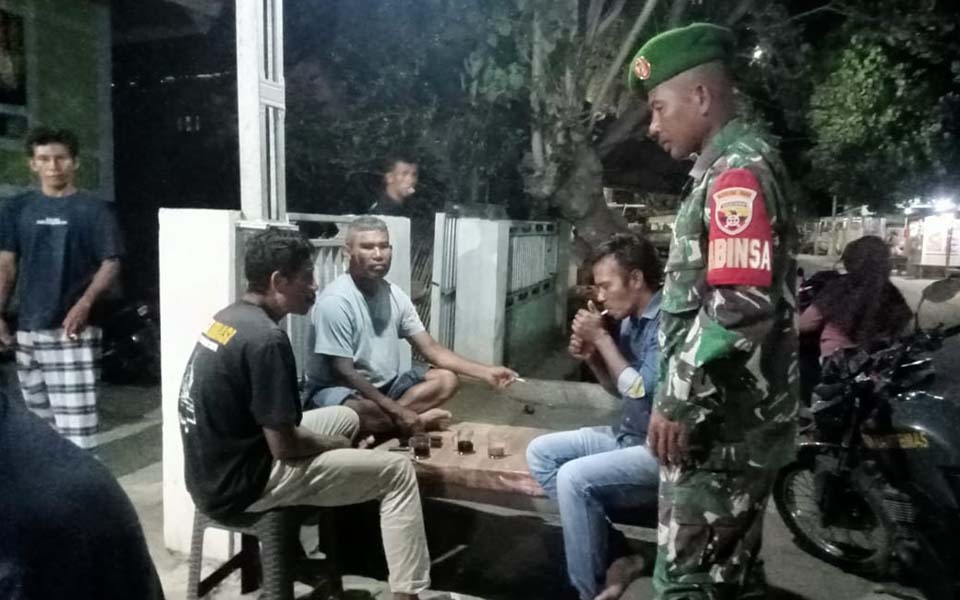
Earlier through Circular Number SE-8/PJ/2026, the DJP opened space for the involvement of the TNI Village Supervisory Non-Commissioned Officers (Babinsa) and Police Security and Public Order Supervisory Officers (Bhabinkamtibmas) in monitoring taxpayer compliance.
"This policy [of involving the TNI] is dangerous because it blurs the boundaries between civil and military authority, expands the state's supervisory function over citizens without adequate legal basis, and has the potential to cause intimidation in relations between the community and the tax authorities", the Coalition said in a joint statement received on Tuesday afternoon July 21.
The Civil Society Coalition for Security Sector Reform consists of an alliance of civil and research organisations such as the Indonesian Legal Aid Foundation (YLBHI), Amnesty International Indonesia (AII), the Commission for Missing Persons and Victims of Violence (Kontras), Indonesian Human Rights Watch (Imparsial), Indonesian Corruption Watch (ICW), the Setara Institute for Peace and Democracy, the Institute for Criminal Justice Reform (ICJR), the Legal Aid Foundation for the Press (LBH Pers) and the Alliance of Independent Journalists (AJI).
The Coalition explained that under a self-assessment tax system, the state has the authority to provide guidance, supervision, inspection and law enforcement. However, the Coalition stated that this authority must be exercised by tax authorities and civil law enforcement officials who have clear mandates, measurable procedures, objection mechanisms and external supervision.
"Involving Babinsa in the tax information collection chain actually shifts the voluntary compliance approach to a security approach", they said.
Political manifestation of fear
The Coalition also believes that the involvement of TNI personnel shows the current situation where the state is managing the people through the political manifestation of fear, down to the lowest regional administrative level.
"At the village level, the Babinsa's presence in tax matters is a form of the political manifestation of fear that that is being established by the state against the ordinary people, primarily directed at vulnerable groups, small businesses, farmers, fisher people, and informal workers", they said.
"In such a context, citizens can feel that they are being monitored not as taxpayers who have rights, but rather as objects of security supervision", they continued.
Therefore, they consider this situation to be contrary to the TNI's reform agenda, the principle of civil supremacy, and efforts to build public trust in tax administration.
The coalition also believes that the policy risks violating the principle of taxpayer confidentiality and the right to privacy. Information regarding a person's income, assets, business activities, transactions and economic conditions is sensitive data whose use must be limited to legitimate tax purposes, with clear access, recording and accountability.
"When this information is collected through a network of regional officials who are not within the DJP structure, the risk of misuse, leakage, stigmatisation and social pressure on citizens becomes even greater", said the Coalition.
TNI Law and national defence
Aside from this, the Coalition stated that legally Babinsa's involvement was not in line with the TNI's mandate as a state tool in the defence sector.
The Coalition stated that the TNI Law places the main tasks of the military institution on upholding state sovereignty, defending territorial integrity and protecting the nation from threats to the country.
In addition to this, the TNI Law also emphasises that Military Operations Other Than War (OMSP) are limited to certain types of tasks and must be carried out based on state policies and political decisions.
"Supervising tax compliance, collecting data on citizens' economic activities, or mapping potential taxpayers are not defence functions and cannot be expanded through administrative circulars", they said.
Based on this, the Coalition is urging the government – and in particular the DJP – to revoke the provisions that open space for the involvement of Babinsa in building an information network for monitoring tax compliance.
They also urged the central government and the House of Representatives (DPR) to thoroughly evaluate tax policies involving defence and security forces so that they do not conflict with the principles of the rule of law, civil supremacy, the protection of human rights and the confidentiality of taxpayer data.
"The Komnas HAM [National Human Rights Commission], the Ombudsman and other relevant supervisory institutions are monitoring potential maladministration, intimidation and rights violations arising from this policy", they said.
In addition, they urged the DJP and the Finance Ministry to strengthen data-based monitoring mechanisms that are legal, transparent, proportional and auditable, as well as ensuring that every field activity is carried out by authorised officers with procedures for protecting citizens' rights.
The involvement of the TNI and the National Police (Polri) in supervising taxpayers is stated in Directorate General of Taxes Circular Number SE-8/PJ/2026 on Guidelines for Supervising Taxpayer Compliance. The circular was issued by the Director General of Taxes, Bimo Wijayanto, in Jakarta on July 15.
In the circular, the TNI and police elements involved in monitoring activities are Babinsa and Bhabinkamtibmas. These elements of the apparatus are particularly involved in information network development activities for the supervision of registered taxpayers, unregistered taxpayers and regions.
"Supervision activities shall be carried out using various methods and approaches, such as visitation, canvassing, direct observation, building information networks (through the Village Supervisory Non-Commissioned Officer/Police Security and Public Order Supervisory Officer), assessment using remote sensing technology, web scraping, the utilisation of media information...," said Wijayanto as quoted from general points in a copy of the circular seen on Monday July 20.
Separately, Wijayanto emphasised that the involvement of TNI and police officers will be limited to coordinating and building information networks, not carrying out audits or collecting taxes.
"Once again, this is an SE [circular] directed at the DJP internally. So there is no need to polemicise it and stir up a fuss that later the tax officers will involve Babinsa and all kinds of things. That's just information coordination", said Wijayanto during a press conference at the Finance Ministry offices in Jakarta on Tuesday afternoon. (kid/mnf/kid)
Notes
Babinsa or Bintara Pembina Desa, are non-commissioned military officers posted in villages and wards and affiliated with the civilian administration. These officers provide a community level presence for TNI's territorial command structure which mandates the deployment of military command posts and detachments at all levels of the civil administration: provincial, district, sub-district and village. This structure provides the organisational framework for the TNI to act as a political security force at all levels of society.
[Translated by James Balowski. The original title of the article was "Koalisi Sipil Kecam Pelibatan TNI Awasi Wajib Pajak".]