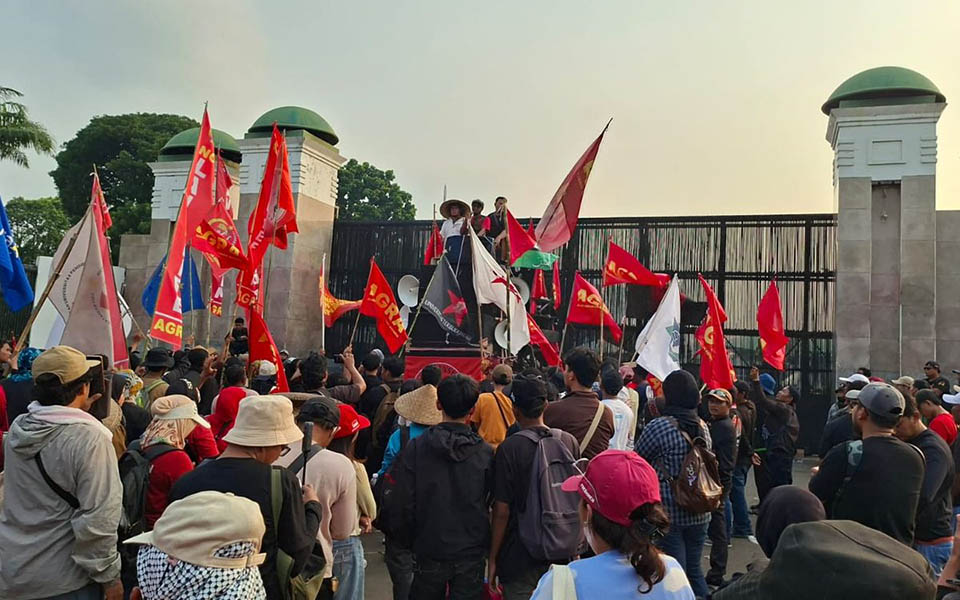


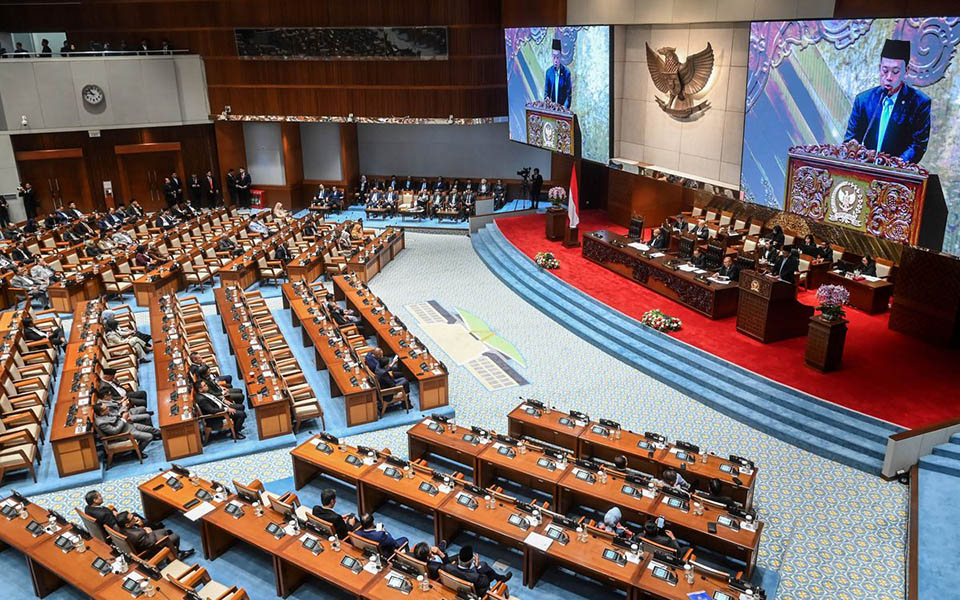
Jannus TH Siahaan – The passing of the Agrarian Reform Law by the House of Representatives' (DPR) during a plenary session on September 22 has been hailed as marking a new chapter in national land law.
The government and parliament claim this new regulation as a monumental achievement because we now have a legal instrument that is touted as being capable of resolving long-standing land conflicts and at the same time restructuring land tenure to prevent continued domination by a handful of corporate entities.
However, if examined critically and thoroughly through the lens of the spatial political economy, these sweat claims actually harbor structural contradictions which are instead deeply concerning.
Behind the rhetoric regarding the management of assets and access within this law lies a significant potential for spatial adjustment mechanisms to systematically serve the interests of large-scale capital accumulation.
Rather than acting as a protective shield for smallholder farmers, traditional fishers and indigenous communities, this legal product instead rolls out a red carpet for the consolidation of land control by agribusiness and extractive sector oligarchies.
This paradigm shift appears fundamental when compared with the spirit of Law Number 5/1960 on Basic Regulations on Agrarian Principles (the 1960 Basic Agrarian Law (UUPA)).
The 1960 UUPA was deeply rooted in a decolonisation ethos characterised by socio-nationalism, wherein the State's Right of Control (HMN) functioned purely as a public authority to curb land concentration and guarantee the social function of land.
Conversely, the 2026 Agrarian Reform Law appears to adopt a market-based paradigm of land formalisation, where land is no longer viewed as a source of social livelihood for the people, but merely as an economic commodity intended to facilitate the flow of investment.
This shift in philosophical foundation carries serious consequences for how the state views the concentration of land control.
The government has indeed aggressively sold the promise that this new regulation will limit land control by both private business entities and state-owned enterprises (SOE).
The problem however, is that these claims on limiting land control warrant critical scrutiny because concealed behind them is a web of legal loopholes that create moral hazards and potentially legitimise massive-scale land control.
At first glance, the inclusion of articles governing the management, control and restriction of land possession and ownership in the 2026 Agrarian Reform Law appears to be a pro-people breakthrough.
However, here lies the rhetorical trap. The law contains absolutely no nominal figures or clear quantitative thresholds on the maximum land area a corporation may control.
All technical provisions concerning these minimum and maximum limits are left entirely to subsequent Government Regulations (PP).
Deferring these regulations creates a space for negotiation that is highly susceptible to institutional hijacking practices.
Agribusiness and extractive industry associations have a golden opportunity to lobby policymakers to set extremely lenient limits.
The moral hazard becomes even more apparent given that the law includes exemption clauses for projects categorised as National Strategic Projects (PSN), SOE operations and land consolidated under the Land Bank Agency's Management Rights (HPL).
Through these exemption clauses, land area restrictions are automatically waived if a corporation collaborates in a PSN scheme or leases land from the Land Bank.
Meaning, legislated land ownership restrictions are essentially an illusion, because giant corporations can still acquire tens to hundreds of thousands of hectares of land provided they operate under the legitimising umbrella of government projects.
Worse still, these new regulations do not impose sanctions such as confiscation or destruction of existing land holdings that currently exceed legal limits or operate illegally within forest areas.
Instead of redistributing illegally held lands to farmers, the law in fact prioritises schemes for administrative rectification and the imposition of financial fines.
This policy effectively whitewashes the land-grabbing that has been going on for years, so those with concentrations of illegal land will receive legal approval for it.
This process of whitewashing and the abandonment of strict sanctions is worsened by the pervasive revolving door phenomenon in national land governance.
The practice of the transfer of former high-ranking officials from technical ministries to board-level positions as directors or commissioners at private corporations creates structural conflicts of interest.
Consequently, the formulation of implementing regulations in the form of government regulations is vulnerable to being used to protect capital interests rather than fulfilling the mandate for genuine land redistribution.
The flow on of this institutional hijacking is the institutionalisation of watered-down sanctions in land regulations.
Violations such as unauthorised occupation of forest areas, land possession exceeding the limits of the Right to Cultivate (HGU) and environmental destruction are no longer treated as serious crimes punishable by imprisonment or the revocation of business licenses.
This kind of law-making attests to a state-facilitated crime, wherein public authorities actively engineer legal loopholes to shield corporations from criminal prosecution.
As a concrete example, an investigative report by the Indonesian Forum for the Environment (Walhi) recorded at least 4,671 forest and land fire hotspots within corporate HGU concession areas throughout August 2026.
From the perspective of ecological justice, these recurring findings should trigger an automatic revocation of HGU permits and the seizure of the land.
However, rather than taking decisive action, the 2026 Agrarian Reform Law offers administrative remediation mechanisms that effectively soften sanctions for corporations responsible for forest fires.
At the same time, the people's right to obtain restitution for seized land faces very tight restrictions.
Provisions in the new law stipulate that locations allocated for PSNs, BUMN assets or the Land Bank reserves are automatically excluded from the list of Agrarian Reform Priority Locations (LPRA).
This policy directly shields project areas from claims regarding the restoration of rights by local populations and indigenous communities.
Land restitution, which should serve as a means to heal the historical wounds of agrarian conflict victims, is ultimately stifled to ensure the smooth flow of investment.
The exemption of project areas and the whitewashing of corporate concessions are certain to escalate structural agrarian conflicts in various regions.
Records from the Consortium for Agrarian Reform (KPA) for 2025 document at least 341 agrarian conflicts across 33 provinces, covering an area of 914,547 hectares and directly affecting 123,612 families.
The majority of these conflicts are concentrated in areas undergoing expansion for plantations, mining and infrastructure projects from West Java to North Sumatra, South Papua and East Kalimantan.
Rather than resolving the root causes of these tenurial disputes, the new law threatens to trigger a wave of forced evictions in the name of legal certainty for investment.
A similar threat looms over indigenous communities whose managed territories have not yet been officially recognised.
Data from the Nusantara Indigenous Community Alliance (AMAN) indicates that 26.2 million hectares of forest lie within indigenous territories, with 7.3 million hectares directly overlapping with business concessions.
This reality stands in stark contrast to the government's achievement record on recognition, which has only reached a total of 332,505 hectares of customary forest.
In other words, the expansion of the Land Bank and PSNs will accelerate the alienation of indigenous communities from their customary lands and living spaces.
So in analytical terms, capital-friendly spatial planning will drive Indonesia's land Gini ratio (G) to increasingly alarming levels.
The inequality indicator, currently in the high range (0.59-0.68), is projected to edge ever closer to 1.
This is occurring because corporate giants continue to enjoy the consolidation of hundreds of thousands of hectares of land, which is protect by instruments such as HGU and Land Bank HPL.
Meanwhile, the poor are offered only marginal land parcels of than half a hectare or merely the formalisation of titles for land they already control.
This uneven distribution gives birth to spatial enclaves, where residents' living spaces are hemmed in by vast stretches of monoculture plantations and extractive industries.
If agrarian law is more concerned with securing capital than restoring land to the people, then I offer this critique not as a definitive conclusion, but as a marginal note that hopefully is wrong.
- Jannus TH Siahaan holds a Doctorate in Sociology from Padjadjaran University and is an observer of social issues and public policy. He has previously worked as a journalist and in the mining industry.
[Translated by James Balowski. The original title of the article was "Bahaya di Balik Retorika UU Reforma Agraria 2026".]