

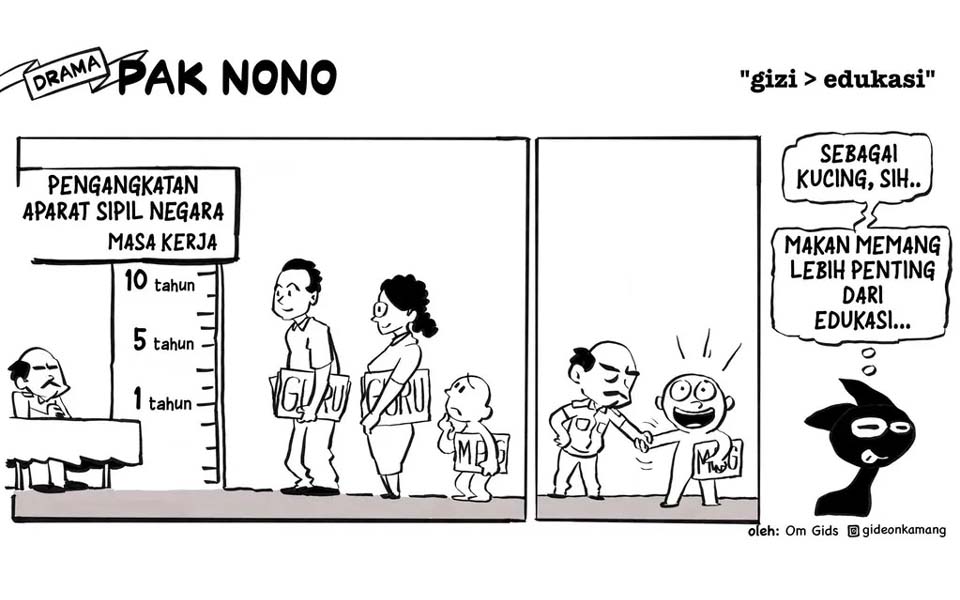
Sign reads “State Civil Servant (ASN) Promotions”. Chart reads “Period of Employment 1 year, 5 years, 10 years”. Folders carried by applicants read “Teacher, Teacher, MBG”.
Cat: As a cat, right... food is indeed more important than an education...
A decision to appoint core staff at Free Nutritious Meals (MBG) program kitchens as contract-based civil servants has sparked parliamentary warnings and criticism over recruitment standards, fiscal priorities and widening inequality with honorary teachers.
Earlier, National Nutrition Agency (BGN) head Dadan Hindayana announced that long-serving core staff at Nutrition Fulfilment Service Units (SPPG) – the kitchens that underpin the nationwide school meals program – would be formally appointed as Government Employees with Work Agreements (PPPK) starting February 1.
The policy is based on Presidential Regulation Number 111/2025, which provides the legal framework for the MBG program. Article 17 of the regulation states that SPPG employees "shall be appointed as PPPK in accordance with prevailing laws and regulations".
It does not however specify which professions fall under this category leaving room for interpretation and controversy.
The decision has drawn sharp criticism from policy analysts and legal experts, particularly regarding recruitment procedures and budgetary consequences. They note that the recruitment pathway for SPPG employees remains opaque and that their wages are no longer borne by implementing partners but by taxpayers.
This effectively reduces operational costs for partner organisations, increasing profit margins while shifting financial risk to the state.
Not surprisingly, the harshest criticisms have come from the education sector where the policy is widely viewed as unfair to honorary teachers who have waited years – sometimes decades – for similar recognition.
Indonesia has tens of thousands of non-permanent teachers who have repeatedly failed to secure PPPK status due to limited quotas and budget constraints at the regional level. And the sense of injustice has been sharpened by stark differences in remuneration.
Under the national PPPK salary scheme, core SPPG staff may be placed in Grade III or higher with base salaries of US$140-US$205 per month plus allowances, resulting in a take-home pay of between US$190-US$515 or higher for senior positions.
By contrast, the government recently announced that monthly incentives for honorary teachers will increase from around US$19 to US$26 per month.
While the increase has been welcomed by teachers, even at the lowest PPPK grade, MBG kitchen staff will earn five to ten times more per month than the incentive received by honorary teachers – despite many having served for years or decades in public schools.
The controversy is unfolding against a backdrop of growing public unease over the MBG program itself.
In the 2026 state budget, the MBG program received an allocation of US$21.3 billion, making it one of the largest single spending items in Indonesian history. Nearly 42 percent of the national education budget is now channelled into a program that provides one free meal per day to students – regardless of income or nutritional status.
Critics point to weak targeting, regional imbalances favouring relatively affluent areas in Java and significant opportunity costs, particularly as Indonesia grapples with underfunded schools, disaster recovery needs and persistent poverty in eastern provinces.
[Abridged from an article by Heidoh titled Indonesia's school meals plan faces scrutiny as kitchen staff gain civil service status amid budget row hit.]