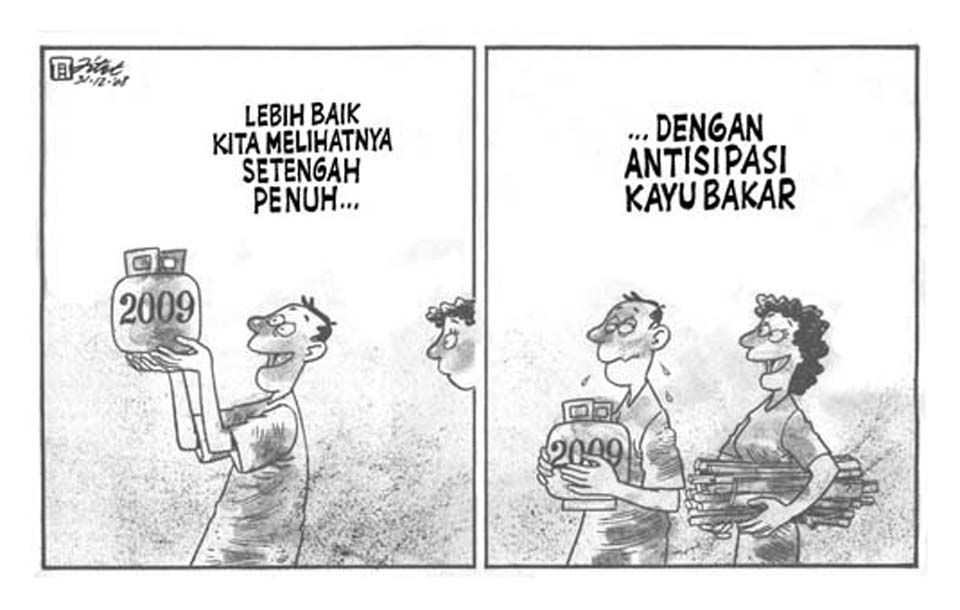



Mother: Charge the car battery! Charge the mobile phones! Turn on the rice cooker! Quick, before...
Father: Before...?
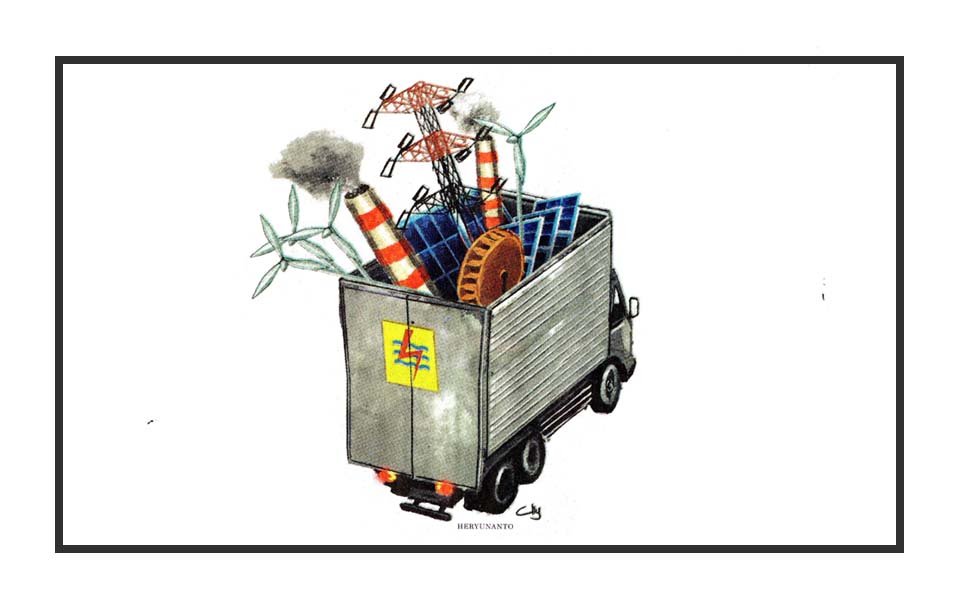
Repeated power outages across multiple regions in recent days have disrupted essential services, interrupted critical examinations and been linked to fatal incidents, prompting renewed scrutiny of the reliability of state-owned electricity company PLN.
North Sumatra has been grappling with repeated power outages since June 4 after 12 PLN transmission towers were damaged by heavy rain and strong winds, disrupting electricity supply across the province.
In Medan, the blackouts have triggered a looming clean water crisis after critical equipment operated by regional water utility PDAM Tirtanadi was damaged during the outages.
Several regions across Java also reported power outages in recent days, including Bekasi, Sukabumi, Bogor and Tasikmalaya in West Java, Semarang, Tegal, Boyolali and Wonogiri in Central Java, as well as Yogyakarta.
The string of blackouts comes just weeks after a massive power outage plunged nearly all of Sumatra into darkness from the evening of May 22 until power was fully restored two days later.
Fabby Tumiwa, chief executive officer of the Institute for Essential Services Reform (IESR), said the public requires a transparent explanation from the Energy and Mineral Resources Ministry and PLN regarding the reliability of the national power supply. He said a comprehensive investigation is needed to identify the root causes of the recent outages.
"The situation highlights weaknesses in the regulatory system's ability to ensure the reliability of the national electricity grid", he was quoted as saying.
Dwi Anggia, spokesperson for the Energy and Mineral Resources Ministry, said the recent power outages affecting parts of Java were caused by technical issues related to PLN's infrastructure. She also rejected concerns that the disruptions were linked to coal supply shortages.
"We continue to coordinate with PLN management to take mitigation steps and improve infrastructure so that similar disruptions do not happen again. I can assure you that the current energy supply system is secure", she said.
However, Energy and Mineral Resources Minister Bahlil Lahadalia later admitted that the problem was in fact related to a shortage of coal supply at PLN due to the dominance of low-rank coal reserves that led to less efficient fuel consumption in power plants, which require a medium-rank coal mixture to maintain operational efficiency.
Lahadalia also conceded that the price of coal supplied under the domestic market obligation (DMO) of 25 percent is far below the international benchmark price. As a result, producers prioritise overseas sales, which command a much higher price, resulting in a shortage of domestic coal supplies.
Observers also say the government's move to cut national coal production did not help the problem. Yayan Satyakti, an energy economics lecturer at Padjajaran University, said the decision to cut the production target under the 2026 coal work plan and budget (RKAB) narrowed the room for production.
In 2026, the government set a production target of 600 million tons, lower than the realisation of coal production in the previous year, which amounted to 790 million tons.
Amidst these production cramps, the much-needed medium-rank coal is absorbed primarily by the export market, while the DMO scheme is fulfilled mostly by low-rank coal. Indonesia allocated 190 million tons of coal per year under the DMO scheme, while PLN requires 154 million tons annually.
"The electricity crisis is primarily caused by the failure of supply planning and production, while pricing policy emerges as a distortion which exacerbates the root cause of the problem", Satyaki told Tempo.