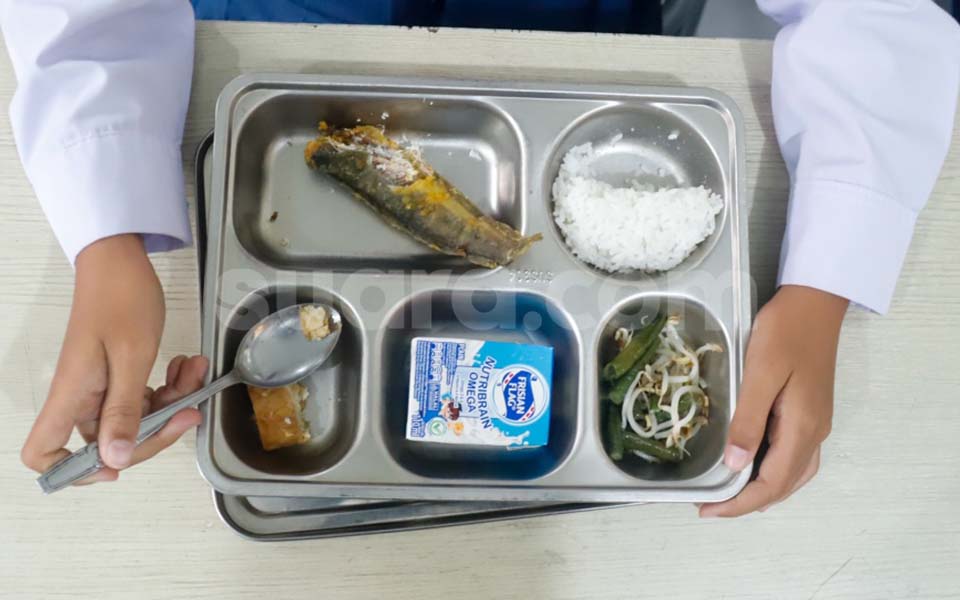


Jakarta – Following the end-of-year school holidays, the National Nutrition Agency (BGN) will restart the Free Nutritional Meals (MBG) program simultaneously throughout Indonesia starting on January 8.
President Prabowo Subianto has claimed that the program was 99.99 percent successful. The president made this claim during a retreat with state officials on January 7.
This assessment however is at odds with that conveyed by Indonesian Education Monitoring Network (JPPI) National Coordinator Ubaid Matraji. According to Matraji, this success rate actually indicates a major failure in the direction of national education policy.
"Yes, it is indeed successful, but it's damaging education. It's undermining policy direction, undermining education budget priorities, and undermining children's futures", Matraji said in Jakarta on Thursday January 8.
He emphasised that the main problem is not the intention to feed children, but rather the way the MBG program is implemented. According to Matraji, the MBG erodes the education budget, sacrifices school quality, demeans the teaching profession and ignores the Constitutional Court's ruling on free education.
"In 2026, the MBG will be funded at 1.2 trillion rupiah per day. Ironically, 69 percent of the funds come from looting the education budget", explained Matraji.
The education gap widening
The JPPI believes that the MBG is actually widening the gap in education quality. The main problem with Indonesian education, Matraji said, is not the lack of food, but rather unequal access to schools, low teacher quality and damaged school infrastructure.
Data from the Ministry of Education, Culture, Research and Technology (Kemendikbudristek) in 2024 shows that only 6.2 percent of early childhood education teachers are certified. At the elementary and junior high school levels the figure is only 34-40 percent.
Meanwhile, 63-71 percent of elementary school classrooms in various regions are in disrepair, and this situation had not changed much by 2025.
"Feeding children in damaged classrooms assisted by teachers that are not supported by quality and welfare will certainly worsen the quality of our education", said Matraji.
He added that this situation has left Indonesia increasingly lagging behind in the quality of education in Southeast Asia.
Academic achievement declining
The JPPI also highlighted the lack of positive impact of the MBG on student academic achievement. A comparison of the results of the 2019 National Examination and the 2025 Academic Competency Test (TKA) showed a significant decline in mathematics, Indonesian language and English.
This fact, according to Matraji, this proves that the main problem with Indonesian education is not hunger, but rather a fragile learning system.
"The state feeds students' bodies, but allows their brains to develop in a fragile learning system", he said.
Teachers sacrificed
Another impact of the MBG program is the decline in the dignity of the teaching profession. Teachers are burdened with non-pedagogical tasks, from logistics and distribution to food supervision. This burden reduces their time for teaching and assisting students.
A case in Kampar, Riau, is a concrete example. An honorary teacher was dismissed and the principal suspended due to technical issues with the MBG program.
Even more ironic, the salaries of MBG employees are said to be up to 10 times that of honorary teachers, even though the budget for the program comes from the education sector.
"In this position, it becomes clear, that teachers are being used as sacrifices and cash cows to keep the MBG project alive", asserted Matraji.
Violating the Constitution
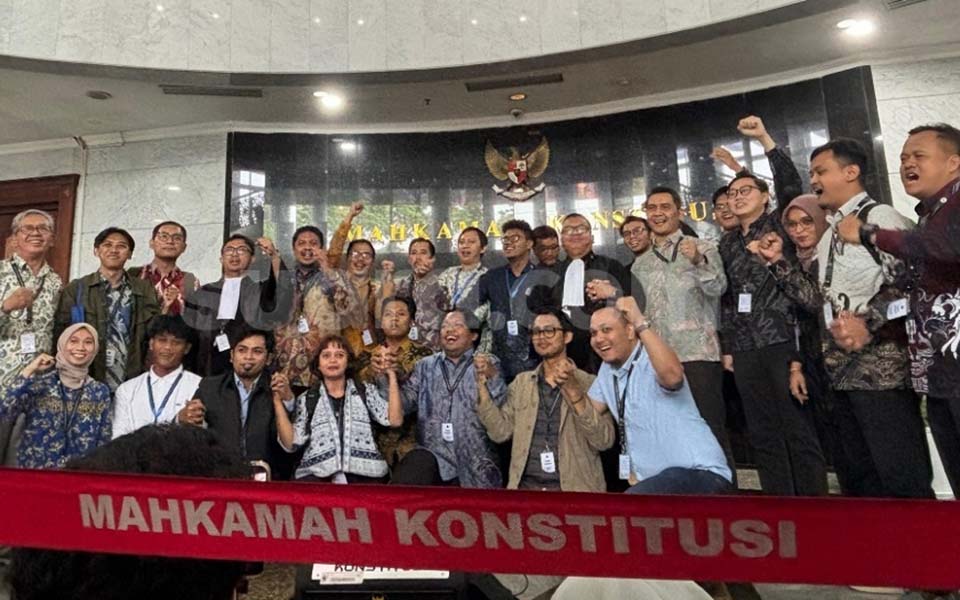
The JPPI believes the government has shifted budget priorities that should have been used to eliminate school fees as per the Constitutional Court's (MK) May 2025 ruling.
According to JPPI's calculations, the cost of realising fee-free schools is only around 75 trillion rupiah, or the equivalent of two months of the MBG program budget.
Meanwhile, there are currently 4.1 million children still not in school. "This is not just a policy omission, but a violation of the Constitution", said Matraji.
Considering this situation, the JPPI is urging the President to halt the MBG program as long as it still uses the education budget.
"As long as it uses the education budget, it must be stopped because its impact is very detrimental to education", he explained.
The JPPI is also urging the government to implement the Constitutional Court's ruling on free basic education and to return budget priorities to improving teacher quality, classroom improvement and the quality of learning.
"Return the education budget priorities to improving teacher quality, classroom improvement, and the quality of learning", said Matraji.
In addition to this, the JPPI is urged the government to stop exploiting teachers in non-pedagogical populist programs.
"Indonesia doesn't need a generation that is simply well-fed, but one that is intelligent, critical, and competitive. The MBG, in its current form, is actually moving us away from that goal", Matraji concluded.
[Translated by James Balowski. The original title of the article was "JPPI Nilai Program MBG Merusak Arah Pendidikan Nasional".]
Source: https://apakabar.co.id/news/jppi-nilai-program-mbg-merusak-arah-pendidikan-nasional/