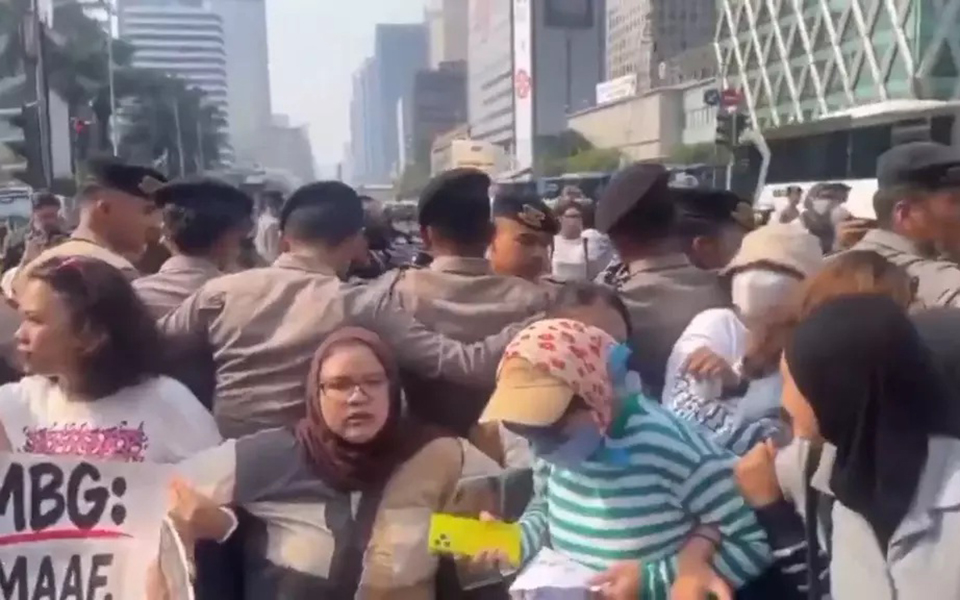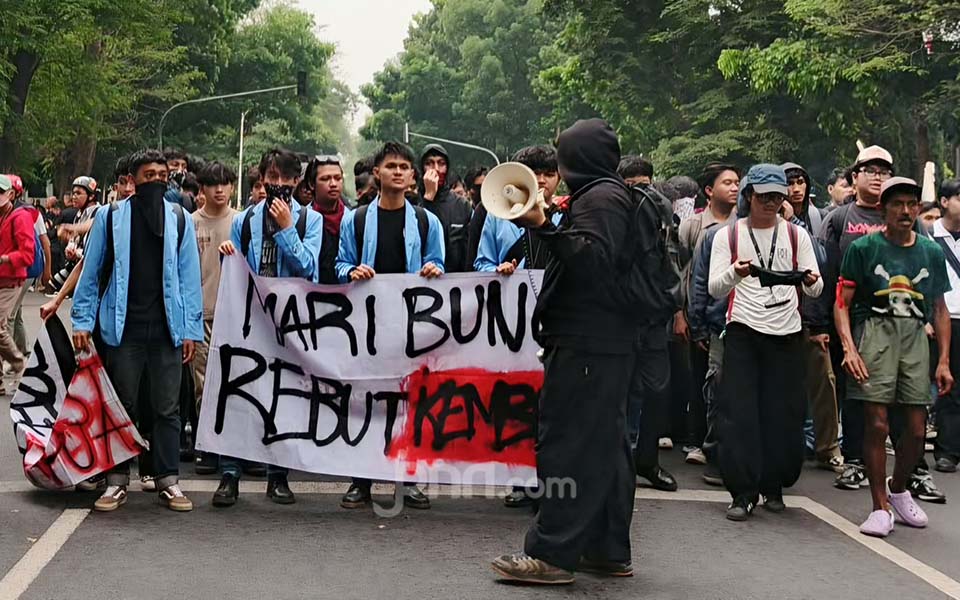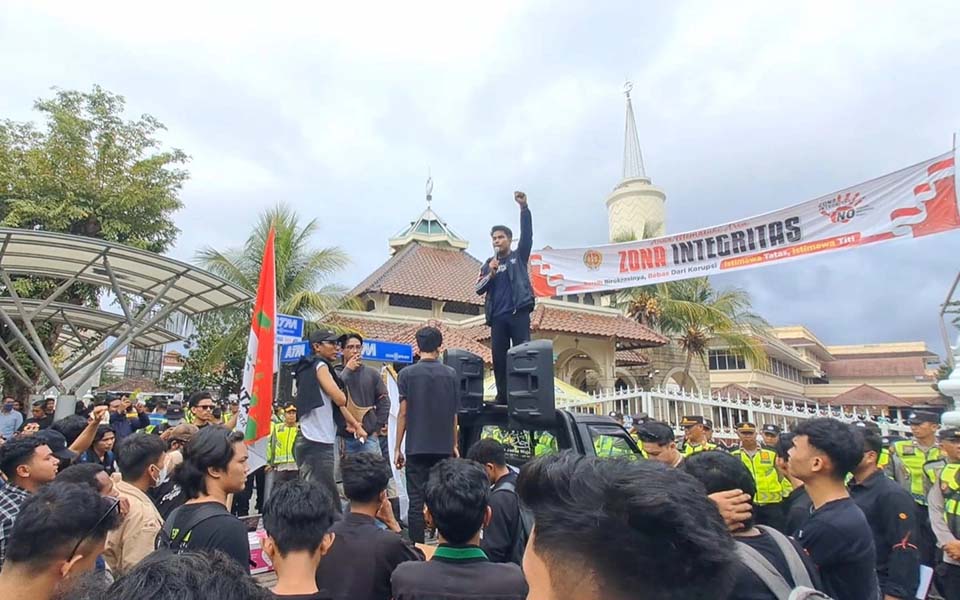


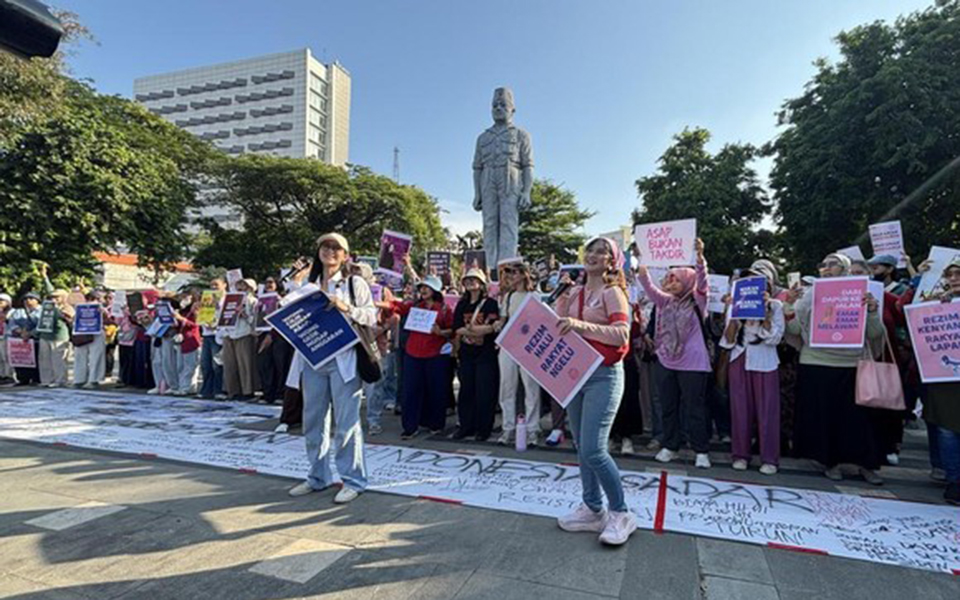
Surabaya – Hundreds of protesters who are part of the Surabaya Moves Alliance (Aliansi Suroboyo Bergerak) and the Surabaya Heroines (Srikandi Suraboyo) group, held a protest action in front of the Grahadi State Building in Surabaya, East Java, on Sunday November 8. The majority of the demonstrators present were from women's groups.
According to CNN Indonesia's observations at the location, the demonstrators expressed their grievances through various mediums from displaying protest posters, taking turns delivering speeches, reciting poetry and presenting theatrical performances and music.
The posters they brought included messages such as, "Robbed by taxes, poisoned by MBG, choked by karhutla", "Indonesia wake up before Indonesia perishes" and "A delusional regime leaves the ordinary people with a headache". Other signs read, "Smoke is not our destiny" and "From the kitchen to the streets, housewives are fighting back".
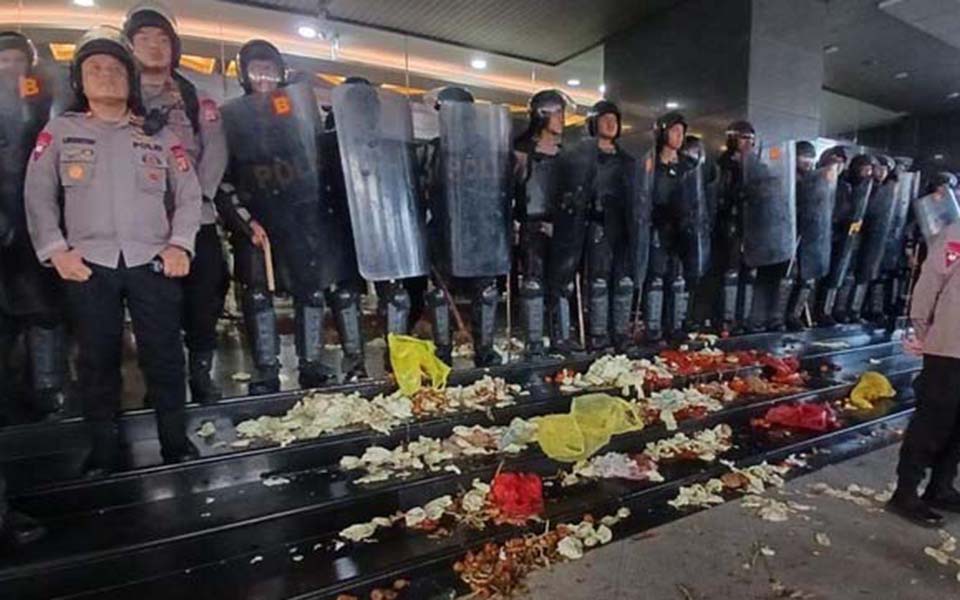
Meanwhile, police officers stood guard on the grounds of the Grahadi State Building, deploying razor-wire barricades to secure the protest area. Several crowd-dispersal vehicles were also visible.
"It's a mix. So there are [protesters] from housewives, professionals, medical workers, then from academics. There all present. Meaning many who are from different elements of society like that", said Surabaya Moves Alliance General Coordinator Kardono Setyorakhmadi on Sunday.
The primary demand voiced by the two groups focuses on a total evaluation of the national leadership.
The protesters believe that the current administration is incompetent in managing the country, which has negatively impacted various layers of society who are increasingly squeezed by economic difficulties and problematic regulations.
In the second demand, they urge the government to resolve the ecological and humanitarian crisis caused by forest and land fires (karhutla).
The protesters urged the central government to declare the situation as a national disaster and to take firm action against all parties proven to be responsible for the fires, without favouritism.
"Secondly, declare the karhutla a national disaster, arrest those setting fires and the corporations doing this, as well as restoring the rights of the disaster victims", they said.
The protesters also sharply criticised the state budget which they believe has been used up for projects that provide no direct benefit to the ordinary people's welfare.
They asked that funding for programs deemed wasteful of state funds be immediate halted in order to safeguard other critical sectors currently facing budget cuts.
"Thirdly, end wasteful programs that are anti-people and anti-democratic such as the MBG [Free Nutritious Meals program], Kopdes [Village Cooperatives], the establishment of auxiliary territorial battalions", they added.
The demonstrators also highlighted poor state governance in articulating their protests. This situation is seen as further worsening the economic pressures weighing on the public, ranging from the depreciation of the rupiah and instability in the capital markets to the growing vulnerability of the basic necessities required for the people's survival.
"Fourthly, improve governance across all fields. It is clear that Indonesia is heading toward an energy crisis; meanwhile, the JCI (Jakarta Composite Index) has collapsed, the rupiah continues to weaken, yeah as a consequences of poor governance and a poor of control regarding this crises", they said.
The fifth and final demand was the public's opposition to the expanding role of the military outside the realm of national defence or in civil affairs. They also rejected any attempts to suppress citizens' freedom of expression and asked for the military to return to the barracks in line with its proper scope.
"And fifth, put an end to repression and the dwi-fungsi (dual function) of the military in the civilian sphere", they asserted.
Aside from highlighting macro-level national issues, the protesters voiced concerns regarding taxes on sanitary pads. They also distributed sanitary pads to several policewomen (Polwan) stationed at the Grahadi State Building as a form of symbolic protest against the unfair tax policy, as well as highlighting to the threat of a health crisis stemming from the state's poor disaster mitigation efforts.
"Our giving out sanitary pads to Polwan and also to friends is evidence that the government has the heart to tax our very own wombs that give birth to the next generation of Indonesians which are also taxed like that", said Surabaya Moves Alliance spokesperson Putri Bunga.
"If for example the government understood priorities, yeah, things like sanitary pads would not be taxed right, meaning those who are already not wealthy so many hundreds of millions of our people are paying taxes on basic necessities like this, we don't ask to bleed every month, yeah, so how can it be taxed?", she added.
The policewomen attempted to respond to being given sanitary pads by offering red roses. However this offer from the police was flatly rejected by the demonstrators at the location in order sought to preserve the integrity of movement.
Setyorakhmadi said that the rejection was not intended to incite conflict, but rather to firmly maintain the movement's independence and prevent any public narrative that might misinterpret this act of resistance as a collaboration facilitated by the authorities.
"This is not a collaborative action. Later it could be misconstrued as a joint action. We are not that kind of group, like the declaration by Raffi Ahmad", concluded Setyorakhmadi, referring to the President s Special Envoy for Youth Development and Performing Arts who attended a Youth Pledge Day event in Jakarta organised by the police. (frd/wis)
[Translated by James Balowski. The original title of the article was "Demo Surabaya, Massa Bagikan Pembalut ke Polwan dan Usung 5 Tuntutan".]