

Aida Ulim, Jayapura – The Indonesian Legal Aid Foundation (YLBHI) has launched the report titled Papua in the Grip of Military Operations. The report profiles the impact of military operations on the lives of civilians in Papua between 2023 and 2025.
The launch of the report was live-streamed on YLBHI's YouTube channel on Tuesday December 16.
Aldi, one of the authors of the report on the human rights situation in Papua between 2023 and 2025, said the report relates to the current situation facing the people of Papua, who to this day are still haunted by state repression, including the practice of extrajudicial killings.
He said that military operations in Papua are not a new or temporary problem. Rather, they have been ongoing for a very long time and have been carried out systematically, making Papua the region with the longest military operation in Indonesian history.
"This report was compiled to report on various findings that have previously been disseminated, both related to military operations as well as the condition of refugees (in the land of Papua). Through data collection and analysis, the YLBHI, together with the LBH Papua [Papua Legal Aid Foundation] endeavoured to see the big picture of how policies formulated in Jakarta directly impact on the humanitarian conditions in Papua", said Aldi.
According to Aldi, the preparation of the report involved various parties to explore the impact of military operations on civilians in Papua.
He said that findings in the field show that the military's presence significantly impacts people's lives. In Central Papua, for example, the number of refugees is reported to be very large and has triggered multiple problems, ranging from limited access to health services to disruptions to children's education.
"We found a stark difference between the official military narrative, which describes troop deployment as an effort to maintain security and ensure economic stability, and the reality experienced by communities. The military presence actually creates fear and restricts community activities, including gardening", he said.
He stated that from 2024 to early 2025 the YLBHI recorded the deployment of approximately 29 non-organic military units to Papua, including the addition of five new battalions in October 2024.
Each unit averaged approximately 450 soldiers. In the Merauke region of South Papua, there was also Operational Control Units (BKO) deployed from late 2024 to 2025 with a strength of 691 soldiers.
"During the same period, the wave of refugees increased significantly. While in 2023 the number of refugees was still relatively limited, since 2024 that number has increased in line with new policies issued by the central government", he said.
He said the government's plan to establish 100 territorial battalions in Papua demonstrates the military's dual role as both a security actor and a development implementer, which has the potential to expand the militarisation of civilian space.
According to Aldi, the impact will be most felt in Central Papua, a region filled with gold mining concessions covering an area of approximately 1.180 million hectares, not including illegal mining activities.
Illegal mining activities have worsened the armed conflict and given rise to casualties, including among workers, most of whom are brought in from outside Papua. This situation highlights the structural poverty and vulnerability of workers amidst the protracted conflict.
Aside from this, optimal operation of the Trans-Papua highway is seen as accelerating capital flow and the expansion of extractive industries, while also facilitating troop mobilisation, particularly the Army.
Through this report, the YLBHI is pushing so that the impact of military operations in Papua, particularly on children, women, and indigenous communities, continues to be articulated.
"We invite on our friends outside Papua to build solidarity and urge an end to military operations for the sake of restoring the lives of civilians and humanity in Papua", said Aldi.
Meanwhile, Emanuel Gobay as author of the report on human rights violations in Papua stated that military operations in the land of the Cenderawasih (as Papua is known) are nothing new, because they have been ongoing since 1961 and have been carried out systematically and structurally by the state since then. Military operations continue to this day.
Operation Trikora (the Triple Commands of the People), which then continued until 1967, coincided with the entry of major economic interests through the signing of a contract of work between the Indonesian government and Freeport McMoRan on April 7, 1967. This signing did not involve the Papuan people as customary landowners.
"During the same period, Operation Baratayudha was carried out, which, according to data compiled by LBH Papua and the YLBHI, resulted in approximately 3,500 casualties", said Gobay.
He said that another military operation that occurred in 1977, Operation Dhani in Wamena, Jawijaya regency, now in Papua Highlands province, resulted in an estimated 5,000 to 10,000 casualties.
This incident is considered part of the state's past crimes in the land of Papua, which have never been seriously revealed or resolved to this day.
"When massive troop deployments have occurred, both organic and non-organic, including after the formation of the new Kodam [Regional Military Command] in South Papua, to date LBH Papua and the YLBHI have never found a presidential decree or recommendation from the DPR RI [Indonesian House of Representatives] that would serve as the legal basis for these troop deployments", he said.
Based on this, the YLBHI and the LBH Papua concluded that the deployment of military troops in the land of Papua was illegal because it violated Law Number 34/2004 on the Indonesian Military (TNI) in conjunction with Law Number 3/2005.
This regulation stipulates that the deployment of military troops must be approved by the DPR and stipulated by presidential decree.
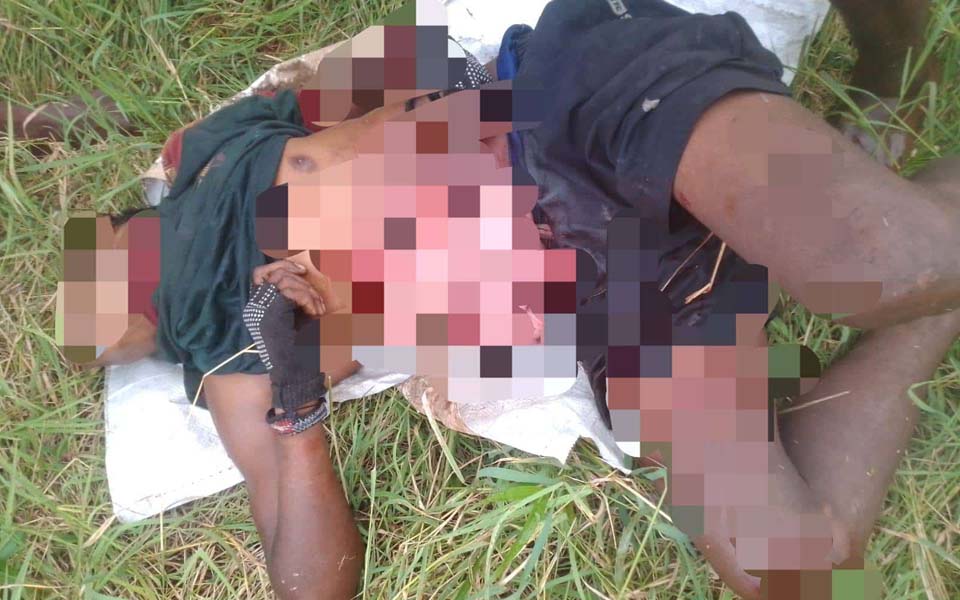
"Although the government stated that the approach that was used was territorial not combat operations, our findings indicate the contrary. Combat operations still occurred and resulted in civilian casualties. At least 60 civilians were reported to have fallen victim, including four residents in Timika who were mutilated", he said.
Gobay said that in addition to the loss of life, troop deployment also triggered a wave of refugees. From 2018 to 2025 the number of refugees continued to increase. Specifically for the 2023-2025 period, approximately 76,228 people were displaced.
And based on data from the Papua Council of Churches (PCC), since 2018, the number of refugees is estimated at around 100,000. The refugees are spread across at least seven districts in West Papua, Southwest Papua, Central Papua and the Papua Highlands.
The majority of refugees are women, children and the elderly. Conditions in the refugee camps are extremely worrying, with limited access to education, healthcare, and food. "Many children have been forced to drop out of school due to this prolonged conflict", he said.
The YLBHI also recorded cases of sexual violence against refugee women, one of which was experienced by a mother in Yahukimo in the Papua Highlands. The case has been reported to the National Commission on Violence Against Women (Komnas Perempuan) but developments in the handling of the case are not yet known.
In the past three years, at least 36 victims of arbitrary killings have also been recorded, while from 2018 to 2024 the death toll reached 151. Almost none of these cases have been prosecuted or brought to a human rights court.
"In this conflict, we discovered the use of ammunition produced by PT Pindad, a state-owned enterprise, which raises questions about weapons production and the parties profiting from the conflict in Papua", said Gobay.
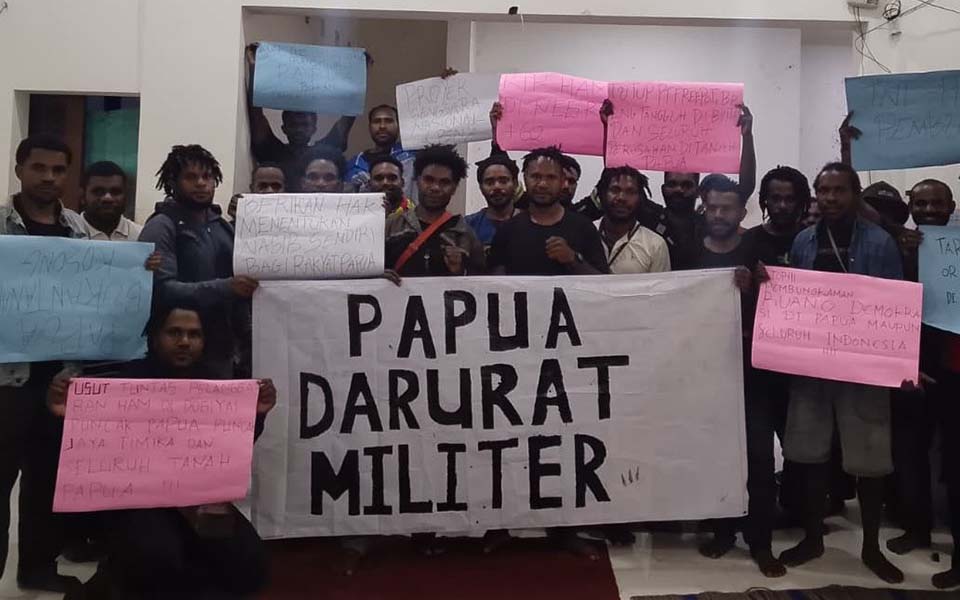
He also noted that peaceful demonstrations by students and civil society groups opposing investment and militarisation have been met with repressive action by security forces. Throughout 2024, around 425 protests were recorded, with at least 90 being repressively dispersed, with some participants being arrested even before actions began.
He said all these findings demonstrate a recurring pattern, the deployment of troops to secure economic interests that trigger armed conflicts and human rights violations, waves of refugees and worsening structural poverty in Papua.
"We urge that these findings become the basis for a serious evaluation by the state and to open space for broader discussions to end the violence and restore the lives of civilians in Papua", said Gobay.
[Translated by James Balowski. The original title of the article was "YLBHI Luncurkan Laporan 'Papua Dalam Cengkeraman Operasi Militer'".]
Source: https://jubi.id/polhukam/2025/ylbhi-luncurkan-laporan-papua-dalam-cengkeraman-operasi-militer/