

Ady Anugrahadi, Jakarta – The Civil Society Coalition for Security Sector Reform strongly rejects the draft Presidential Regulation (Perpres) on the Duties of the Indonesian Military (TNI) in Combating Acts of Terrorism, which has recently been circulating publically.
The coalition believes that the regulation has the potential to threaten democracy and human rights. This was conveyed by Indonesian Human Rights Watch (Imparsial) Director Ardi Manto Adiputra.
He said the draft Perpres will soon be consulted with the House of Representatives (DPR) for approval, as stipulated under Law Number 5/2018 on the Eradication of Criminal Acts of Terrorism.
According to Adiputra however, in procedural terms the regulation of the TNI's involvement through the Perpres is problematic.
"The coalition considers the draft Perpres on the TNI's involvement in counterterrorism to be problematic both formally and materially", Adiputra said in a written statement on Wednesday January 7, 2026.
He said that TNI involvement in security duties should be regulated by law, not by a Perpres. This is considered to be in conflict with People's Consultative Assembly (MPR) Decree Number VII/2000 and the TNI Law.
"Therefore, regulating the TNI's involvement in combating acts of terrorism through a Perpres is something that is wrong and unconstitutional", said Adiputra.
Furthermore, the draft Perpres is considered to widen the TNI's authority excessively and is open to multiple interpretations.
The draft also assigns the TNI a role in prevention, enforcement and recovery in handling terrorism. This formulation is considered to have the potential for abuse beyond the interests of eradicating terrorism.
"Materially/substantively, the Coalition believes that the draft Perpres on the TNI's Duties in Combating Acts of Terrorism has the potential to endanger democracy, human rights, and the principles of the rule of law. The TNI's broad and unclear formulation of authority opens the way for misuse beyond the interests of eradicating terrorism", said Adiputra.
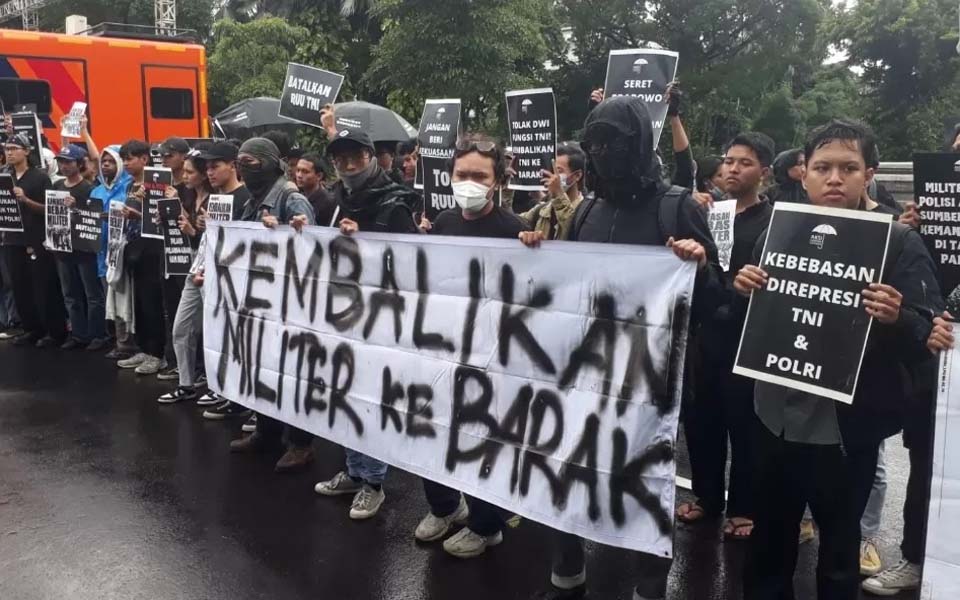
He warned that the expansion of the TNI's role has the potential to encourage the labelling of critical community groups as terrorists. This situation is considered to pose a serious threat to civil society movements, including students and workers, as well as reinforcing the politics of fear.
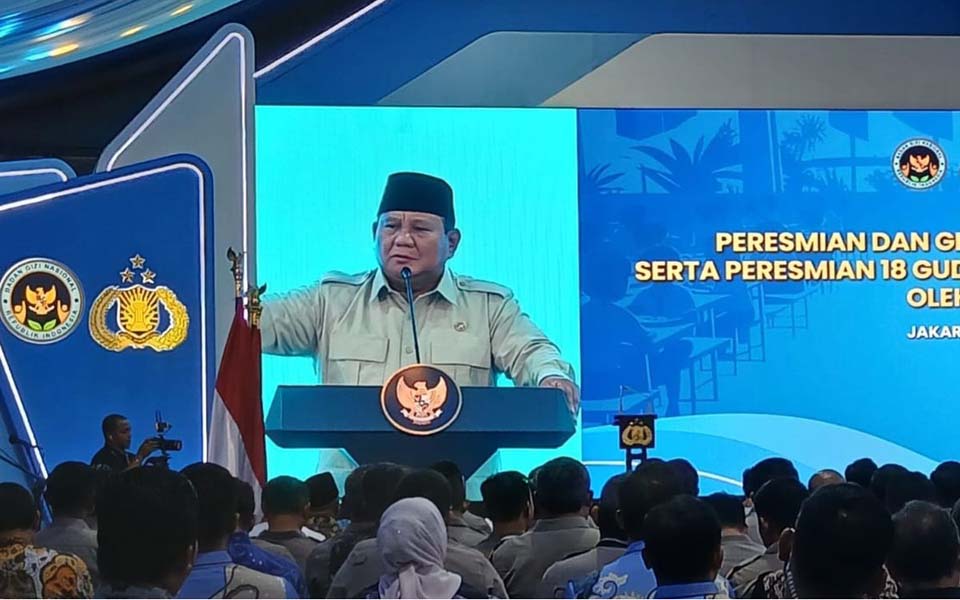
"The draft also risks encouraging the practice of labelling critical community groups as terrorists, so it poses a serious threat to civil society movements, including students and workers. Moreover President Prabowo Subianto [following the mass demonstrations] in late August 2025 identified student protest groups as terrorists". Said Adiputra.
Taking over intelligence, counterterrorism functions
Adiputra also believes the TNI should not be involved in prevention and recovery functions. He believes this role is more appropriately carried out by civilian institutions such as the State Intelligence Agency (BIN), the National Counterterrorism Agency (BNPT) along with related ministries and institutions.
The TNI's involvement should be limited to providing law enforcement assistance in emergency situations and as a last resort.
"Assistance for civilian security forces (law enforcement) should only be provided in special situations (emergencies), as the last option (last resort), and through a Presidential Decree. Granting independent prevention and enforcement authority to the TNI has the potential to give rise to overlapping authority with law enforcement and endangers human rights. It also contradicts Article 30 of the 1945 Constitution", he said.
"Therefore, granting prevention authority to the TNI in the draft Perpres is unnecessary and actually contradicts the Law on the Eradication of Criminal Acts of Terrorism", he continued.
The other issue highlighted by Adiputra is the transparency and accountability of law enforcement within the TNI. To this day, the reform of military justice is considered incomplete.
"If human rights violations occur during the implementation of prevention or enforcement, legal accountability will certainly be difficult to enforce, given the incomplete agenda of military justice reform. Yet, this reform is mandated by MPR Decree Number VII/2000 and the TNI Law itself. Therefore, if the TNI is involved in counterterrorism efforts within the country, the Perpres must explicitly stipulate that the TNI is subject to general justice, and be accompanied by concrete steps by the President to revise the Military Justice Law", said Adiputra.
Military is for war, not law enforcement
Adiputra emphasised that the military is basically trained to engage in war, not to carry out law enforcement functions. Therefore, handling terrorism within the country should remain within the framework of the criminal justice system.
"Granting the TNI direct authority to counter terrorism risks undermining the criminal justice system as stipulated in the Terrorism Eradication Law and the KUHAP [Criminal Procedure Code], thereby increasing the risk of human rights violations", he said.
Based on this, the Coalition has three positions. First, it rejects the draft Perpres on involving the TNI in countering acts of terrorism. Second, they are urging all factions in the House of Representatives (DPR) to reject the deliberations on the Perpres. Third, they are urging President Prabowo Subianto to revoke and review the draft Perpres, which they deem endangers democracy and the future of human rights enforcement in Indonesia.
The Civil Society Coalition for Security Sector Reform consists of several civil society organisations and human rights institutions including Imparsial, the Commission for Missing Persons and Victims of Violence (Kontras), the Indonesian Legal Aid Foundation (YLBHI), the Centra Initiative, the Raksha Initiative, DeJure, the Indonesian Legal Aid and Human Rights Association (PBHI), the Human Rights Working Group (HRWG), Amnesty International Indonesia, the Setara Institute for Peace and Democracy, the Legal Aid Foundation for the Press (LBH Pers), the Indonesian Forum for the Environment (Walhi), the Institute for Criminal Justice Reform (ICJR), the Jakarta Legal Aid Foundation (LBH Jakarta), Indonesian Women's Coalition (KPI), the Andalas University's Centre for Constitutional Studies (Pusako), the Medan State University Human Rights Centre (Pusham), the Brawijaya University Centre for Human Rights and Democracy Development (PPHD), the Surabaya Pos Malang Legal Aid Institute, the Indonesian Alliance of Independent Journalists (AJI) and AJI Jakarta.
[Translated by James Balowski. The original title of the article was "Koalisi Masyarakat Sipil Kritik Draft Perpres TNI Tangani Terorisme, Beberkan Sejumlah Alasannya".]