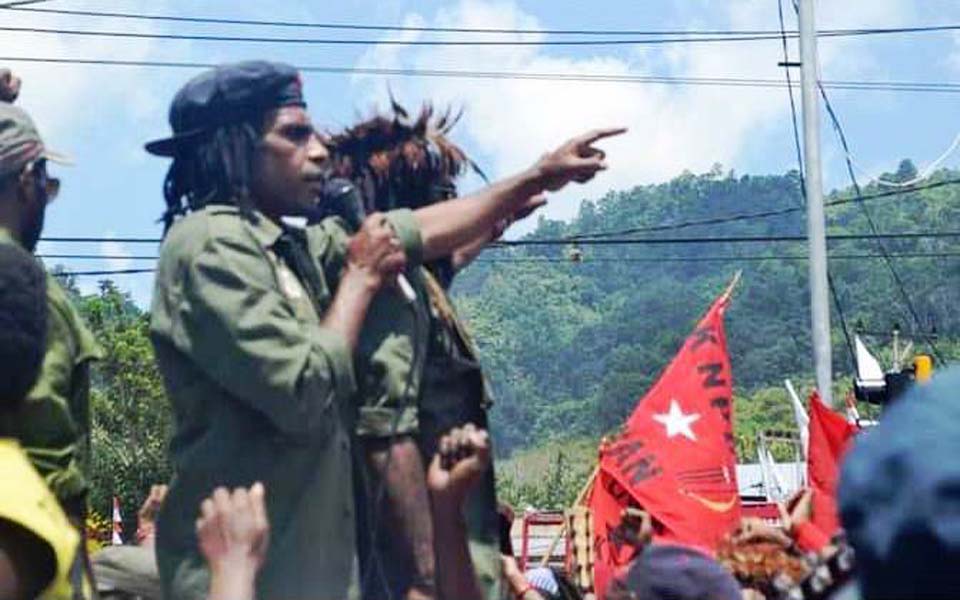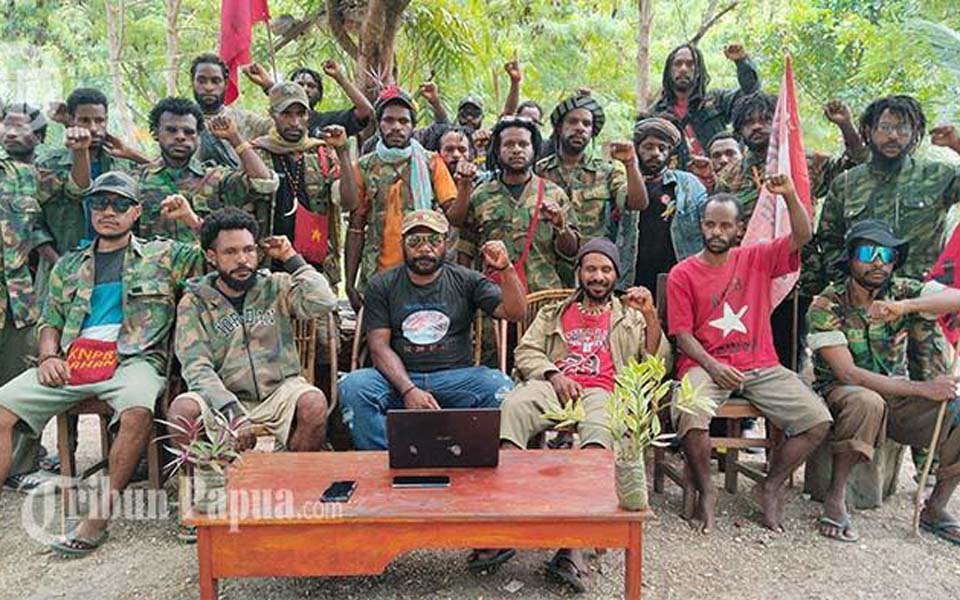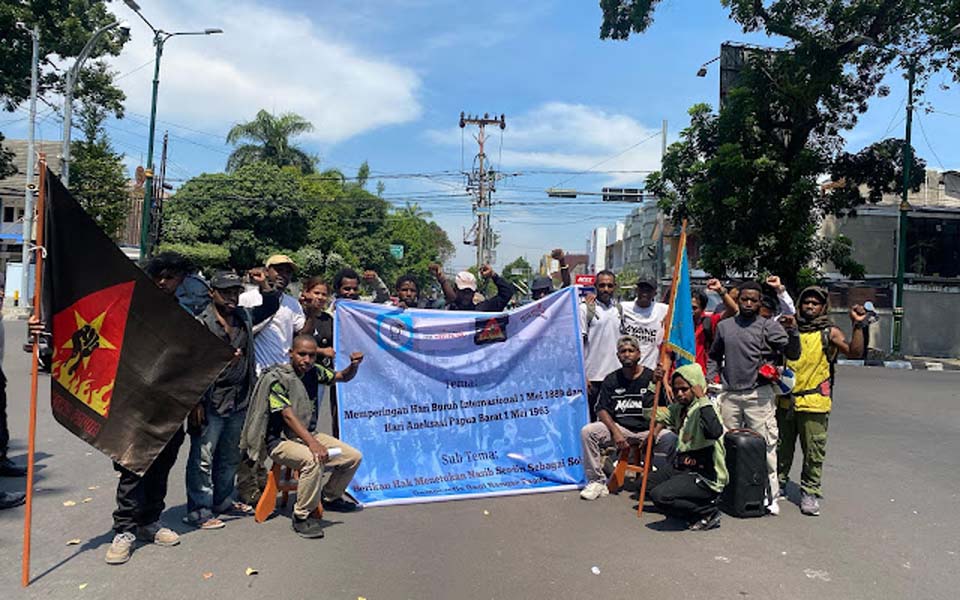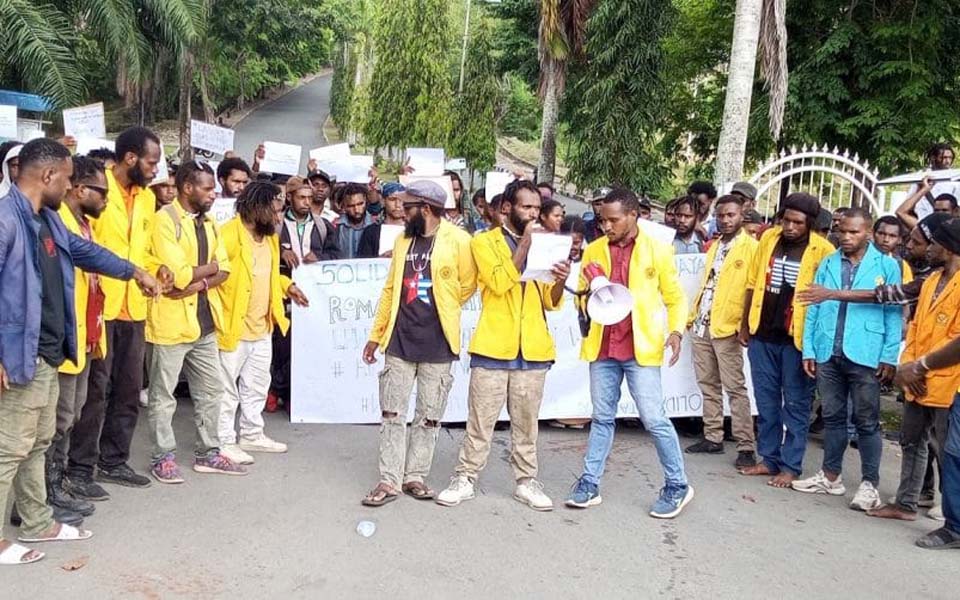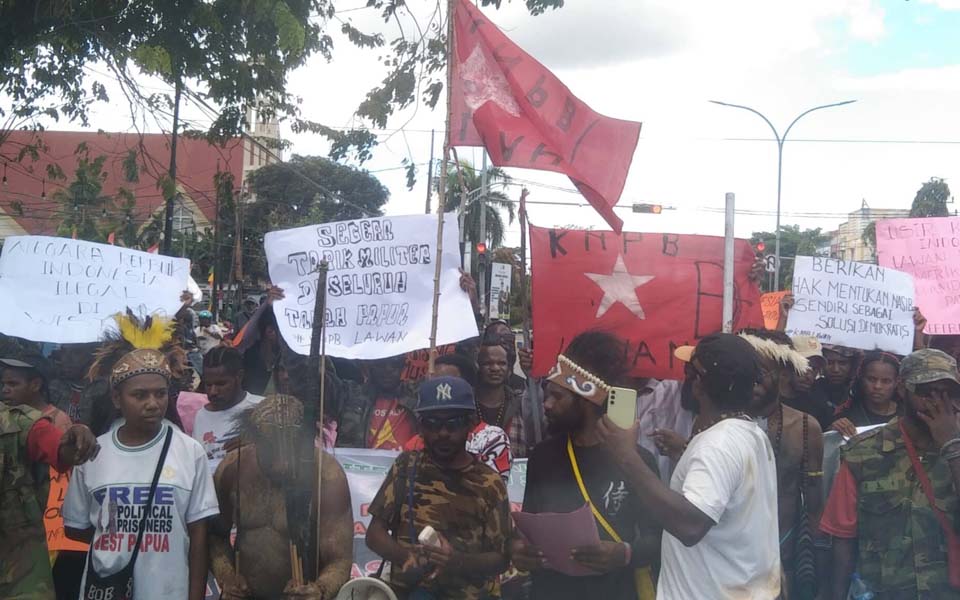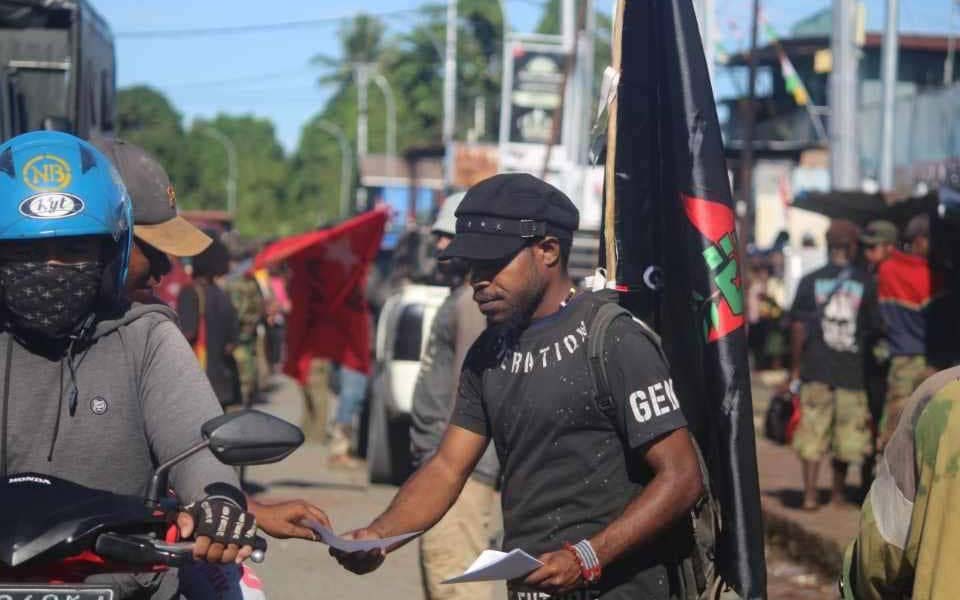


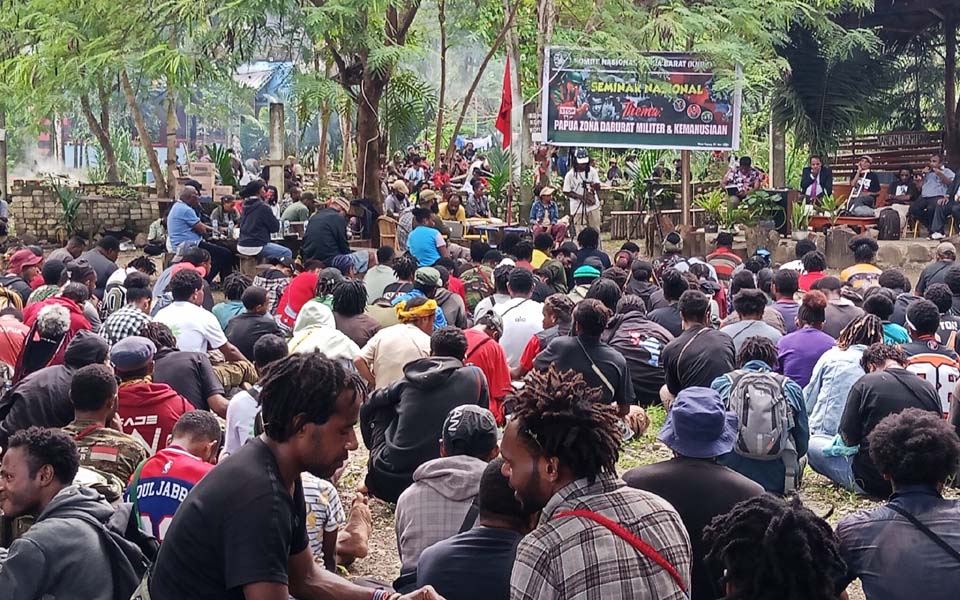
Jayapura, Jubi – The West Papua National Committee (KNPB) held a commemoration of the 63rd anniversary of Papua's annexation into the Unitary State of the Republic of Indonesia or NKRI on May 1, 1963.
The commemoration was held by the KNPB Secretariat at the Waena III State Housing Company (Perumnas) in Yabansai Village, Heram district, Jayapura city, Papua, on Friday May 1.
KNPB General Chairperson Agus Kossay said that legally Papua's integration into the NKRI was illegal because Indonesia came with a military force and forced the Papuan people to become part of the Indonesian state.
"Like the theme of the day, Indonesia mobilised its military forces and took over this land. Then the Papuans were forced by military force to become part of Indonesia. Indonesians say integration, but Papuans say annexation. But we declare that Indonesia in Papua is legally illegal". said Kossay.
He said that the KNPB firmly and officially states to the world that the framing of West Papua's integration into Indonesian territory was a historical lie that the law has to correct permanently.
Because legitimate integration under international law requires the free consent of the people who own the territory, a democratic and transparent process, and the supervision of an independent international body.
Yet, said Kossay, none of these conditions were met in the case of West Papua on May 1, 1963. What happened on May 1, 1963 was the handover of administration from the Netherlands to Indonesia, and the Papuan people were never asked, never talked to, and never gave their consent.
According to Kossay, Indonesia's use of the word integration is a terminological attempt to cover up the true character of annexation.
The KNPB rejects this terminology and designates May 1, 1963 as the day of illegal annexation, which should be commemorated as a symbol of resistance, not a celebration.
"The UN Declaration on the Rights of Indigenous Peoples (UNDRIP), and the Montevideo Convention all support the Papuan position that the Papuan people have the right to determine their own political destiny, without coercion, without military intimidation", he said.
Kossay said that today's commemoration was the initial stage of a people's consolidation. The KNPB is inviting the Papuan people to start organising themselves, from families to communities, as a first step towards further actions.
The Indonesian government was also urged to stop sending military troops to various parts of the land of Papua. The KNPB is calling for security forces to be withdrawn from villages and districts in conflict-prone areas, because people want to live is safety in their own areas.
"The results of the national seminar that was held resulted in a recommendation that the conditions in [the land of] Papua are now threatening and an unsafe situation for the community. This theme is not only an organisational issue, it is also an issue shared by all Papuan people", he said.
He said that the Cartenz Peace Operation and the Habema Operation carried out by the Indonesian Military (TNI) and the Indonesian Police (Polri) in Papua are terror operations against civilians, which must be stopped immediately.
Because these operation, which are claimed to be a law enforcement operations, have actually became an instrument for killing civilians, burning down villages and causing indigenous Papuans to become internally displaced on a massive scale.
"The operations carried out in Nduga, the Bintang Highlands, Intan Jaya, Maybrat, Yahukimo, Puncak Jaya, Puncak Papua, Timika, Fak-Fak, Paniai and surrounding areas have killed hundreds of civilians. Including women and children, and forced thousands of families to flee into the forest in conditions without access to food, health and protection", said Kossay.
Therefore, the impact of these operations is alleged to have caused serious violations of international humanitarian law or IHL and the principles on the protection of civilians in armed conflicts recognised by international law.
In addition to this, the prohibition of access for international journalists and human rights monitors to military operation areas in the land of Papua is considered clear evidence that Indonesia is aware that it is committing crimes that cannot withstand the global spotlight.
"We urge the UN, the UN Human Rights Council and all international bodies to immediately issue an order to stop these two operations and open full access for independent monitors throughout the West Papua region", said Kossay.
KNPB spokesperson Ogram Wanimbo meanwhile said that the handover of Papua administration from the United Nations Temporary Executive Authority or UNTEA to Indonesia in 1963 did not receive the agreement of the Papuan people.
The handover was also seen as a form of annexation, not integration, and as one of the darkest moments in Papuan history.
"We highlight a number of historical events, including the declaration of Papuan independence on December 1, 1961, the 1962 New York Agreement, as well as the implementation of the Determination of Popular Opinion or Pepera [Act of Free Choice] in 1969. These various processes do not fulfill the principle of self-determination as regulated under international law", said Wanimbo.
The KNPB also urged international institutions, the UN, the International Court of Justice (ICJ) and the UN Human Rights Council, to immediately carry out an independent investigation into human rights violations in Papua, open access to journalists and international observers, and review the legal status of Papua from an international perspective.
The KNPB also asked organisations such as the Melanesian Spearhead Group (MSG) and the Pacific Islands Forum (PIF) to raise the issue of Papua as the main agenda and encourage diplomatic steps regarding the status of the region.
"To the international community to pay attention to the situation in Papua, and we emphasise that the political struggle for self-determination will continue", he said.
Wanimbo said that that the KNPB also encourages dialogue or negotiations between Papua and the central government in Jakarta, as an effort to find a solution to the conflict that is taking place.
According to Wanimbo, they will continue to fight until Papua's demand for self-determination is achieved.
"The state is carrying out a massive military invasion, we will also consolidate the ordinary people (on a) massive scale and we will paralyse the cities. Only one thing, Indonesia wants and does not have to open negotiations for the Papuan people with Jakarta, in order to find a solution. If there is no solution, the Papuan people will continue to resist until we are finished", he said.
Wanimbo said that similar commemorations have been held out in a number of places in Papua such as Timika, Wamena, Sorong and Manokwari, as well as cities outside Papua such as Gorontalo and Makassar. These actions were held out as a form of protest against the status of Papua in the NKRI.
"These activities are the start of a series of consolidations that will continue to be carried out, involving various elements of society, including students and civil society organisations, to voice their aspirations", he said.
[Translated by James Balowski. The original title of the article was "KNPB Peringati 63 Tahun Aneksasi Papua Dalam NKRI".]
Sour0ce: https://jubi.id/mamta/2026/knpb-peringati-63-tahun-aneksasi-papua-dalam-nkri/