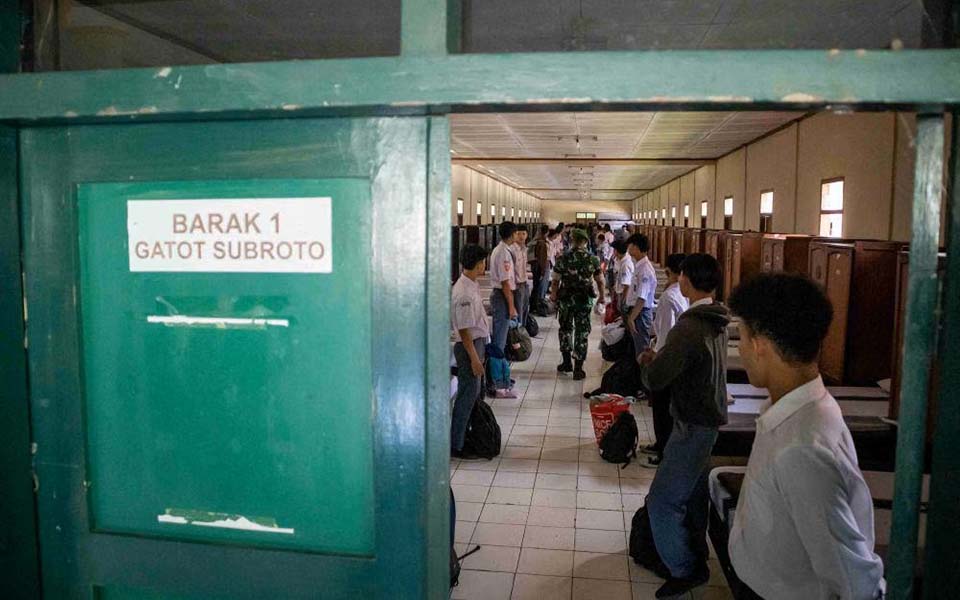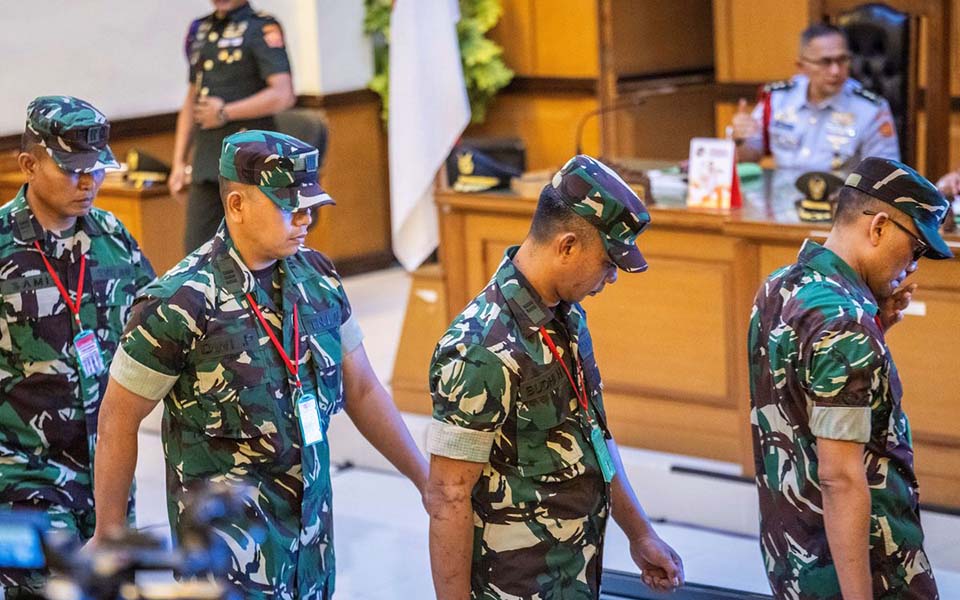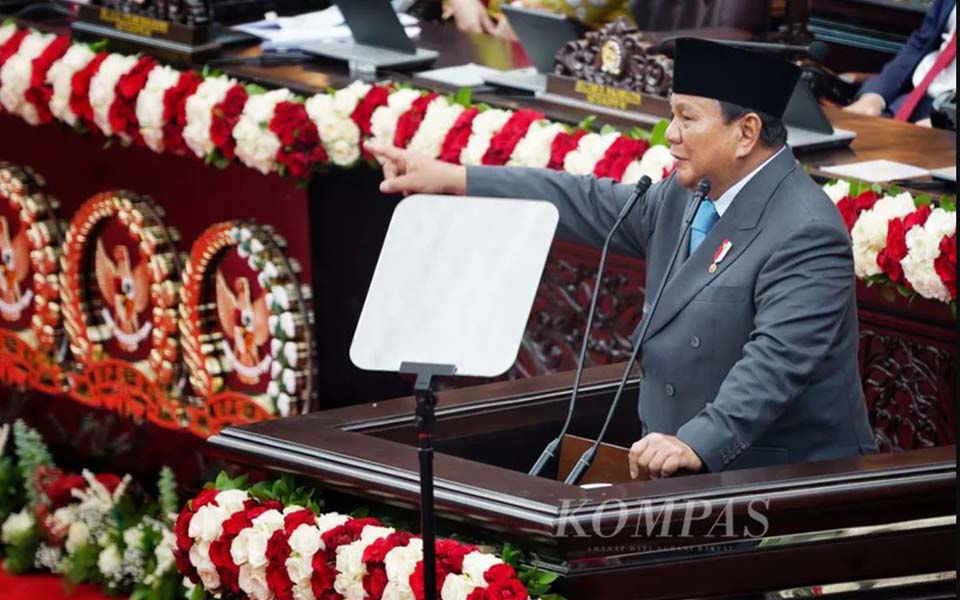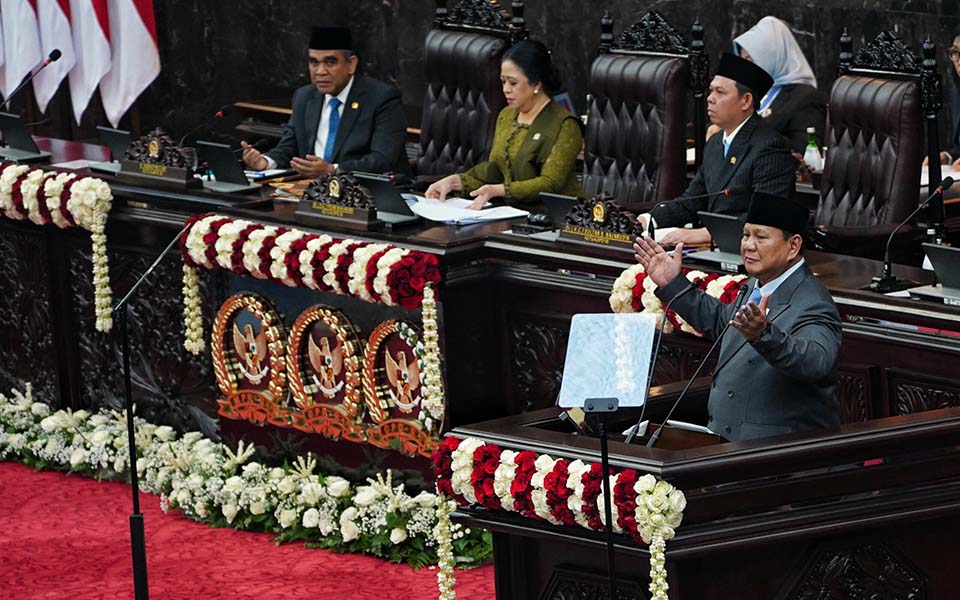


Jakarta – The Civil Society Coalition has criticised President Prabowo Subianto's plan to expand the strength of the Indonesian Military (TNI) by establishing new battalions on the pretext of securing Indonesia's natural resources and combating illegal logging, illegal mining and unauthorised plantations.
The President's statement, which said that ideally each regency should be guarded by a battalion, given the fact that 360 of the country's 514 regencies currently lack a TNI unit, reflects a flawed perspective: the complex issue of natural resource governance is being reduced to a matter of military force deployment.
The coalition asserts that environmental crimes, such as illegal logging, unlicensed mining and encroachment on protected forest areas, are matters of civil law enforcement, licensing governance, corruption, environmental oversight and the accountability of both officials and business actors. Addressing these issues by expanding the presence of TNI battalions in all regencies is not only misguided but also risks reviving the "dual function" (dwi-fungsi) practice of the military, which was rejected by the agenda of reformasi – the political reform process that began in 1998.
Indonesia's Constitution places Indonesia as a state based on the rule of law, not one that resolves civil issues through a military approach. Article 1, Paragraph (3) of the 1945 Constitution affirms the principle of the rule of law, while Article 30 governs state defence and security within a framework that is subject to the law, democracy and human rights. Within this framework, the TNI's primary mandate is to serve as an instrument of state defence against military and armed threats, both external or internal, that compromise state sovereignty. Positioning the TNI as the primary actor in natural resource oversight at the regency level blurs the distinction between defence functions and civil law enforcement functions.
Furthermore, while the TNI Law recognises Military Operations Other Than War (OMSP), their implementation must be based on a state political decision and must be limited, proportional and accountable, without supplanting the functions of civilian institutions. The plan to massively establish new battalions to safeguard natural resources effectively places the TNI within a permanent framework of civilian oversight, territorial control, the policing of economic activities and potential agrarian conflicts. This constitutes a distortion of the TNI's constitutional mandate and a violation of the principle of civilian supremacy.
Legal issues surrounding natural resource crimes such as illegal logging, illegal mining and unauthorised plantations must be addressed through legal instruments governing the environment, forestry, mining, plantations, spatial planning and anti-corruption efforts, as well as the restoration of the rights of indigenous peoples and local communities.
The competent authorities for this task are civilian agencies and law enforcement bodies that operate with clear legal mandates, oversight mechanisms, evidentiary standards and judicial accountability. Militarising the response to environmental crimes risks leading to enforcement actions lacking transparency, undermining legal processes and creating opportunities for the abuse of authority.
If the government is genuinely committed to halting forest destruction and the illegal exploitation of natural resources, priority must be given to strengthening permit oversight, conducting corporate compliance audits, cracking down on corruption networks and the economic actors profiting from these activities, protecting whistleblowers and restoring the territories of indigenous peoples and victims of agrarian conflicts. Simply adding military battalions fails to address the root causes of the problem: impunity, the natural resource oligarchy and weak state accountability.
Furthermore, the establishment of new battalions at the regency level with a mandate to safeguard natural resources threatens to expand military territorial control over civilian life. In the context of agrarian conflicts, customary lands, opposition to mining, protests against plantations and the criminalisation of environmental defenders, an increasingly massive military presence could escalate intimidation, curtail freedoms of expression and assembly, incite violence against citizens and silence criticism of extractive projects.
The Coalition warns that natural resource security must not serve as a pretext for shrinking democratic space. In a democracy, the oversight of natural resources requires transparent civilian governance, public participation, recognition of indigenous rights, access to information, an independent judiciary and law enforcement subject to public scrutiny. A militaristic approach risks treating citizens merely as objects of security operations rather than as holders of constitutional rights.
Then, the argument that Indonesia's defence budget remains below 2 percent of GDP, standing at around 0.9 percent for decades and trailing Singapore's allocation of over 3 percent, cannot be used as a justification for expanding the military's role into the civilian sphere. Defence budget figures must not be divorced from constitutional principles, genuine national defence needs, public policy effectiveness and democratic oversight of state spending.
Increasing the defence budget to establish new battalions in every regency risks diverting state resources away from urgent priorities such as strengthening environmental oversight agencies, enforcing forestry and mining laws, protecting indigenous communities, providing basic services and undertaking ecological restoration. Without a clear legal basis, a transparent needs assessment and oversight by the House of Representatives (DPR) and the public, this policy could lead to a costly and unaccountable expansion of the military institution that runs counter to the security sector reform agenda.
Once again, the Civil Society Coalition asserts that protecting Indonesia's natural resources is a constitutional obligation of the state. However, that obligation must be fulfilled through the rule of law, democracy, accountability and the protection of human rights, rather than through an expansion of the military's role in the civilian sphere. The plan to establish a new battalion to safeguard natural resources constitutes a misuse of authority and a constitutional violation because it shifts the military's defence function toward civilian law enforcement and oversight roles.
Jakarta, September 18, 2026
Civil Society Coalition for Security Sector Reform
Indonesian Human Rights Watch (Imparsial), the Commission for Missing Persons and Victims of Violence (Kontras), the Indonesian Legal Aid Foundation (YLBHI), Amnesty International Indonesia (AII), the Human Rights Working Group (HRWG), the Indonesian Forum for the Environment (Walhi), Centra Initiative, Raksha Initiatives, the Indonesian Risk Centre (IRC), Indonesian Corruption Watch (ICW), the Jakarta Legal Aid Foundation (LBH Jakarta), the Setara Institute for Peace and Democracy, the Legal Aid Foundation for the Press (LBH Pers), DeJure, the Community Legal Aid Foundation (LBH Masyarakat), the Democratic Alliance for Papua (ALDP), Public Virtue, the Institute for Criminal Justice Reform (ICJR), the for Public Research and Advocacy (ELSAM), the Indonesian Legal Aid and Human Rights Association (PBHI), the Jakarta Alliance of Independent Journalists (AJI Jakarta), the Women's Legal Aid Foundation for Justice (LBH APIK), the Indonesian Women's Coalition (KPI), the Medan Lega Aid Foundation (LBH Medan), the Indonesian Alliance of Independent Journalists (AJI Indonesia).
Contact persons:
- Ardi Manto Adiputra (Imparsial)
- Muhammad Isnur (YLBHI)
- Dimas Bagus Arya (Kontras)
- Usman Hamid (Amnesty International Indonesia)
- Al Araf (Centra Initiative)
- Julius Ibrani (Indonesia RISK Centre)
- Bayu Wardhana (AJI Indonesia)
[Translated by James Balowski. The original title of the article was "Militerisasi Kekayaan Alam Melanggar Konstitusi".]
Source: https://ylbhi.or.id/informasi/siaran-pers/militerisasi-kekayaan-alam-melanggar-konstitusi/