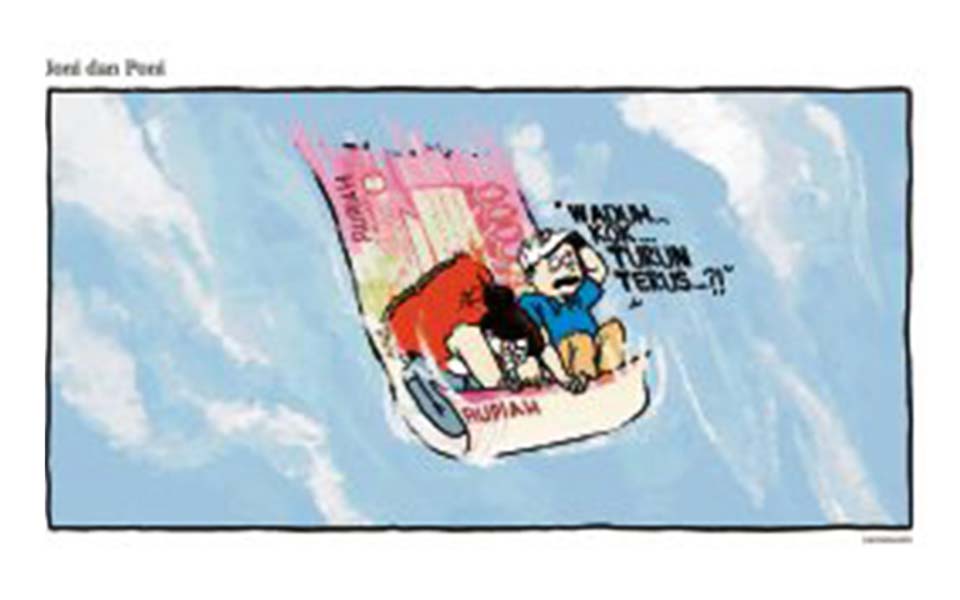



Josi: I can still recover from this can't I?
Indonesian stocks suffered a massive sell-off on October 16 losing 678 points or 11.57 percent to close at 5,185, the lowest level this year, after the global index provider MSCI warned it could reclassify Indonesia from an Emerging Market to a Standalone Market.
The Jakarta Composite Index (JCI) has traded in negative territory throughout the session, moving between 5,185 and 5,404. The benchmark had started 2026 on a strong footing, hitting a record high of 9,134 on January 20 before entering a prolonged downslide.
Pilarmas Investindo Sekuritas said MSCI's warning had drawn significant attention from markets because a reclassification could lead to Indonesian stocks being excluded from major MSCI indexes used by global investors as investment benchmarks.
"Investors' concerns mainly relate to ownership transparency, free-float measurement and allegations of coordinated trading practices", Pilarmas wrote.
Chief of Economic Affairs Minister Airlangga Hartarto attributed Friday's market turmoil, including the trading halt and the rupiah's slide to around 18,000 rupiah per US dollar, to MSCI's plan to reconsider Indonesia's market classification.
"First, this was certainly triggered by MSCI's announcement, but the announcement came earlier than expected. They had actually promised to make it in November, but it came in October", Hartarto told reporters on Friday.
Fakhrul Fulvian, chief economist at Trimegah Sekuritas Indonesia, said MSCI's potential reclassification raised questions that went beyond the benchmark's daily performance.
"This is not simply a matter of the JCI falling. When MSCI begins questioning whether Indonesia still deserves to be classified as an Emerging Market, what is being tested is confidence in our market institutions", said Fulvian.
He said MSCI's concerns have not emerged suddenly. Since early this year MSCI has flagged opacity in share ownership structures, insufficient information to accurately assess free float, and concerns about potential coordinated trading behaviour that could undermine proper price formation.
"Therefore, in my view, this is no longer just a free-float problem. It has become a problem of trust", added Fulvian.
[Abridged from a Jakarta Globe article title "Rupiah buckles under MSCI pressure, sinks past Rp 18,000" (https://jakartaglobe.id/business/indonesian-stocks-end-at-2026-low-after-losing-1157-on-msci-warning).]