

Hidayat Salam – The Shadow Cabinet in collaboration with the Centre of Economic and Law Studies (Celios) has provided critical notes on the first two years of the administration of President Prabowo Subianto and Vice President Gibran Rakabuming Raka.
They believe that the wheels of government over this period have been overshadowed by the pitfalls of populism, weak institutional coordination and an expanding power structure that has not translated into improved public welfare.
The report, titled Prabowo-Gibran 2-Year Performance Report, which was initiated by Celios and the Shadow Cabinet captures assessments from both the general public and expert groups. These evaluations were gathered between September 15 and October 9 involving 1,142 general public respondents and 129 experts, selected using a snowball sampling method.
The results was that the general public gave the Prabowo-Gibran cabinet an average performance score of 4.7 out of 10. In contrast, the expert group gave a failing grade that was much lower, namely 2.9 from a scale of 10.
"The two-year performance assessment of the Prabowo-Gibran cabinet. The cabinet performance assessment, the general public gave it 4.7 out of 10 and based on experts 2.9 out of 10", said Celios Director Bhima Yudhistira when presenting the report results online on Sunday evening October 11.
In addition to the cabinet's performance, the work of President Prabowo during his two years in office was also evaluated. President Prabowo received a score of 2.8 out of 10 from experts, meanwhile the general public's assessment stood at 4.6 out of 10.
"As for Gibran, experts rated him at 2.2 out of 10, while the general public rated Vice President Gibran's performance at 4.9 out of 10", Yudhistira said.
Yudhistira explained that these low ratings were caused by a disorientation in priority programs and the real economic burdens increasingly felt by the public.
As many as 82 percent of respondents complained about increasingly burdensome taxes and levies, 62 percent believed the government had failed to address unemployment and 53 percent stated that their household economic conditions had deteriorated compared to the previous year.
This dissatisfaction has also directly impacted political legitimacy with 55 percent of respondents who voted for Prabowo in the last election stating they would not vote for him again.
Aside from economic problems, this time the assessment report specifically recorded indicators on the public's sentiment toward President Prabowo's leadership. The results showed that the majority of respondents were experiencing psychological stress due to the direction of state policies.
For instance, 75 percent of respondents stated they were stressed by current government policies, while 67 percent reported feeling distressed by Prabowo Subianto's behaviour and leadership style.
"The responses show that 75 percent feel stressed by government policies. And specifically 67 percent are stressed by Prabowo Subianto's behaviour", revealed Yudhistira, who serves as the Minister of Finance and Budget Governance in the Shadow Cabinet.
Public unease was further confirmed through sectoral evaluations conducted by Shadow Cabinet ministers on the technical ministries of the Red and White Cabinet. Strategic ministerial portfolios were predominantly rated 3 out of 10, particularly in sectors such as natural resources, the environment, presidential governance and basic social services.
For example, Shadow Cabinet's Minister of Environmental Protection and Climate Change Iqbal Damanik gave a score of 3 out of 10 to four ministries simultaneously: the Ministry of Energy and Mineral Resources, the Ministry of Forestry, the Ministry of Environment and the Ministry of Agrarian Affairs and Spatial Planning/National Land Agency.
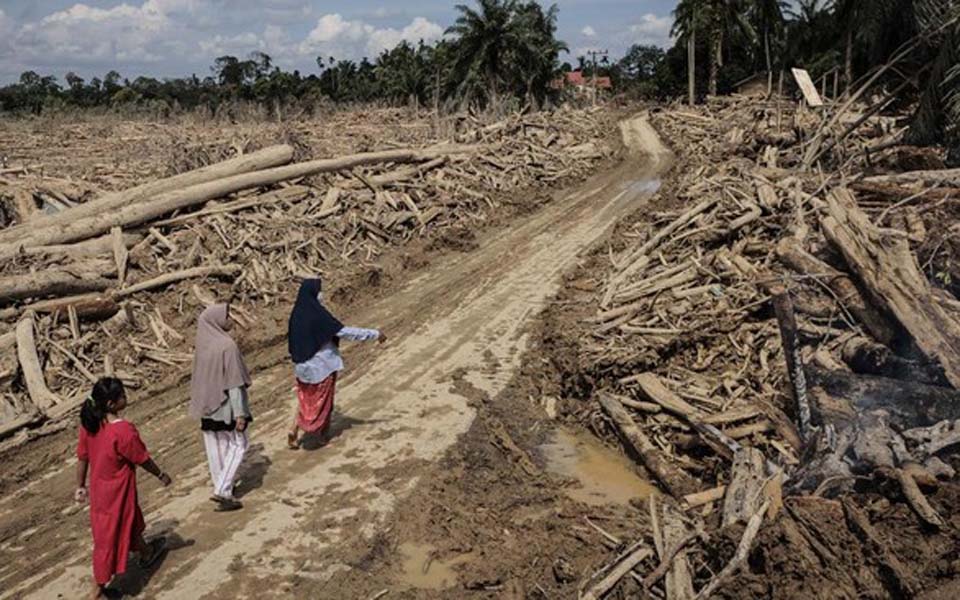
Damanik believes that technical officials have been slow to respond to the forest and land fire (karhutla) emergency that is spreading into national conservation area, allowing agrarian conflicts involving indigenous communities to drag on and holding the energy transition agenda hostage to perpetuate fossil fuel projects.
A lack of inter-agency coordination is seen as exacerbating the ecological crisis. Damanik pointed out that the government's response is often reactive and minimal lacking measurable preventive measures in handling karhutla.
"This demonstrates that the handling of forest and land fires has been very minimal indeed, the actions by the government and very minimal measures from the government. It also reveals that President Prabowo is even unaware, cannot ask the right people, namely, his own Ministry of Forestry. We saw in August of this year, during at a limited meeting on handling the karhutla, the Ministry of Forestry and even the minister did not attend", said Damanik.
A score of 3 out of 10 was also awarded to the Ministry of State Secretariat by the State Secretary in the Shadow Cabinet Feri Amsari for failing to manage inter-agency coordination and allowing policies to be formulated without regard for constitutional law principles.
Root of the governance problem
According to Amsari, the phenomenon of ministers receiving uniformly poor performance ratings stems from a leadership trapped by short-term populism. Most ministers are seen as being caught up in performing formalities to polish the ruling administration's public image, rather than upholding good governance and constitutional compliance.
Furthermore, public policies are often implemented without pilot testing and disregard planning by the National Development Planning Agency (Bappenas). This ultimately backfires when fiscal burdens skyrocket and the quality of public services plummets.
He cited the chaotic implementation of priority programs such as the Free Nutritious Meal (MBG) program which proceeded without adequate feasibility testing. Meanwhile the basic rights of educators were in fact disregarded.
"However, I'm convinced the public is beginning to realise that the government's work that is always masking problematic policies that ultimately result in adverse effects on public services. Forest fires, disaster management, chaos in the world of education with the MBG poisoning students, teachers not getting decent livelihoods, so ultimately the quality of our education is poor", said Amsari.
Bivitri Susanti, a lecturer at the Indonesia Jentera School of Law, emphasised that this failing grade is not merely an attempt to pinpoint the shortcomings of individual ministers, but rather a warning bell regarding anomalies within the state governance system.
According to Susanti, the government's most fundamental failure is rooted in an unwillingness to meaningfully listen to public aspirations. Yet survey findings confirm that 80 percent of the public place a willingness to listen to the people the most crucial criterion for future national leaders.
In addition to this, the difference in values between experts and the general public demonstrates the enduring grip of the government's populist politics. The current administration is seen as adept at crafting populist-style policies that appear to favour the ordinary people despite substantially not having a transformative impact and frequently monopolising the definition of truth through official state narratives.
"It's this populism, right, which causes such stark differences in public perception and we also then see that the policies are in fact all populist in nature. Even though many of them are disconnected, have no impact, and so on. But it's as if they are providing a service, as if, yes, serving the ordinary people because of that populist character", she said.
Furthermore, Susanti also highlighted the bloated structure of the Prabowo-Gibran cabinet comprising up to 161 officials, including coordinating ministers, ministers, deputy ministers, the Presidential Advisory Council and presidential special envoys.
Meanwhile, repeated cabinet reshuffles have proven ineffective in resolving the root causes of bureaucratic stagnation because the rotation of officials has served merely as a transactional instrument to maintain political loyalty, co-opt critical groups and sideline those holding different views.
For Susanti, this two-year report should prompt the public's imagination not to be trapped in the repetitive cycle of elite circulation. At the same time, the public is demanding a restoration of governance grounded in constitutional discipline and democratic ethics.
Government response
Separately, Kurnia Ramadhana, Deputy III of the Government Communication Agency, said that the government respects the findings of the Celios survey and the Shadow Cabinet as part of public oversight and evaluation of the administration's performance. These assessments provide valuable input, particularly regarding policy direction, employment opportunities, purchasing power and the economic burdens faced by the public.
"The government understands that public trust must be built through policies that address the community's needs, accountable implementation, and openness to criticism", said Ramadhana said on Monday October 12.
Nevertheless, Ramadhana also emphasised that the government has fulfilled its mandate through measurable policies and programs with results open to public evaluation. Indeed, several national indicators show signs of improvement.
Referring to Statistics Indonesia (BPS) data, continued Ramadhana, Indonesia's economy grew by 5.29 percent in the second quarter of 2026 compared to the same period the previous year. The poverty rate fell from 8.47 percent in March 2025 to 8.07 percent in March 2026, while the open unemployment rate stood at 4.65 percent in May 2026.
"These achievements are part of the government's performance measures which can be examined openly. The government's next responsibility is to ensure that these improvements are increasingly felt by the public through decent employment opportunities, rising incomes, and the maintenance of purchasing power", said Ramadhana.
As an effort to help the public meet basic needs, the realisation of social assistance spending has also reached 115.8 trillion rupiah by September 30, including through the Family Hope Program (PKH), the Basic Food Card (Kartu Sembako), educational aid and health insurance premium subsidies. Then, the MBG program that has reached 56.99 million beneficiaries as of August 31, while the Free Health Check-up program had reached 73.8 million people as of July 31, 2026.
Furthermore, in the education sector, the government reportedly completed the revitalisation of 16,167 educational institutions in 2025 and has set a target to revitalise 71,744 institutions in 2026. So far also there has been 182 People's Schools (Sekolah Rakyat) established across various regions. These schools aim to expand educational access for children from poor and extremely poor families.
According to Ramadhana, these programs aim to improve learning conditions and reduce economic barriers to accessing education. Their implementation is accompanied by efforts to enhance the quality of learning, ensure the readiness of educators and ensure equitable access.
Ramadhana emphasised that the government views survey results and development indicators as complementary inputs for evaluation. Improvements in national indicators can occur alongside efforts to resolve the difficulties still faced by some segments of society. Consequently, concerns regarding the cost of living, employment challenges, and service quality continue to receive attention.
"The government is committed to improving policies that are not yet optimal, increasing the effectiveness of budget utilisation, and opening avenues for public criticism and oversight. The government's success must be measured by the changes people experience in their daily lives", said Ramadhana.
[Translated by James Balowski. The original title of the article was "Rapor Pemerintahan Prabowo-Gibran dari Kabinet Bayangan".]
Source: https://www.kompas.id/artikel/rapor-merah-pemerintah-prabowo-gibran-dari-kabinet-bayangan