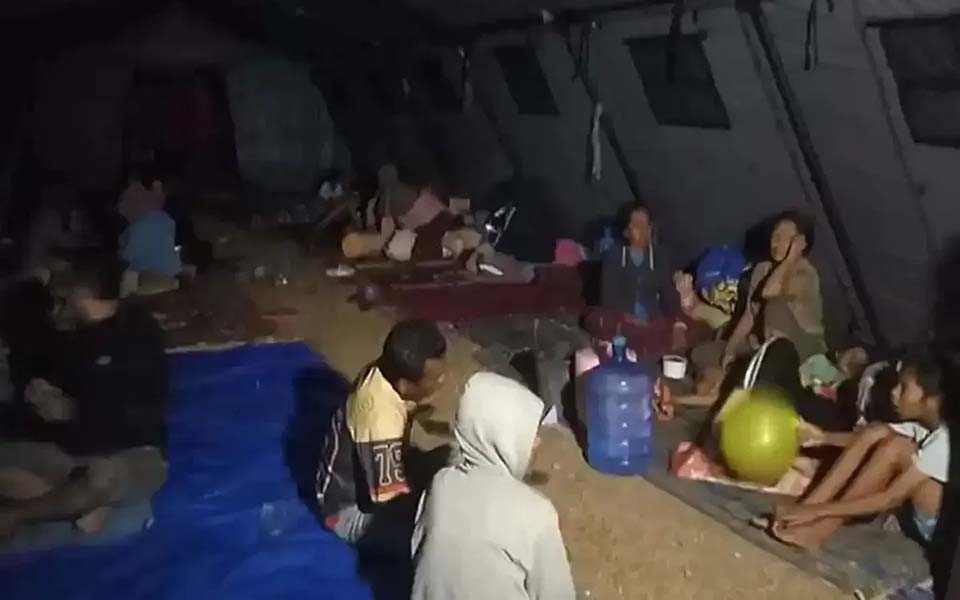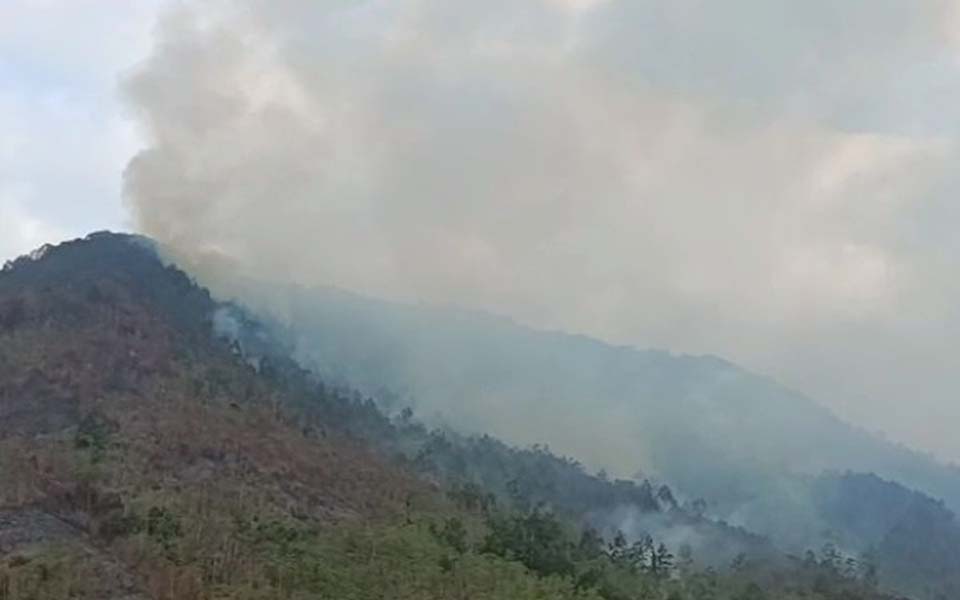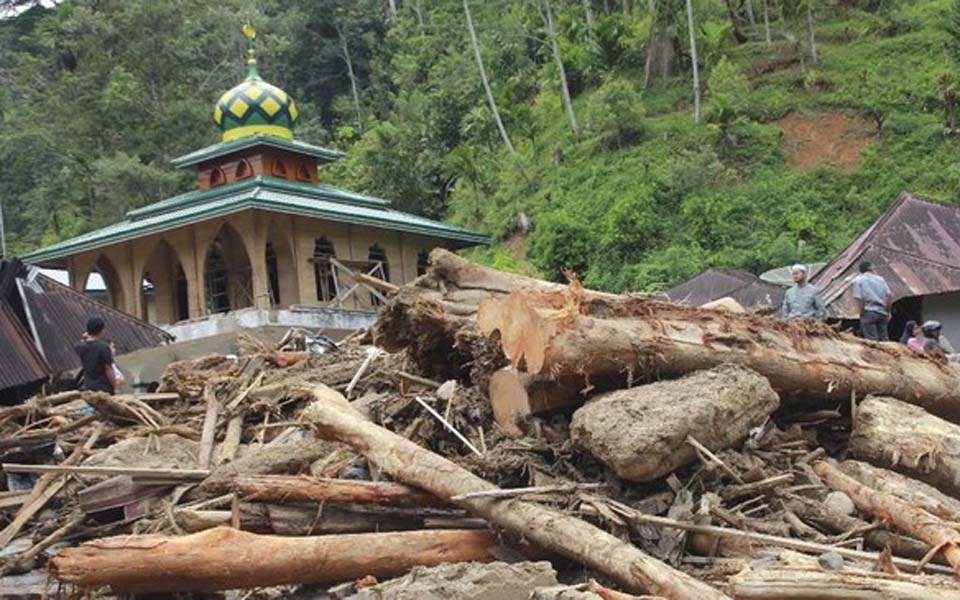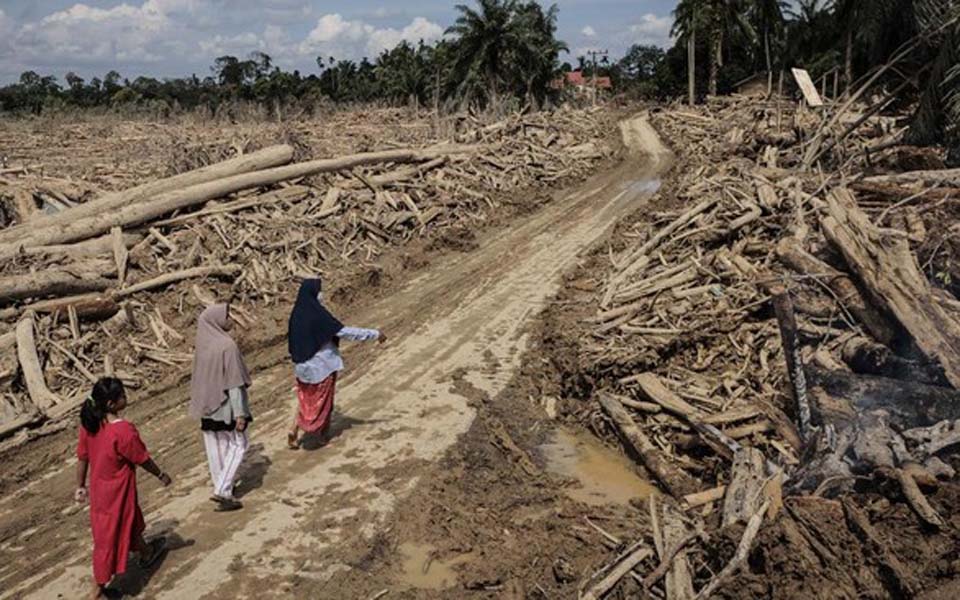


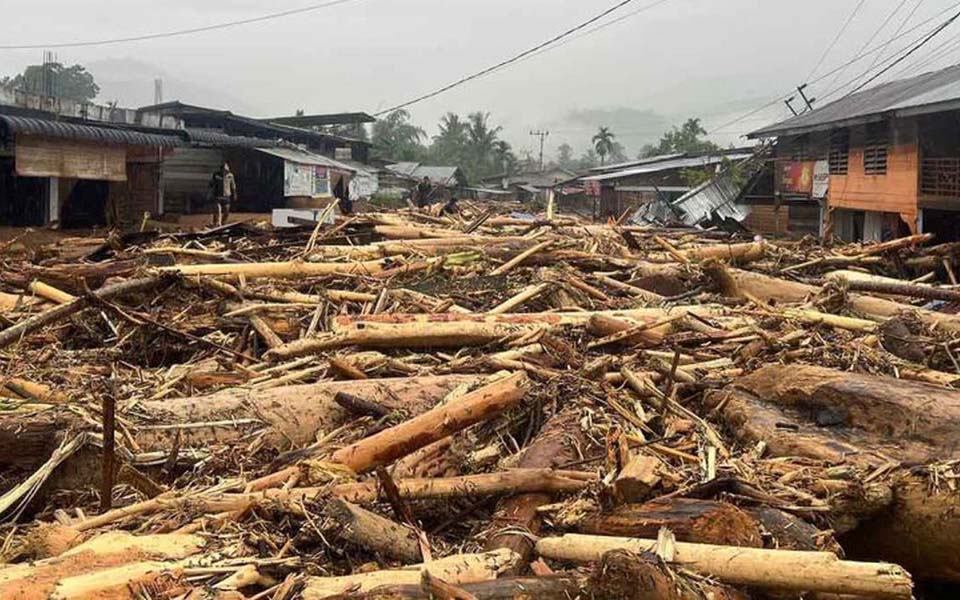
The flood and landslide disasters that hit Aceh, North Sumatra and West Sumatra starting on November 25, 2025, killed 1,190 and left 141 people still missing as of January 17.
In addition to this, more than 40 days since the disaster struck, there are around 131 thousand people still living in refugee camps.
Mining Advocacy Network (Jatam) National Coordinator Melky Nahar said that the disaster destroyed more than 175 thousand residents' houses, closed access to transportation and paralysed the social and economic life of residents in Aceh, North Sumatra and West Sumatra.
For this reason, this disaster is like a catastrophe that ravages and paralyses all aspects of life.
"This catastrophe did not come suddenly, but was an accumulation of enormous destructive power from the destruction of the natural landscape due to excessive exploitation of extractive industries", said Nahar on Saturday January 17.
A new Jatam report shows that there is almost no area in Aceh, North Sumatra and West Sumatra that has not been filled with extractive permits, ranging from mining and forestry concessions to industrial scale oil palm plantations that have existed for years.
The state's greed can be seen when concession permits invade upstream areas of river basins (DAS) and disaster-prone areas.
The deforestation of natural forests in upstream watersheds, the erosion of slopes and hills to the narrowing of rivers due to extractive industry operations are clearly legalised by state administrators. With regard to illegal extractive activities, state administrators seem to turn a blind eye and ignore them.
As a consequence, when extreme rain falls the damaged natural landscape loses its ability to regulate water. So, it is not surprising that the Sumatran catastrophe was a disaster that was deliberately invited.
"Ironically, those who were forced to bear the consequences of this enormous destruction were the millions of residents of Aceh, North Sumatra and West Sumatra", he explained.
Corporate traces of state administrators
In its latest report titled Sumatra Catastrophe: Traces of the Oligarchy in Upstream, Watershed and Disaster-Prone Zones, Jatam found traces of state administrators and key political party officials, both directly and indirectly, in several corporations operating in areas essential for citizens' livelihoods and ecological sustainability.
It is not surprising therefore that the Sumatran disaster is not only seen as a result of extreme weather, but rather the result of greed, rapacity and policy mismanagement. The central government however hastily labelled the massive tragedy a "natural disaster".
"The technocratic narratives about extreme rainfall and climate anomalies continue to be repeated, while the role of state policy in opening the way for massive exploitation has been almost completely removed from public debate", said Nahar.
"According to Jatam, this is a practice of depoliticizing disasters that is very dangerous and deceitful. Because, the communities of residents who were the victims were forced to accept this disaster as fate, not as a result of political decisions that ignored the safety of residents", he asserted.
The collaborative report by Jatam and the Aceh Wetland Forum reveals that there is a strong connection between areas affected by floods and landslides and concessions of companies owned or directly connected to state officials and the political elite.
In Aceh, North Sumatra and West Sumatra, upstream areas and strategic watersheds are controlled by mining, palm oil and forestry companies whose shares, directors or commissioners are intertwined with national circles of power.
This relationship creates a very acute conflict of interest, which places state administrators in a dual role, namely as regulators and as protectors of business interests.
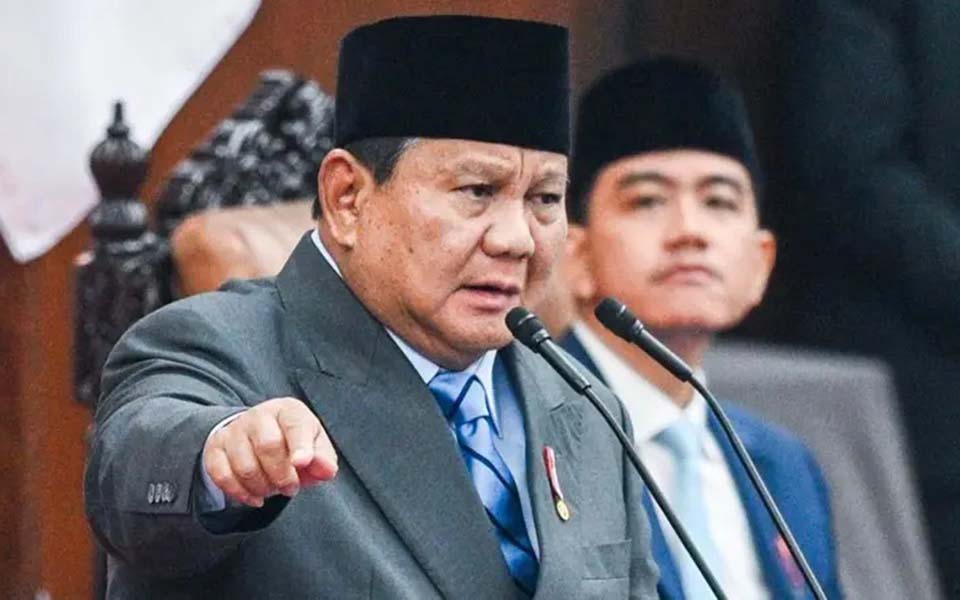
In Aceh, the report shows the connection between President Prabowo Subianto and a number of active ministers, as well as the national political elite, with mining, forestry and plantation companies operating in upstream watershed areas and disaster-prone zones.
Prabowo's name was traced through a network of coal and industrial plantation forest business ownerships and affiliations in Aceh, whose concessions cross many watershed and landslide-prone areas.
There is also the name of Coordinating Minister for the Economy Airlangga Hartarto in the coal business network whose concessions are located in areas that has long been associated with flash floods and water crises.
Another name that emerged was Surya Paloh as a political elite member of the National Democrat (NasDem) Party. Paloh owns interests in a number of coal concessions in West Aceh and Nagan Raya which have been repeatedly hit by flash floods.
In addition to this, there is also the name Aburizal Bakrie, who is an important political official in the Golkar Party who owns gold mining concessions in Aceh through PT Gayo Mineral Resources in Gayo Lues and PT Linge Mineral Resources in Central Aceh, which are located in upstream and landslide-prone areas.
In North Sumatra, the Bakrie Group controls PT Dairi Prima Mineral (DPM) lead and zinc mining concessions in Dairi and Pakpak Bharat districts, areas prone to earthquakes and landslides which have been legally declared problematic and had their permits revoked by the Supreme Court.
In addition to this, Bakrie also owns palm oil and rubber plantation concessions as well as processing facilities in Asahan and Labuhan Batu, areas that were also affected by the disaster.
Apart from the network of political elites, the Sumatran disaster is also supported by the role of giant corporations which have long controlled upstream areas, watersheds and key natural landscapes.
The Sinar Mas Group through Golden Agri Resources and PT SMART for example, is recorded to have connected palm oil supply chains in Aceh, including areas around the Leuser and Rawa Singkil ecosystem areas, which have repeatedly been linked to deforestation and flooding.
Then, there is the Musim Mas Group which operates in Aceh Tamiang, Aceh Singkil, East Aceh and Subulussalam, areas that were badly affected by the flooding in Aceh.
In North Sumatra, the Astra Group is present through the Agincourt Resources gold mine in North Sumatra as well as the Astra Agro Lestari palm oil expansion, whose concession is in an area prone to flooding and landslides.
There is also Toba Pulp Lestari (TPL), which has existed for more than four decades in the upstream areas of essential watersheds.
"The presence of these giant corporations confirms that Sumatra is being used as a field for large-scale capital accumulation, while the ecological risks fall upon citizens, and when a disaster occurs, the state returns to hiding behind the narrative of natural disasters", said Nahar.
In West Sumatra, a similar pattern occurs. The province is burdened with hundreds of mineral and rock mining permits as well as forestry and palm oil concessions operating in disaster-prone areas and river basins.
A number of large corporations are recorded as having concessions or supply chain connections in West Sumatra including the Wilmar Group, Golden Agri Resources (the Sinar Mas Group), the Musim Mas Group, Astra Agro Lestari and Bakrie Sumatra Plantations.
The activities of these companies, which change forest cover and landscapes on a massive scale, have weakened natural hydrological systems and increased the region's vulnerability to flash floods and landslides.
"This report shows clearly that Aceh, North Sumatra and West Sumatra are just treated as economic zones, not as living spaces for millions of citizens", explained Nahar.
As a consequence, these three areas quickly turned into zones that sacrificed the safety of residents. Ironically, for the state administrators who also act as extractive businesspeople in these three regions, the loss of life and destruction of social facilities are just considered "financial losses" that naturally arise for the sake of growth and sharing the concession cake.
"In other words, the safety of citizens is a variable that can be sacrificed at any time", he said.
Cherry picking law enforcement
In early January 2026, the Forest Area Control Task Force (Satgas PKH) announced that there were 12 companies whose activities were strongly suspected of being the cause of the ecological disaster in Aceh, North Sumatra and West Sumatra. However there has been no meaningful transparency regarding the names of the companies in question.
The PKH Task Force only mentioned initials and without an open explanation regarding the basis for the determination, the results of the environmental audit or what legal steps would be taken. This practice creates the impression of favouritism and reinforces suspicions that the law works selectively, especially when dealing with large corporations close to power.
"This report shows that there are more than 12 companies that should be held responsible for the disaster that occurred in Sumatra", said Nahar.
Investigations in upstream watershed areas and disaster-prone zones show dozens of mining, forestry and plantation concessions operating at key water control points and have been proven to be damaging the natural landscape.
"It's just that many of these companies are connected, either directly or indirectly, with circles close to power", continued Nahar.
Jatam believes that limiting responsibility to only 12 companies shows that there is a conscious effort by state administrators to protect their companies as a tactical political choice.
By narrowing the list of responsible parties, the government seems to be consciously protecting the interests of corporations that have structural proximity to the centres of power, while at the same time emptying the meaning of law enforcement as an instrument of ecological justice and protecting the safety of citizens.
With this political choice, the impression appears that the state is more busy maintaining investment stability than ensuring corporate accountability for the damage caused.
The catastrophe that occurred in Sumatra emphasises that ecological disasters are not just natural events, but are the result of unequal power relations between the state, corporations and citizens.
"As long as law enforcement remains weak, selective and not transparent, similar disasters will continue to recur. Sumatra will continue to be paid cheaply as an economic zone, while the lives and safety of its citizens become a cost that is considered tolerable", concluded Nahar.
Toba Initiatives researcher and Social Initiatives Development and Study Group (KSPPM) Secretary Delima Silalahi asserts that the disaster that occurred in Sumatra shows that residents were victims who had been sacrificed by the state.
"Meanwhile the main perpetrators who have been making huge profits for years have never been touched by real law enforcement efforts", asserted Silalahi.
On the other hand, regional oligarchs also own mining and palm oil concessions.
"The traces of the oligarchy at the regional level are also unbroken. Regional officials, from regents to governors, many own mining concessions and palm oil concessions, some of which are in forest areas and essential ecological areas", said Aceh Wetland Forum Director Yusmadi Yusuf.
Residents' voices of opposition to mining activities in Sibak Krueng Woyla, West Aceh, have never been taken seriously. In fact, after residents held an audience with the West Aceh Regency Legislative Council (DPRK), the West Aceh regent issued two edicts to stop gold dredging activities.
"However, the activities were never stopped for even a second. Even the voices of the people's struggles never made national news", said West Aceh resident Abdullah.
[Translated by James Balowski. The original title of the article was "Jejak Oligarki Bencana Sumatera, JATAM Bongkar Nama-nama Besar".]
Source: https://www.suarabangka.com/jejak-oligarki-bencana-sumatera-jatam-bongkar-nama-nama-besar/