

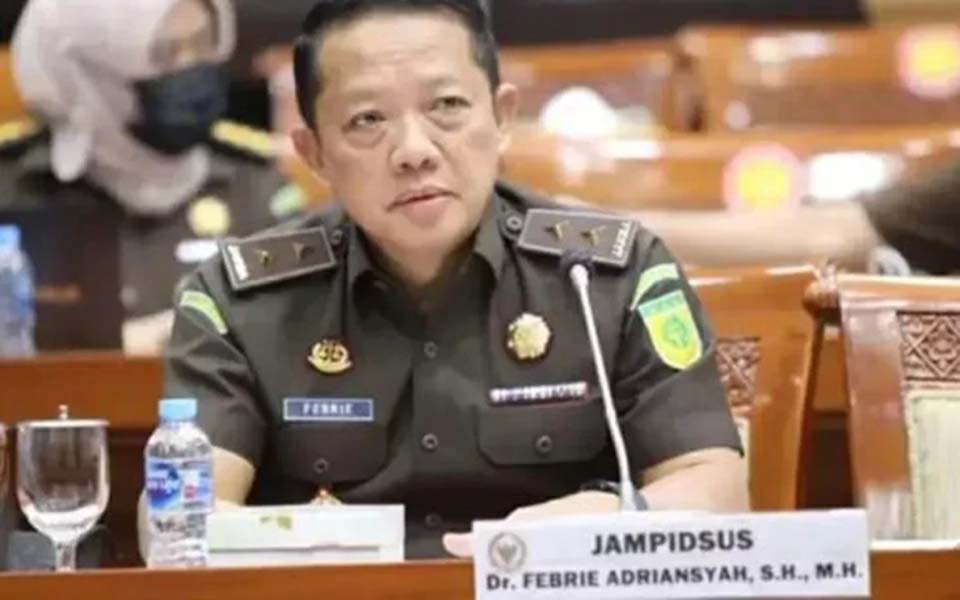
Bambang Arifianto – The Indonesian Legal Aid Foundation (YLBHI) has criticised the transfer of a case involving alleged corruption and money laundering (TPPU) that has ensnared former Deputy Attorney General for Special Crimes (Jampidsus) Febrie Adriansyah (FA).
The handling of the case has been transferred from the National Police (Polri) to the Attorney General's Office (AGO).
According to YLBHI, the transfer lacks a clear legal basis and leaves behind various irregularities. The organisation maintains that based on statutory provisions, the case should have been handled by the Corruption Eradication Commission (KPK) in order to eliminate conflicts of interest, prevent interference and ensure the independence of the law enforcement process.
"Not instead handed over to the Attorney General's Office, whose leadership is implicated in the corruption case", said YLBHI Chairperson Muhammad Isnur in a press release received by Pikiran Rakyat on Tuesday July 14.
YLBHI views the transfer as a dangerous precedent for the rule of law. They argue that the move threatens to undermine the legal system, create legal uncertainty and further erode public trust in law enforcement institutions.
The alleged corruption and money laundering case involving Adriansyah has also sparked public outrage, as it implicates a law enforcement official who ought to be at the forefront of the fight against corruption, rather than being a perpetrator of such crimes.
In the midst of this scrutiny, it emerged that the case had been transferred to AGO after being previously handled by the National Police Corruption Crimes Task Force (Kortas Tipikor) and the Jakarta Metro Police (Polda Metro Jaya).
The YLBHI considers the transfer to be irregular as it took place after the National Police Chief, the Attorney General, the Minister of Defence and the Indonesian Military (TNI) commander held a closed-door meeting with the President at the State Palace on Saturday July 11.
"There is a big question about the President's role in the scenario of transferring case handling from the National Police to the Attorney General's Office", stated the YLBHI.
In addition to this, just the day before the AGO halted an investigation into alleged corruption in the management of the Free Nutritious Meal (MBG) program via Letter Number B-3256/F.2/Fd.2/07/2026, signed by the Deputy Attorney General for Special Crimes Director of Investigations.
The YLBHI also highlighted the involvement of the National Police and the TNI in the MBG program. The National Police operates 1,376 Nutrition Fulfillment Service Units (SPPG), while the TNI managed 452 SPPG units in 2025, with a target to increase this to 2,000 units.
Contrary to legal provisions
The YLBHI emphasised that neither the Criminal Procedure Code (KUHAP) nor Law Number 30/2002 in conjunction with Law Number 19/2019 on the KPK, recognises a mechanism for transferring corruption cases between law enforcement agencies.
According to the YLBHI, this precedent creates uncertainty in the enforcement of anti-corruption laws, particularly when officials from a law enforcement agency that holds the authority to handle a case are in fact suspected of involvement in corruption networks.
Such a situation, according to the YLBHI, has repeatedly weakened the anti-corruption agenda. Therefore the existence of the KPK as an independent body is deemed essential for handling cases involving law enforcement personnel.
The YLBHI pointed out that Article 10A of Law Number 19/2019 empowers the KPK to take over the investigation or prosecution of corruption cases currently being handled by the police or the prosecutor's office.
Aside from this, the alleged value of corruption in this case reportedly exceeds 1 billion rupiah. Under Article 11 of the same law, the KPK possesses the legal grounds to handle the case.
"Therefore, the transfer of FA's case from the National Police to the Attorney General's Office, without considering the option for the KPK to take it over, clearly disregards this provision and allows legal certainty to be eroded", the YLBHI asserted.
The transfer of the case is also seen as creating opportunities for delays, the protection of the main perpetrators and interference by the executive, legislative or judicial branches. Yet, this is the situation that is anticipated by Article 10A of the KPK Law.
On the other hand, the handling of the case by the National Police also raises questions.
Ideally, every case should be investigated until the public prosecutor declares the case dossier complete. In this case however, the investigation was in fact halted midway through its transfer to the AGO, rather than proceeding through the standard transfer of the case dossier for prosecution.
According to the YLBHI, this move risks obscuring the tracks of other perpetrators and at the same time closing off opportunities to trace corruption proceeds or additional evidence that has yet to be uncovered.
The YLBHI also noted public concern that the ongoing legal process that is underway is merely a formality, just to create the appearance of law enforcement, while in the end limiting accountability to a single party and obscuring the tracks of other perpetrators.
Six demands
The YLBHI warned that transferring a case without a formal legal basis could allow the suspect to file a pretrial motion challenging the validity of their suspect status. There are concerns that this situation could leave the case legally untouched once again and hinder the recovery of state assets.
This risk is considered even greater because the handling of the case by the AGO is proceeding behind closed doors, making public oversight difficult.
Furthermore, the YLBHI believes that the resurgence of discourse regarding the death penalty for corruptors could actually divert public attention from efforts to thoroughly investigate the case, including the tracing of assets and perpetrator networks.
They argue that such discourse is inconsistent with the direction of modern criminal law reform, which places greater emphasis on recovering state financial losses.
In its statement, the YLBHI conveyed six demands. First, urging President Prabowo Subianto to demonstrate his commitment to eradicating corruption without interfering in law enforcement processes, including in the handling of the Adriansyah case.
Second, they urged the KPK to immediately take over the case based on the authority it has under Law Number 30/2002 in conjunction with Law Number 19/2019, rather than just conducting supervision.
Third, urging the AGO to conduct the case handling process transparently and accountably to the public.
Fourth, the National Police Chief is urged to evaluate and audit the investigation process that led to the case's transfer to the AGO, and at the same time ensuring there is no intervention that weakens the anti-corruption agenda.
"Immediately detain FA, there cannot be any discrimination in law enforcement let alone 'corruption within the enforcement of corruption cases' as a serious offense (an extraordinary crime) that clearly causes harm to the general public", the YLBHI asserted.
Fifth, the President and the House of Representatives (DPR) are urged to restore the independence and authority of the KPK, which are considered to have been weakened since the 2019 revisions to the KPK Law.
Sixth, the YLBHI calls on the public to continue monitoring law enforcement in this case and not to stop voicing the importance of independent and transparent corruption eradication.
[Translated by James Balowski. The original title of the article was "YLBHI Kritik Pelimpahan Kasus Febrie Adriansyah ke Kejagung, Minta KPK Ambil Alih".]