

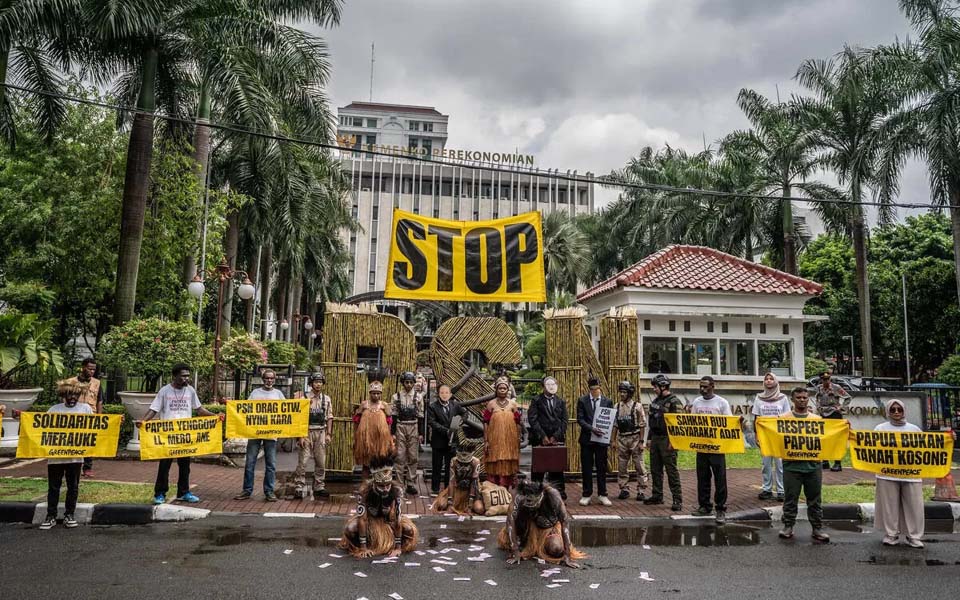
Esti Utami – On Thursday December 18 Greenpeace Indonesia held a creative peaceful action in front of the office of the Coordinating Ministry for Economic Affairs in Jakarta.
Through a theatrical performance, Greenpeace activists and a number of young Papuans articulated the struggle of indigenous peoples whose living areas have been stolen in the name of the Merauke sugarcane national strategic project (PSN).
The activists set up an art installation reading "STOP PSN" which was built using banners and recycled sugar cane stalks.
Activists who attended the action also brought banners with messages related to ending the PSN such as "Stop the Merauke PSN", "Save Forests, Stop Sugarcane" and "Papua is Not an Empty Land".
The action was held to reject massive deforestation in Merauke. Recently, this threat was clearly promoted by President Prabowo Subianto at a meeting in Jakarta to accelerate Papua's development on Tuesday December 16.
In front of the regional heads from throughout the land of Papua, Prabowo expressed his desire to expand oil palm, sugar cane and cassava plantations in Papua for the availability of fuel oil and bioethanol.
As reported on its official website, Greenpeace Indonesia called the President's discordant remarks ironic considering that parts of Sumatra Island are still crippled by the climate crisis and ecological disaster due to massive deforestation.
The impact of ecological disasters in western Indonesia apparently has not diminished the government's ambition to pursue false solutions that have the potential to sacrifice the natural landscape in eastern Indonesia.
Greenpeace Indonesia Forest Campaigner Belgis Habiba said that the Merauke Sugarcane PSN is currently the largest deforestation project in the world with the potential for enormous damage to key ecosystems in the southern Papua eco-region.
"We have just witnessed the massive impact of the climate crisis and ecological damage occurring in Sumatra due to massive deforestation carried out in the last few decades. A similar disaster has the potential to be very big for Papua, if the government still insists on pursuing its food and energy security ambitions by destroying nature", said Habiba.
Vincen Kwipalo, from the Yei indigenous community, who last week was summoned and underwent questioning as the reporter of alleged plantation crimes and the theft of the Kwipalo clan's traditional territory by the company PT MNM, also joined in the peaceful action.
Kwipalo highlighted that the government has stated it wanted to focus on development, but they do not look at the fate of the indigenous peoples who are evicted from their land.
"Where do they want us to go? The presence of companies in the village has also given rise to horizontal conflicts, but the government doesn't see that, right? The government only wants to pursue development without looking at the impact on us. What they call development from the government actually makes us indigenous peoples suffer", said Kwipalo.
The stories of Kwipalo and other Merauke residents affected by the PSN have been summarised in Greenpeace Indonesia's latest report entitled The Bitter Reality Behind the Sweet Promise of Merauke Sugarcane PSN, which was released this week.
In the report, Greenpeace discovered concessions covering an area of 560,000 hectares, or the size of the island of Bali, that the government had designated for a giant sugar cane plantation project in Merauke.
Out of this total concession area, 419,000 hectares is natural forest, while the remaining area is wetlands covering 83,000 hectares and savannah covering 34,000 hectares.
Greenpeace Indonesia Forest Campaigner Refki Saputra stated that this giant project, which is being promoted as a shortcut to self-sufficiency in sugar and renewable energy (E10 blended bioethanol fuel), is a fake solution.
"Pursuing the fulfilment of bioethanol from Merauke will actually encourage large-scale natural forest conversion. The ambition to pursue renewable energy will actually increase emissions and shift the focus away from improving farmers' sugar production", said Saputra.
"In short, PSN Sugarcane is a real form of the practice of political colonialism on empty land in Papua which exchanges biodiversity and the living space of indigenous peoples for bio-fuel", he asserted.
[Translated by James Balowski. The original title of the article was "Greenpeace bersama Masyarakat Adat Gelar Aksi Damai Mengkritik PSN Tebu di Merauke".]