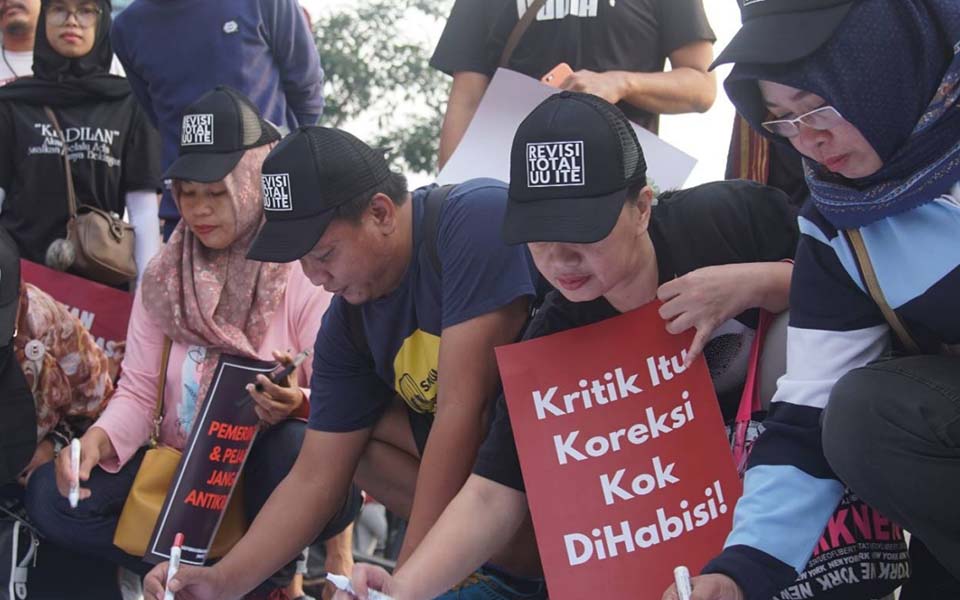


M Fathur Rohman, Jakarta – A Kamisan (Thursday) action was again held in front of the State Palace in Central Jakarta on Thursday January 15.
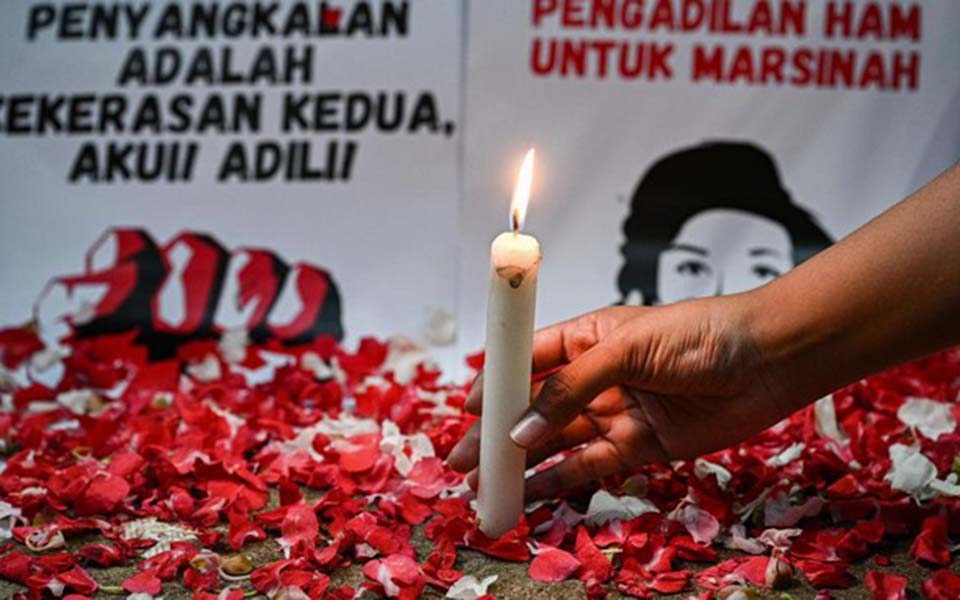
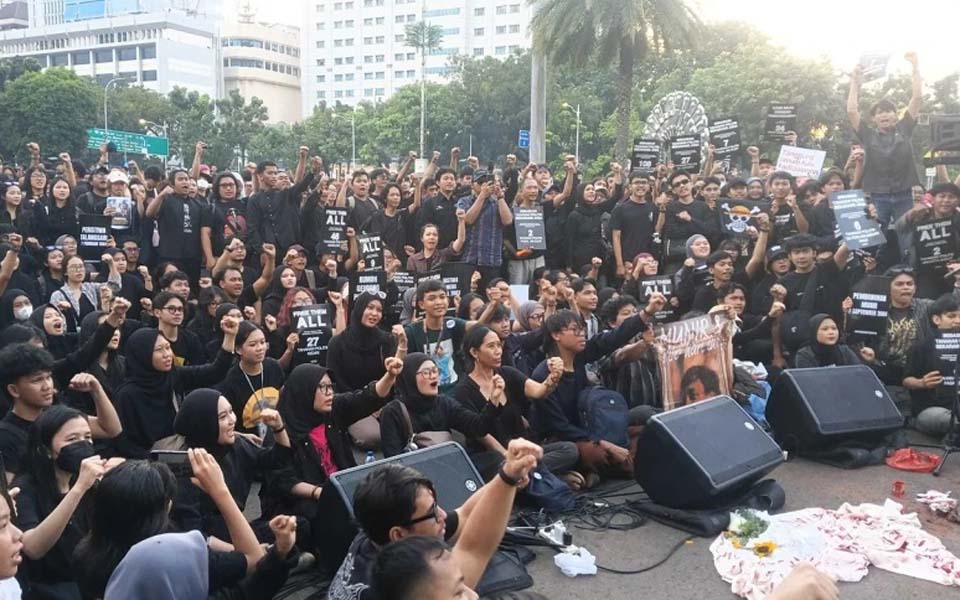
To commemorate the 19th anniversary of the Kamisan actions, civil society asserted its rejection of the normalisation of state violence, while at the same time strengthening demands for the resolution of human rights violations and an end to impunity.
Since its inception in 2007, Kamisan actions have become a collective memory for victims' families and civil society. The actions continues to remind the state of its constitutional obligation to resolve cases of gross human rights violations, and at the same time responding to various forms of violence, censorship and democratic regression that are considered to be recurring.
The 19th anniversary of Kamisan actions took place amidst increasing intimidation of activists and shrinking freedom of expression. One issue that emerged was the terror attack against Greenpeace Indonesia's Climate and Energy Campaign Manager Iqbal Damanik, who attended and spoke at the 893rd Kamisan action.
In a speech, Damanik revealed the terror and threats he has experienced recently. He emphasised that the intimidation not only targeted him personally, but was also experienced by other activists and public figures who frequently voiced criticism of government policies.
One form of terror highlighted was the delivery of headless chicken carcass, which Damanik reported to the National Police Criminal Investigation Directorate (Bareskrim Polri) on Wednesday January 14. Participants at the Kamisan action responded to this incident with a symbolic act of simultaneously shaking chicken rattles in the direction of the State Palace.
"We are never afraid of these chickens being sent. Let's make these chickens crow so the leaders listen. We will continue to speak out like roosters crowing every morning", Damanik declared to the protesters.
This symbolic act was intended as a form of resistance against terror and intimidation, as well as a satire on attempts to silence freedom of expression in the public sphere.
In addition to the issue of terror against activists, this Kamisan action was also marked by a strong statement by Amnesty International Indonesia Executive Director Usman Hamid who said that Indonesian democracy is experiencing a serious retreat.
"Indonesia has abandoned a democratic political system based on the people's participation, freedom of expression from the people. Therefore, we must close ranks, must consolidate, must unite our voices, the movement in various forms. There is also a pattern against women", said Hamid.
Hamid highlighted a pattern of repression that specifically targets women in protests and public expression. According to him, women are often positioned as if they don't have the right to express anger, criticism and unrest about socio-political and socio-economic situations.
"One of the most serious patterns of repression recently has been the targeting women. It's as if women are not allowed to participate in demonstrations, express themselves, declare their frustrations, their anger, frustration with the socio-political or socio-economic situation in Indonesia", he said.
He also touched on several cases of the criminalisation of women involved in protests, including the case of Laras Faizati and the wave of demonstrations in various regions that emerged in August last year in response to state violence and unjust policies.
"And what's more important again is the policies of the government and the DPR [House of Representatives]. It's impossible for the police, for example, to take to the streets or handle demonstrations if there aren't any demonstrations. And there can't be demonstrations if there aren't unfair policies", said Hamid.
According to Hamid, policies such as housing allowances for DPR members, budget cuts, tax increases and even land confiscation for national strategic projects (PSN) have exacerbated the sense of injustice among the public.
"So I think that justice has been lost in Indonesia", he said.
Hamid emphasised that silencing people under the pretext of criminal law must end. He believes that expressions of anger by citizens, including women, are not criminal acts.
"These statements may not be liked by some officials, [be seen as] inappropriate by some officials, but they are not criminal", he asserted.
He also warned of the dangers of criminalising ideas and restricting unauthorised demonstrations that contradict the democratic principles and the history of the nation's struggle.
"I was one of the formulators of these Kamisan actions, 19 years ago", he said.
Hamid said he hopes that the Kamisan actions will continue to serve as a space for political education, a vehicle to articulate public concerns and a source of hope amidst the community's fatigue with violence and injustice.
"Munir once said that we are all tired of violence. But Munir said the struggle to end it is not over", he concluded, referring to renowned human rights defender Munir Said Thalib who was assassinated in 2004.
[Translated by James Balowski. The original title of the article was "19 Tahun Aksi Kamisan, Masyarakat Sipil Tolak Normalisasi Kekerasan Negara".]