

Nadhifa Azkiya Hurin – "Long live the victims, don't be silent, fight!". A phrase that is presented at every Kamisan (Thursday) action in various different cities across Indonesia.
The phrase is not just a rallying cry, but rather a deep breath of resistance that is maintained so that memories do not fade and promises of justice continue to be met.
This week the Kamisan actions are celebrating their 19th anniversary. Victims, their families and even supporters remain loyal to the action. For Maria Catarina Sumarsih and other human rights activists, nearly two decades is certainly not a short time to fight for the principles of justice and human rights in this country. This long journey however is proof that the state has not yet fully resolve its responsibility for various past gross human rights violations.
For today's generation, the term Kamisan action may sound unfamiliar. Many are unaware of its background, demands or meaning. Despite this, the Kamisan action's consistency has never truly waned. It continues to be present, week after week, Thursday after Thursday, as a silent yet steadfast form of resistance.
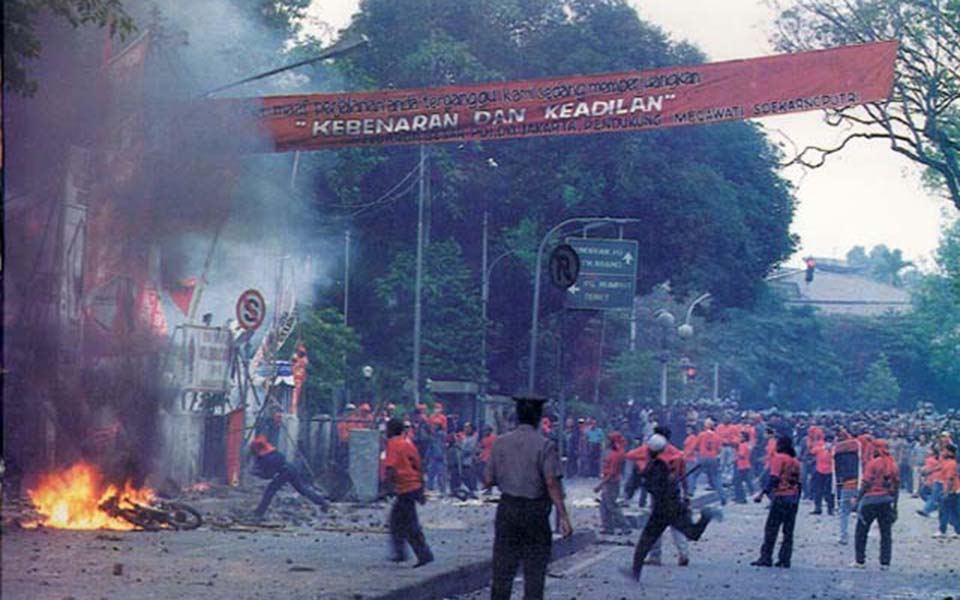
Kamisan actions are a demonstration held every Thursday in front of the State Palace by victims of human rights violations in Indonesia. They first began on January 18, 2007. From the outset, its primary demand was clear: to ask for state accountability for resolving gross human rights violations, such as the Trisakti Tragedy in 1998, the Semanggi I and II Tragedy in 1997-98, the May 13-15, 1998 Tragedy, the Tanjung Priok affair in 1984, the Talangsari incident in 1989 and various other cases that have yet to find justice.
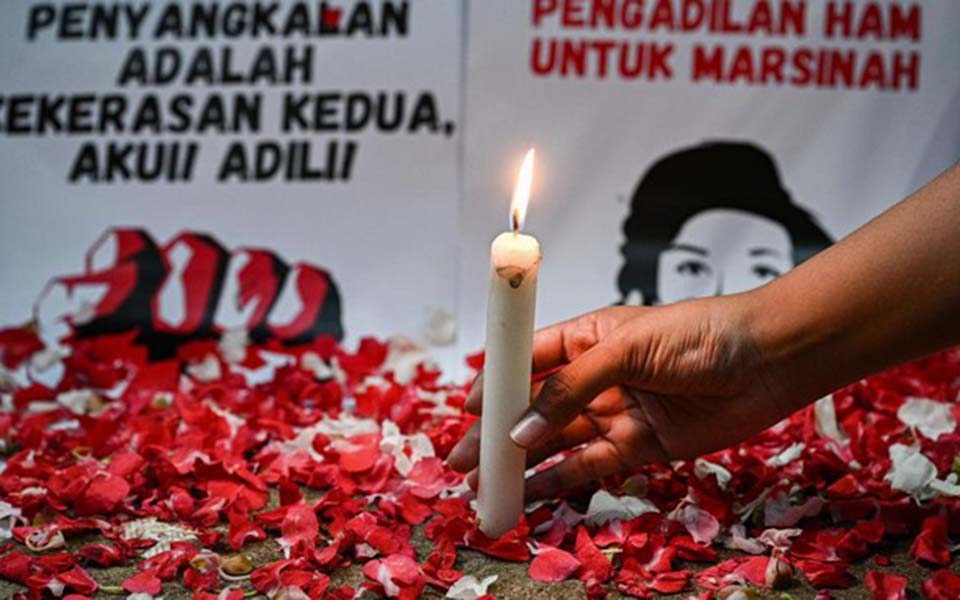
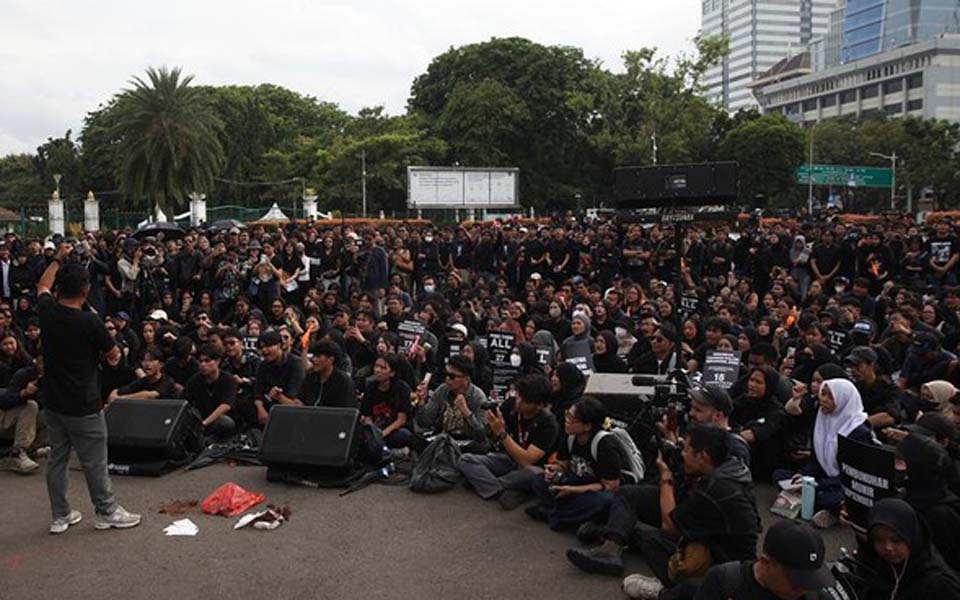
The Kamisan actions were spearheaded by three family members of victims of human rights violations during the New Order era of former president Suharto: Sumarsih, the mother of Bernardinus Realino Norma Irmawan, Suciwati, the wife of the late Munir Said Thalib, and Bedjo Untung, a family member of a victim of human rights violations against those accused of involvement with the Indonesian Communist Party (PKI) in 1965-66. From the start, the Kamisan actions were chosen as silent demonstrations. Participants wore all black and carried black umbrellas as a symbol of mourning, resistance and determination.
As of January 15, 2026, more than 800 Kamisan actions have been held. The actions no longer just take place in Jakarta, but have also grown, resonated and reverberated in various other cities such as Surabaya, Malang, Bandung, Semarang, Yogyakarta and Medan. This spread shows that the unrest and demands for justice for human rights violations are not confined to one city, but rather are a national issue felt across generations, transcending territorial boundaries.
The Kamisan actions and the figure of Ibu Sumarsih have also been immortalised in popular works. One such example was the song "Kamis" by Hindia or Baskara Putra, featured on the Doves mixtape, '25 on Blank Canvas. In the track, Ibu Sumarsih conveyed that the black colour she always wears at Kamisan actions is not just a symbol of grief for the victims' families, but also a symbol of determination. The powerful closing line, "Don't let there be only victims, but no perpetrators", reaffirms the long-standing demand for justice.
At the 893rd Kamisan action in front of the State Palace yesterday, Baskara Putra was also present in person. His presence is more than just moral support. It embodied a stance, a statement that human rights issues should not be taken lightly or distanced from the lives of the younger generation. Amidst popular culture often perceived as apolitical, the presence of public figures in spaces of struggle like this opens the door to broader dialogue.
The presence of young people at Kamisan actions indicates that this struggle is slowly finding its resonance again. The Kamisan actions are no longer merely understood as a space of mourning for victims, but also as a space for learning, a space for remembrance, and a space for the courage to not forget. Amidst the rapid flow of information and the tendency toward apathy often associated with today's generation, Kamisan actions stand as a reminder that justice never comes automatically, it must be continually demanded.
For 19 years, Kamisan actions have proven that silence does not mean surrender. Instead, it represents a consistent, calm and dignified form of resistance. The black umbrellas, black clothing and recurring presence every Thursday symbolises an unwavering commitment that historical wounds cannot be healed by time, let alone erased without accountability.
Ultimately, Kamisan actions no longer belong solely to the victims and their families. They belong to the public, to today's generation and to the future. As long as the state fails to fully fulfil its responsibility for gross human rights violations, the Kamisan actions will continue to be present – a voice reminding us that justice delayed is injustice itself.
[Translated by James Balowski. The original title of the article was "Menyapa Peringatan 19 Tahun Aksi Kamisan".]