

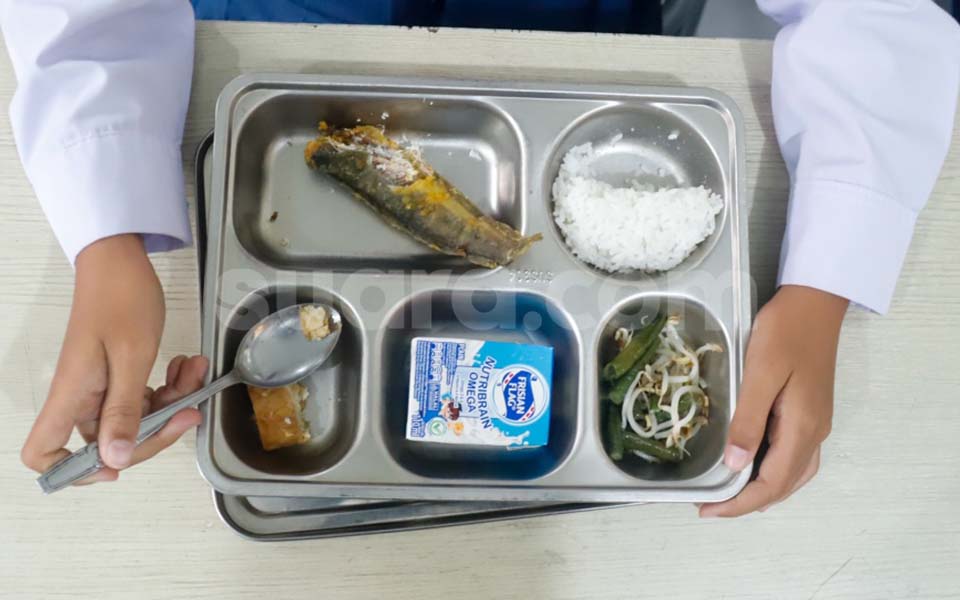
Bangun Santoso Novian Ardiansyah – Public satisfaction with the Free Nutritious Meals (MBG) program has declined. According to a survey conducted by Saiful Mujani Research and Consulting (SMRC) from July 5-19, the majority of the public expressed dissatisfaction with the program. Only 33.8 percent were very satisfied or somewhat satisfied.
SMRC Executive Director Deni Irvani reported that public awareness of the MBG program in July 2026 reached 95.4 percent. This figure remained relatively unchanged from the November 2025 survey, which stood at 95 percent.
"So, relatively it's unchanged. Almost everyone is already aware of this program", Irvani said while presenting the survey results on the SMRCTV YouTube channel on Tuesday July 28.
According to Irvani, it's understandable that the government's flagship program is so well known, considering that President Prabowo Subianto has been promoting it since his presidential election campaign.
"Yes, the National Nutrition Agency (BGN) was formed before Prabowo's inauguration [in October 2024], during [former president] Jokowi's [Joko Widodo] administration. So it's natural that its popularity and recognition are very high", said Irvani.
Of the 95.4 percent of people who were aware of the MBG program, SMRC asked them about their level of satisfaction with it.
The results showed that 6.2 percent were very satisfied, 27.6 percent were somewhat satisfied, 31 percent were less satisfied, 30.6 percent were not satisfied at all and 4.6 percent had no opinion.
Irvani simplified this into two categories: 33.8 percent who were very or somewhat satisfied, while 61.6 percent who were less or not satisfied at all.
"Meaning, the majority of people who are aware of this program feel less or less satisfied with the implementation of the MBG program. So, it's interesting. It's very popular, but in terms of evaluation, I think public sentiment toward the MBG program is relatively less positive or negative", Irvani said.
Yet SMRC noted that based on the results of a November 2025 poll, public assessment of the MBG program was very positive, with a majority of 62.5 percent stating they were either very or somewhat satisfied.
Currently, public assessment of the MBG program has reversed. In July 2025, the majority of the public is actually dissatisfied.
"Conversely, the proportion of those dissatisfied actually increasing to 61.6 percent. So now the majority is dissatisfied, while those who are very or somewhat satisfied have a positive attitude towards the implementation of the MBG, decreasing from 62.5 percent to 33.8 percent. This is interesting because if we look at the difference in the change from 62.5 percent to 33.8 percent, that's a change of approximately 29 percent", said Irvani.
SMRC researcher Saidiman Ahmad said the decline in public satisfaction with the MBG program is similar to the decline in public satisfaction with President Prabowo's performance in general.
In November 2025, the level of public satisfaction with Prabowo's performance reached 81.2 percent. But within nine months, by July 2026, his approval rating dropped 30 percent to 51.1 percent.
"This also appears to be a similar decline in the president's approval rating, more or less the same as the decline in approval for the implementation of the MBG program", Irvani said in response to Ahmad's remarks.
Reasons for decline
Irvani revealed several factors contributed to the decline in public satisfaction with the MBG program. One of these is related to the corruption case that implicated three leaders of the BGN, including former chairperson Dadan Hindayana.
"I think that also greatly influenced how the public views it. Furthermore, the management of the MBG program has been widely reported as having problems, whether it be poisoning cases, for example. I think that's still a common occurrence", said Irvani.
Survey method
The survey, conducted from July 5-19, used Indonesian citizens eligible to vote in the general election as the population, namely those aged 17 or older or married at the time of the survey.
The population was divided into two groups or subpopulations: Indonesian citizens eligible to vote and who own mobile phones, and Indonesian citizens eligible to vote but do not own mobile phones.
A random sample was selected for each subpopulation. In the subpopulation of cell phone owners, a sample of 605 people was randomly selected using a double sampling method, and respondents were interviewed by telephone.
In the subpopulation without cell phones, a sample of 144 people was randomly selected using a stratified multistage random sampling method, and respondents were interviewed face-to-face.
"So we used a multi-mode or dual mode in this survey. Why? Because within that population, it turns out that around 80 percent of residents use cell phones, while the remaining 20 percent don't. And for efficiency, we conducted a telephone survey to cover around 80 percent", said Irvani.
"Now, then we approached the remaining people who don't have cell phones, conducting a face-to-face survey so that the sample could represent the entire population", Irvani continued.
The survey's margin of error is estimated to be around 3.7 percent with a 95 percent level of confidence.
[Translated by James Balowski. The original title of the article was "Survei SMRC: Popularitas MBG Tinggi, Tapi Kepuasan Publik Merosot".]