

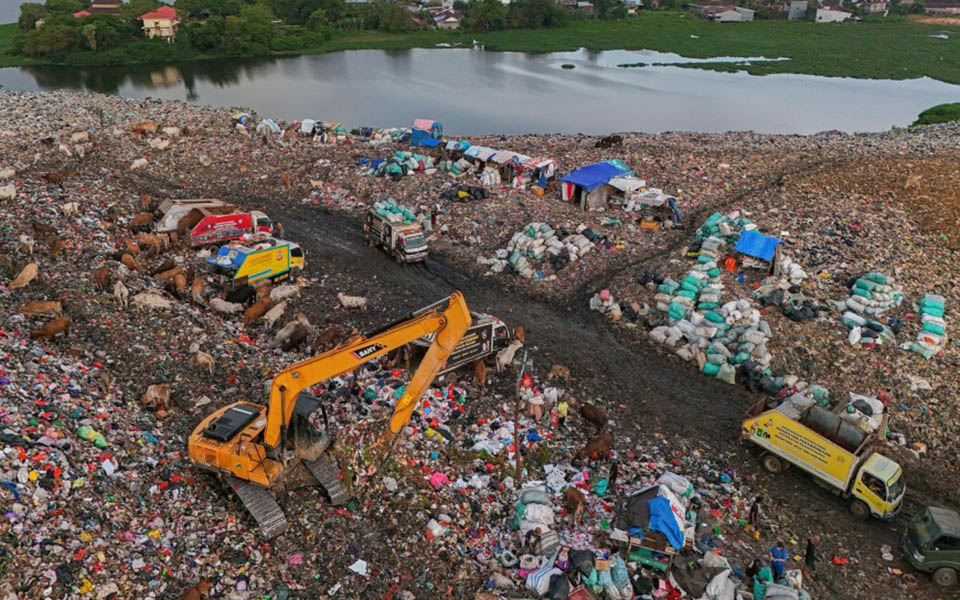
Chairunisa – The government plans to build 33 Waste to Electrical Energy (PSEL) processing facilities with an investment value of 89 trillion rupiah, which is the concern of the Indonesian Forum for the Environment (Walhi).
Walhi believes that government policies have not addressed the root of the problem regarding the waste crisis in Indonesia.
According to the environmental organisation, the government tends to focus on building large-scale waste processing facilities rather than improving the waste reduction system from upstream.
Walhi national urban justice campaigner Wahyu Eka Styawan said that the development of PSELs should not make the government ignore the problems of production and consumption which are sources of waste generation.
"In fact by accelerating the development of PSELs, the government is ignoring upstream waste, both production and consumption", he said.
According to Styawan, this policy risks making the waste management system in Indonesia rely solely on large-scale processing facilities which require high costs.
On the other hand, the problems that cause waste generation, such as the use of single-use plastic and weak reuse systems, have not been resolved optimally.
Walhi also highlighted the non-optimal application of producer responsibility or Extended Producer Responsibility (EPR). Yet, producers need to participate in monitoring, in other words being responsible for the waste that comes from the products and packaging produced.
Walhi highlights budget priorities
Styawan also questioned the reasons behind the government allocating large investments for PSEL development when the reduction and sorting of waste from upstream to date still needs strengthening.
"The government keeps saying that waste reduction and sorting must be strengthened. If so, why is this 89 trillion rupiah not being prioritised to build a waste management system at the source?", he asserted.
Styawan sees that the main problem with waste management in Indonesia as not simply a lack of access to processing technology such as PSEL or Refused Derived Fuel (RDF). In fact, the problem is more fundamental, such as the fragility of the waste reduction system.
Apart from environmental issues, Walhi also questions the financial consequences of the PSEL project.
Through the scheme highlighted by this organization, the state electricity company PT PLN is required to buy electricity produced by PSEL with a take or pay mechanism of around USD 0.20 per kWh or the equivalent of 3,200-3,500 rupiah per kWh for 30 years.
With this scheme, according to the environmental organisations, it the potential to create a difference between the purchase price of electricity from PSEL and the cost of providing electricity in the national electricity system.
As an illustration, one PSEL facility with a capacity of 36 MW is projected to cause a financial burden of around 454 billion rupiah per year.
Moreover if it lasts for the 30 year contract period, the value is predicted to reach around 13.6 trillion rupiah. This figure is much larger than the predicted initial investment for a PSEL project, which is around 3 trillion rupiah.
Strengthening upstream management
Walhi is also questioning the form of transparency regarding the total costs that must be borne by the state while the PSEL project is operating.
Wahyu said the government needs to explain the parties who will bear the long-term financial risks of the project.
"Don't let these costs add to the burden on PLN and ultimately become a burden on the APBN [state budget], so that tax money is burned in vain, of course the public will suffer losses", said Styawan.
Instead of prioritising the construction of large-scale waste processing facilities, Walhi is pushing for the budget be used to strengthen upstream waste management.
This includes building waste sorting infrastructure, composting and biodigester facilities, strengthening waste banks and improving organic waste transportation and processing services.
The organisation does not forget to push for increased welfare and capacity of waste sector workers, the provision of incentives to encourage reuse systems and to implement producer responsibility more effectively and as a solution.
Thus, Styawan emphasised that the construction of waste processing facilities will not be enough if the source of reducing waste from its source has not been addressed optimally.
"Without improving governance from the upstream, PSEL development will not solve the root of the waste problem, but has the potential to increase the burden on state finances in the long term", concluded Styawan as quoted on the official Walhi website on Monday September 28.
- The full Walhi statement in Bahasa Indonesia can be read here: https://www.walhi.or.id/89-triliun-untuk-33-psel-pemerintah-abaikan-akar-krisis-sampah
[Translated by James Balowski. The original title of the article was "Pemerintah Siapkan Rp89 triliun untuk 33 PSEL, WALHI Pertanyakan Prioritas Pengelolaan Sampah".]