

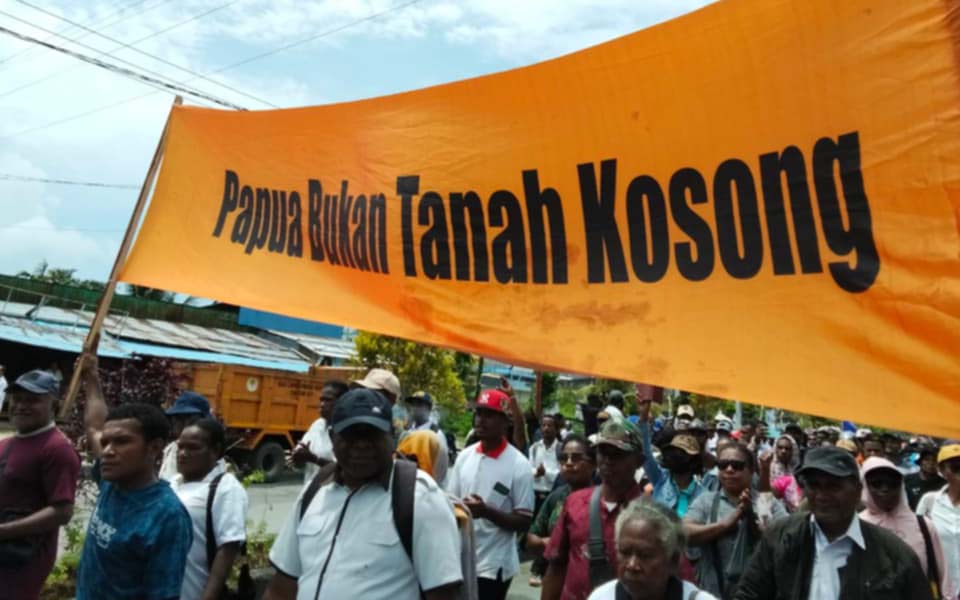
Jayapura – In response to diplomatic developments in the Pacific region, a coalition of Papuan civil society organisations has issued a joint statement urging the Indonesian government to immediately grant independent, safe and unconditional access for international monitoring in the Land of Papua.
This statement was in response to several important regional and international developments, including decisions made by the Melanesian Spearhead Group (MSG) caucus in Koror, Palau; the communique from the 55th Pacific Islands Forum (PIF) Leaders' Meeting; and statements made by Pacific leaders during the 81st Session of the United Nations General Assembly (UNGA) in September.
The coalition, which comprises indigenous organisations, human rights institutions, church groups, human rights defenders and women's groups, asserted that this attention must be followed by concrete steps to protect civil society, guarantee humanitarian access and ensure accountability for human rights violations in Papua.
The Coalition expressed its appreciation to the governments of the Solomon Islands, the Republic of Vanuatu and the Republic of the Marshall Islands for their consistent efforts in bringing the human rights and humanitarian situation in Papua to the regional and international stage. The coalition urged the Indonesian government to respond to these concerns openly and constructively through tangible actions, rather than mere diplomatic statements.
"As a member of the MSG and a dialogue partner of the PIF, Indonesia bears a moral, legal, and diplomatic responsibility to respond to these regional concerns in an open and accountable manner. Commitment to human rights must be demonstrated through concrete action on the ground in the Land of Papua", stated ELSHAM Papua Director Paul Mambrasar in a press release on Saturday October 17.
Worsening displacement, threats to indigenous land
The Coalition highlighted the deteriorating human rights and security situation in Papua as a consequence of ongoing military operations and armed conflicts. Since 2018, more than 127,031 civilians have reportedly been forced to flee their homes. This situation has given rise to a humanitarian crisis that demands an immediate response, adequate protection, and sustainable solutions.
"Internally displaced persons continue to face limited access to healthcare, decent housing, food, and education. The Indonesian government must urgently ensure the provision of humanitarian aid, protect the displaced, and secure solutions that are safe, voluntary, and dignified including the right for these individuals to return to their home communities once conditions allow", stated Rutina Labene from the Human Rights Study Centre at the Walter Post School of Theology (STT Walter Post) of the Kingmi Papua Church (a member of the Papuan Council of Churches, PCC).
Aside from the refugee crisis, the Coalition has expressed concern over the expansion of National Strategic Projects (PSN) and large-scale extractive investments, which threaten indigenous territories, forests and the livelihoods of local communities particularly in South Papua. The coalition believes that development must not come at the cost of indigenous rights, increased militarisation or result in the dispossession of people s living spaces without their free, prior and informed consent.
"The expansion of PSNs and extractive investments that disregard the rights of Indigenous peoples threaten the survival of the Malind, Yeinan, Awyu and Muyu indigenous communities as well as all across South Papua. We urge an end to military expansion, the withdrawal of non-organic troops from residential areas, and the suspension of any PSN projects that threaten or seize indigenous lands without meaningful consultation and respect for the rights of Indigenous peoples", stated Beatrix Gebze of the Women s Advocacy Institute (eL_AdPPer) in Merauke.
Demanding consistency in human rights
Indonesia's commitment to human rights on the international stage must be tangibly reflected in its domestic policies and practices, including in Papua. Indonesia's membership in the UN Human Rights Council for the 2024-2026 term must be accompanied by concrete steps to prevent human rights violations, protect civil society and ensure the enforcement of the law and accountability for any violations that occur.
"Indonesia cannot demand respect for human rights globally while disregarding these same principles in Papua. Intimidation, arbitrary surveillance, and the criminalisation of human rights defenders, journalists, and indigenous leaders must cease. Alleged gross human rights violations must be investigated through an independent, transparent, and credible process", stated Gustaf Kawer SH, a human rights advocate and head of the Papua Association of Human Rights Advocates (PAHAM Papua).
Independent international monitoring is essential for building trust, ensuring openness and allowing the situation in Papua to be assessed objectively based on the actual conditions on the ground. Therefore, the Indonesian government must immediately grant safe, unimpeded and unconditional access to relevant international monitoring mechanisms.
"Providing unimpeded and unconditional access to the Office of the UN High Commissioner for Human Rights (OHCHR), UN Special Rapporteurs, the joint mission from the PIF-MSG, as well as independent international media, does not constitute a threat to national sovereignty. In fact openness is a vital step toward building transparency, strengthening accountability, and restoring international trust", said Apolos Sroyer, a representative of the Papuan Indigenous Council (DAP) and the Kankain Karkara Byak.
Rejecting ceremonial responses, urging Inclusive dialogue
The Coalition emphasised that international attention toward Papua must not be met merely with diplomatic statements or public relations campaigns, without of concrete steps and tangible change on the ground. Resolving the conflict requires the political courage to address the root causes and to open a space for genuine, inclusive and meaningful dialogue with representatives of the Papuan people.
"Sustainable peace requires a genuine, inclusive and meaningful political dialogue with representatives of the Papuan people. This process must involve indigenous communities, church leaders, civil society, political actors, women, and youth, and it must be directed toward resolving the root causes of the conflict. We reject ceremonial responses that create the impression that the humanitarian crisis in Papua has ended, while the suffering of the people continues", stated Leonardo Ijie, a human rights advocate from the Kaki Abu Sorong Legal Aid Foundation (LBH).
The Coalition asserted that resolving the conflict is inseparable from the state's obligation to uncover the truth and uphold justice for victims, survivors of violence and their families. The state must conduct a thorough investigation into alleged human rights violations, identify and prosecute the perpetrators through fair legal proceedings, ensure redress for victims and take concrete measures to prevent the recurrence of similar violations. Without the disclosure of truth and genuine accountability, impunity will persist, and the rights of victims and their families will remain neglected.
"The state is obligated to thoroughly investigate alleged human rights violations and ensure that the perpetrators are held accountable through a fair legal process. We the victims and their families have a right to truth, justice, and reparation. There must be no impunity, no turning a blind eye, and no human rights violation left without accountability!", stated Tineke Rumkabu, coordinator of United for Truth (BuK), an organisation for victims and survivors in Papua.
Samuel Awom from the Papua Commission for Missing Persons and Victims of Violence (Kontras Papua) emphasised, "We, the civil society of the Land of Papua, are prepared to welcome a visit from the OHCHR and a delegation from Pacific nations, so that they may meet directly with victims and survivors of human rights violations and hear the voices of the Papuan people and Indigenous communities".
The joint statement was initiated by a coalition of 10 civil society organisations in the Land of Papua: the Papua Institute for Human Rights Studies and Advocacy (ELSHAM Papua), PAHAM Papua, BuK, the PCC, LBH Kaki Abu Sorong, Kontras Papua, KEWITA, PWG, eL_AdPPer Merauke and the Justice, Peace and Integrity of Creation (KPKC) division of the Evangelical Christian Church (GKI) in the Land of Papua.
It is also fully supported by 16 networks focused on human rights, the environment and humanitarian issues, including the Papua Indonesian Forum for the Environment (Walhi Papua), the Manokwari Legal Aid Assessment, Research and Development Institute (LP3BH Manokwari), the NGO Cooperative Forum (Foker LSM Papua), the Franciscan Papua Commission for Justice, Peace and Integrity of Creation (JPIC), the Papua People's Democratic Movement (Garda-P), the Papuan People's Liberation Movement (GempaR), the West Papua National Authority (WPNA), the East Mimika Concern Foundation (LEPEMAWI Timika), LBH Papua Merauke, the Justice, Peace and Integrity of Creation Desk of the Papuan St Augustinian Order (JPIC-OSA), the Papua Justice and Human Integrity Foundation (YKKMP) and independent women human rights defenders.
[Translated by James Balowski. The original title of the article was "Koalisi Masyarakat Sipil Papua Desak Akses Tanpa Syarat bagi Utusan PBB dan Pasifik".]