

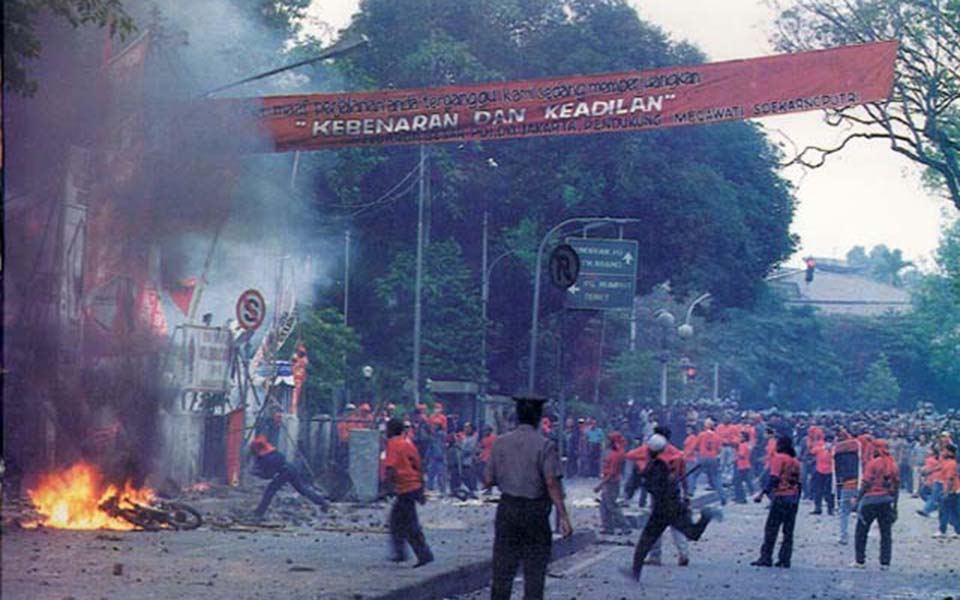
Responding to the 30th anniversary of the July 27th attack today, Amnesty International Indonesia Executive Director, Usman Hamid, said:
"Exactly three decades have passed, but to this day the state has not yet brought justice to the victims and their families for this dark tragedy. This is despite new evidence indicating the location of the unidentified graves of the victims of Kudatuli (Kerusuhan 27 Juli 1996, as the incident is known).
Yet the state appears to prefer maintaining impunity to thoroughly investigating this past gross human rights violation. The attack on the Indonesian Democratic Party (PDI) Central Leadership Board (DPP) office at Jalan Diponegoro No. 58 in Jakarta 30 years ago, is a dark historical legacy that marks the repression of the New Order era (of former president Suharto).
The National Human Rights Commission (Komnas HAM) concluded that there were six gross human rights violations, including violations of freedom of assembly and association, freedom from fear, freedom from cruel treatment and violations of the protection of life and property.
Ironically however, for 30 years, the state's lack of political will has continued to act as a shield for the human rights violators in this case. The interconnection of jurisdictions trials held from 2002 to 2003 failed to shed light on this case. The process only touched the field operators such as a civilian being convicted of throwing stones, while military officers were instead acquitted.
The state's half-hearted legal process failed to provide justice for the victims and their families, but instead demonstrated systemic impunity. Consequently, the law failed to address the intellectual actors behind the scenes, so that it now leaves big questions about who the masterminds behind this bloody tragedy are.
"Komnas HAM must immediately conduct a pro-justice investigation, as mandated by Law Number 26/2000 on Human Rights Courts, in a transparent manner and publish its progress to the public. Investigations into the graves of unidentified victims of the 1996 riots could provide key or new evidence confirming the existence of victims beyond the official data. Furthermore, the DPR [House of Representatives] must also play a role by immediately proposing an ad hoc Human Rights Court for the July 27, 1996, cases."
We fear that allowing this case to remain unresolved is tantamount to allowing the state to perpetuate impunity and deliberately denying justice to the victims. The state's failure to thoroughly investigate and bring the perpetrators to justice in this case will set a bad precedent, demonstrating Indonesia's weak commitment to human rights. As long as justice is not upheld, the state's respect for human rights in this country will remain an illusion and the people will remain vulnerable to similar repression in the future.
Background
The July 27, 1996, incident was marked by an attack on the PDI central leadership board offices at Jalan Diponegoro No. 58 in Jakarta. At the time, the PDI DPP office, controlled by supporters of Megawati Sukarnoputri (the party's general chairperson based on the results of the 1993 Surabaya congress), was stormed by supporters of Soerjadi (the general chairperson based on the results of the 1996 Medan congress), supported by hundreds of police officers, according to a report compiled by Amnesty International.
The 30-year anniversary of the incident was commemorated with several events, including a historical exhibition and photo archive at Taman Ismail Marzuki Arts Centre in Jakarta, including photos showing the unidentified graves of victims of the July 27, 1996, riots.
Amnesty International published a report on the attack on July 30, 1996, three days after the incident. In its initial report, Amnesty International collected data showing that between 206 and 241 people were arrested by security forces following the attack. At least 90 people were injured and between five and seven were reported dead. According to the report, the PDI claimed that 28 people were still unaccounted for, not including those hospitalised, detained or in hiding.
A Komnas HAM investigation meanwhile revealed five deaths, 149 injuries and 23 missing. Komnas HAM also said that six forms of human rights violations occurred in the case, namely violations of the freedom of assembly and association, freedom from fear, freedom from cruel and inhumane treatment, protection of life and protection of property.
Throughout 2002-2003, the government held an interconnection of jurisdictions trial over the attack. The court however only presented defendants responsible for the incident.
According to media reports, the court was only able to convict a civilian named Jonathan Marpaung for mobilising a crowd and throwing stones at the PDI office. He was sentenced to two months and 10 days in prison. Meanwhile, the two military officers who were tried, namely Budi Purnama and Suharto, were acquitted.
[Translated by James Balowski. The original title of the article was "30 Tahun Tragedi Kudatuli: Komnas HAM harus buka penyelidikan projustisia".]