


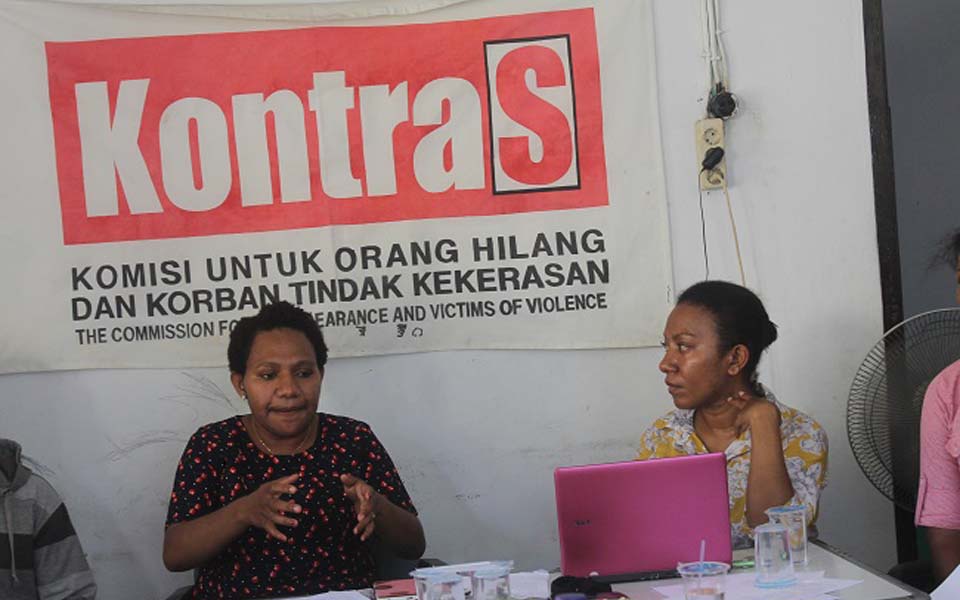
Andi Saputra, Jakarta – The Commission for Missing Persons and Victims of Violence (Kontras) says that human rights violations in Papua are still high. These violations represent a threat to civil freedoms and discriminate against the Papuan people’s identity.
Documents containing the term 'Jubi'
Displaying 141-147 of 147 documents
News/West Papua
Kompas – January 18, 2010
Jakarta – Acts of violence and human rights violations in Papua have continued throughout 2009. This situation has further complicated efforts to resolve various problems in Papua through dialogue, as desired by the majority of Papuan people.

News/Indonesia
Kompas – May 19, 2006
Solo, Kompas – The disagreement between the progressive-revolutionary forces that exist in Indonesia must be ended immediately. If not, these forces will be unable to weave together the cooperation needed to generate the energy to withstand the entry of neoliberalism into Indonesia that is becoming increasingly pervasive and visible.
News/West Papua
Kompas – May 14, 2005
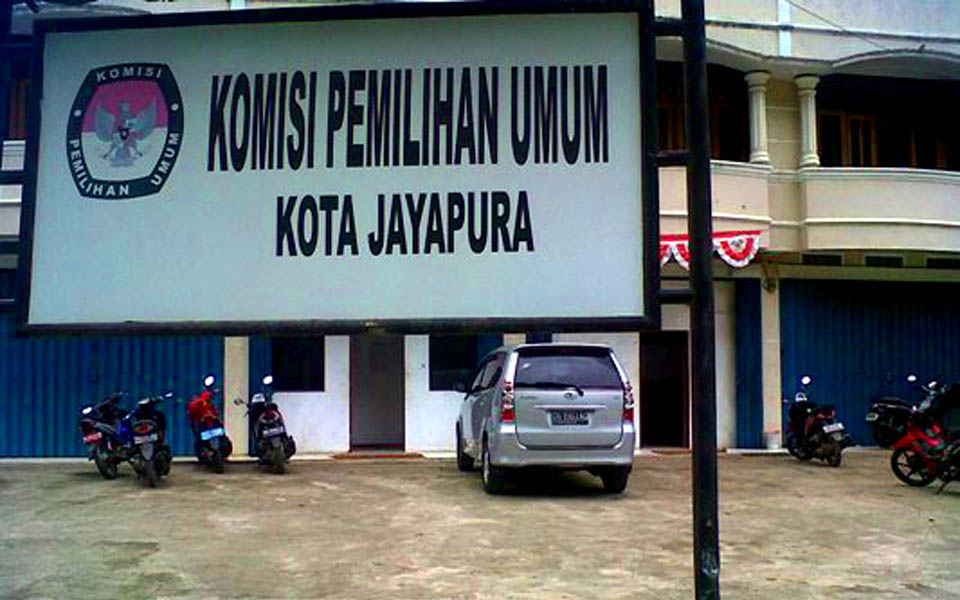
Jayapura – A number of political parties in Papua have established a tariff for anyone wishing to nominate themselves as a regent, deputy-regent, mayor or deputy-mayor. The provision is an internal party matter so the amount of the tariff will vary, as there are no precise regulations on the illegal collection of money by political parties.
News/West Papua
Detik.com – May 19, 2004
Suwarjono, Jakarta – Opposition to presidential and vice-presidential candidates from the military are surfacing again. A coalition of West Papuan non-government organisations (NGOs) say that presidential candidates with a military background will make it difficult to uphold values of human rights in Indonesia.

News/Indonesia
Fpdra.com – April 17, 2004
M. Ilham, Jakarta – According to the government the elections in West Papua were a success, however for the people of Papua this cannot be said to be true, moreover as many as 70,000 Papuan people were not registered to vote. Identification cards are not longer used at polling stations [voters must have a separate voter registration card].

News/West Papua
Kompas – January 8, 2004
Jayapura – Two years after the implementation of the Law on Special Autonomy in West Papua, the level of human rights violations remains high. There has been no commitment from any parties to apply the Law on Special Autonomy consistently. Rather, this law is seen as disrupting the Unitary State of the Republic of Indonesia (NKRI).