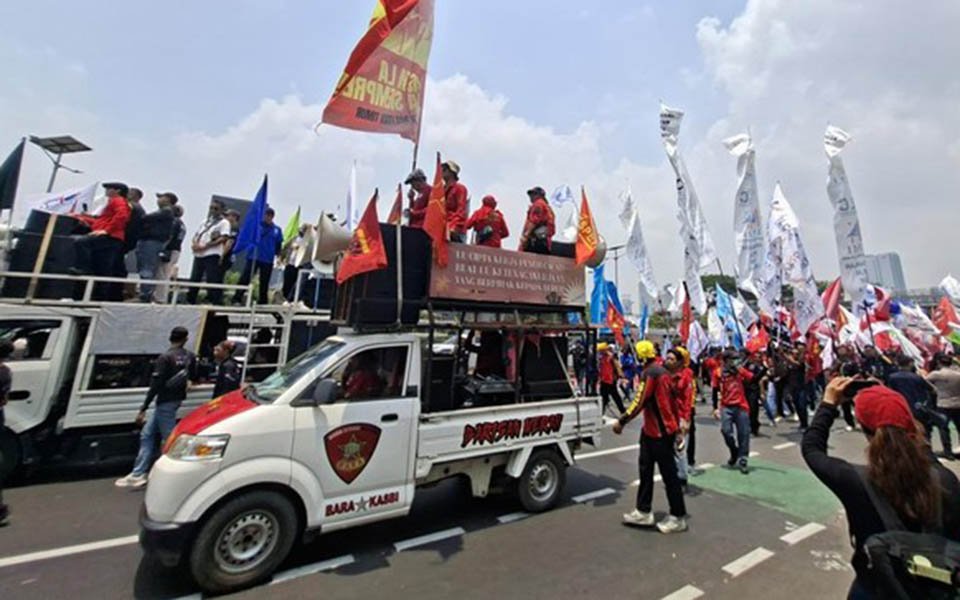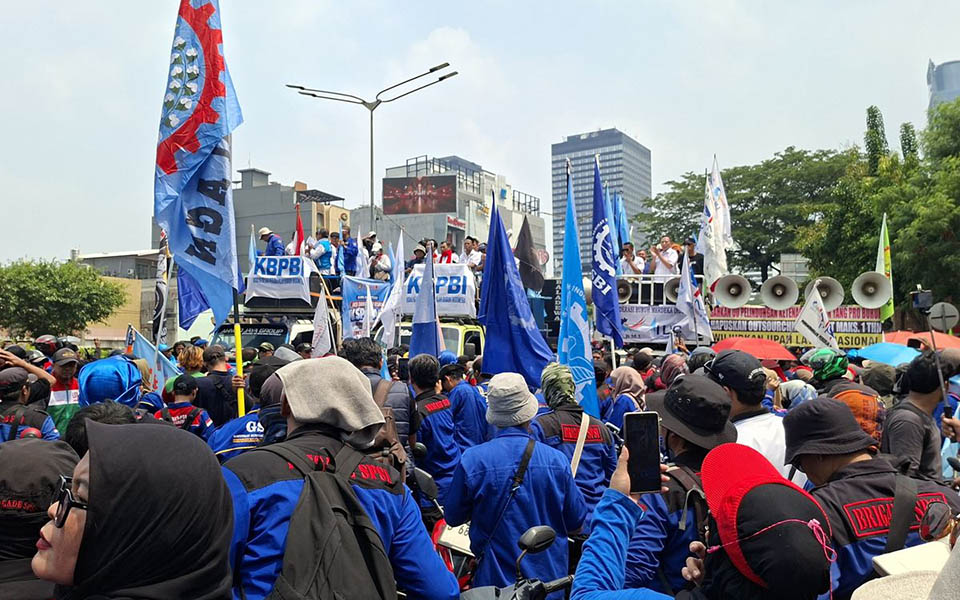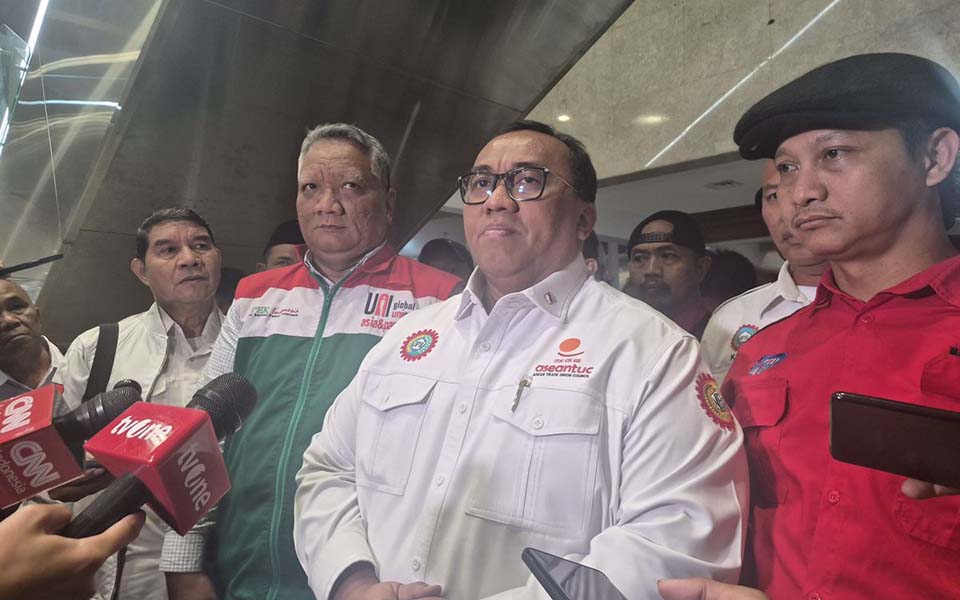


Jakarta – Labour Party Secretary General Ferri Nuzarli and around 1.3 million members and administrators of the Indonesian People's Organization (ORI) – a political wing of the Confederation of the All Indonesian Trade Unions (KSPSI) led by Andi Gani Nena Wea – have resigned from the party.
Nuzarli Ferri claimed that there were differences of opinion regarding the direction of the party's struggle. The decision by Ferri and his members and administrators to leave did not come long after Labour Party President Said Iqbal entered the circles of power.
Iqbal now serves as a the Presidential Special Advisor on Labour and Workers' Welfare, after waiting for many years for such a position.
Iqbal is not concerned about the decision by Nuzarli and the other members saying that said the resignation of cadres from political parties was a common thing.
"Regarding my friend's claim, I have no comment, especially regarding the 1.3 million members", Iqbal told CNN Indonesia on Saturday evening June 27.
Nuzarli's resignation also put the Labour Party back in the spotlight. The party had its debut in the 2024 elections, but then failed to win a seat as a member of the House of Representatives (DPR) and stroll into Senayan, as the parliament is known.
The Labour Party's share of the national valid vote was only 972,910 votes or 0.64 percent, so it did not meet the parliamentary threshold of 4 percent.
Quoting from the official Labour Party website, the party was reestablished by founders who came from the four largest trade union confederations and 50 national level trade union federations, teacher and honorary staff forums, and farmer and fisher organisations.
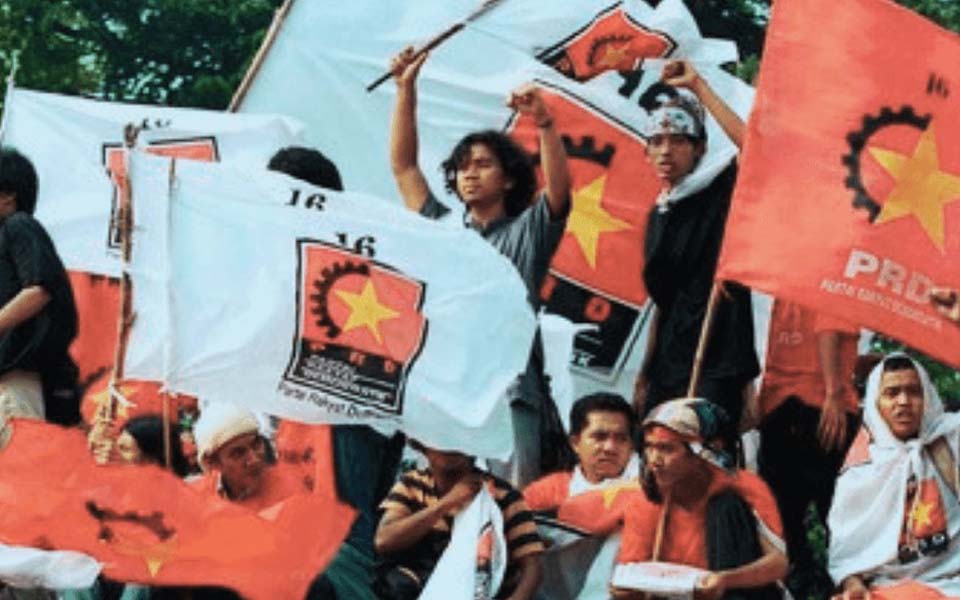
The Labour Party does indeed have a background that is less than flashy in Indonesia, especially in the election arena. In the 2004 legislative elections, the Social Democratic Labour Party under the leadership of long-time labour activist Muchtar Pakpahan participated in the election. However, they also failed to get into parliament at that time.
Coopted by the oligarchy
Centre for Indonesian Governance and Development Policy (CIGDEP) co-founder Cusdiawan believes that the Labour Party's gloomy footsteps cannot be separated from the context of the political-economic structure and historical legacy of the New Order regime of former president Suharto.
He believes that workers have suffered a depoliticisation and have only become subordinates in the rhetoric of economic development campaigned by the state, and on the other hand are more in the vortex of oligarchic competition.
Cusdiawan says that in the sociological category, workers do indeed have a strong social base. However, they have not become a significant political force in the political arena in Indonesia.
"Workers are experiencing depoliticisation, that is, they are separated from the traditions of class politics and have only become subordinates in business and state interests", Cusdiawan told CNN Indonesia on Monday June 29.
Cusdiawan said that it is this that is the root of why workers' social power has not been converted into political power, including failing to be represented in the formal-institutional political arena.
Cusdiawan also said that as a continuation of this historical structural problem, labour as a sociological category has never really been a political subject, including in each legislative election contestation that has taken place.
Without class awareness and politics, workers are fragmented into pockets of other identities. Aside from this, weak institutional capacity stemming from class politics also makes it easier for the oligarchic elite to co-opt labour organisations.
Cusdiawan said that in the end workers only end up in the vortex of competition between the interests of the elite and oligarchs whose votes are contested, including each time an election takes place.
"It is here that workers do not really become political subjects. Although changes at the surface level as a consequence of workers' demands can be seen, but these are not changes in a more structural or deep-rooted context", he said.
In addition to this, Cusdiawan also has a view as to why the Labour Party tends to "fail" when participating in elections.
He is of the view that in this era, voter preferences in elections are not based on social class. Even if so, that factor is not a determining one.
"This is also what I think is a factor in the failure of the Labour Party in every election", he said.
Movement fragmentation
Separately, the Trias Politika Strategis Executive Director Agung Baskoro touched on the fragmentation of the movements within the Labour Party, which has many organisations and groups.
"Because a good party can bring together various organisational factions, so that it can create a strong structure to make the party continue to grow and develop over time", said Baskoro.
Then, Baskoro also said that the majority of political parties in Indonesia have a large vote-getting niche when it comes to identity, ethnicity religion or race.
Conversely, he said, the Labour Party is closely aligned with professional groups, so the niche is getting smaller.
"Moreover we know that our workers, the Indonesian population have quite a lot of informal jobs in the agricultural sector, then fisheries, then plantations, the informal sector more or less has no affiliation with the industrial sector", he said.
Aside from this, he also believes that there is a lack of charismatic figures in the Labour Party itself. According to Baskoro the party needs a strong figure or figures. However, he did not see this from the Labour Party.
"So that when the pileg [legislative elections] take place, the public will find that in each dapil [electoral district], they have labour figures who are relevant to their needs and interests", he said. (fra/mnf/fra)
[Translated by James Balowski. The original title of the article was "Partai Buruh di Indonesia Minim Kesadaran Kelas, Dikooptasi Oligarki".]