

Norbertus Arya Dwiangga Martiar, Jakarta – After being held in the East Java city of Yogyakarta, a National Consolidation of the Republic Conference or Konsolnas KR has also been held in Jakarta.
Despite initial challenges, the event served as a platform for civil society organisations and individuals from various backgrounds to develop ideas for the betterment of the Republic of Indonesia. The forum also discussed the platform, design and pioneering leadership for the Konsolnas KR in the Jakarta area.
Initially, the Konsolnas KR was scheduled to be held at the University of Indonesia (UI) Salemba Campus in Jakarta. As of Saturday (June 27), there had been no changes from the campus. On Saturday evening however, security officers halted preparations that were still underway at the location. Then, around midnight, the organising committee received notification of a permit denial from UI.
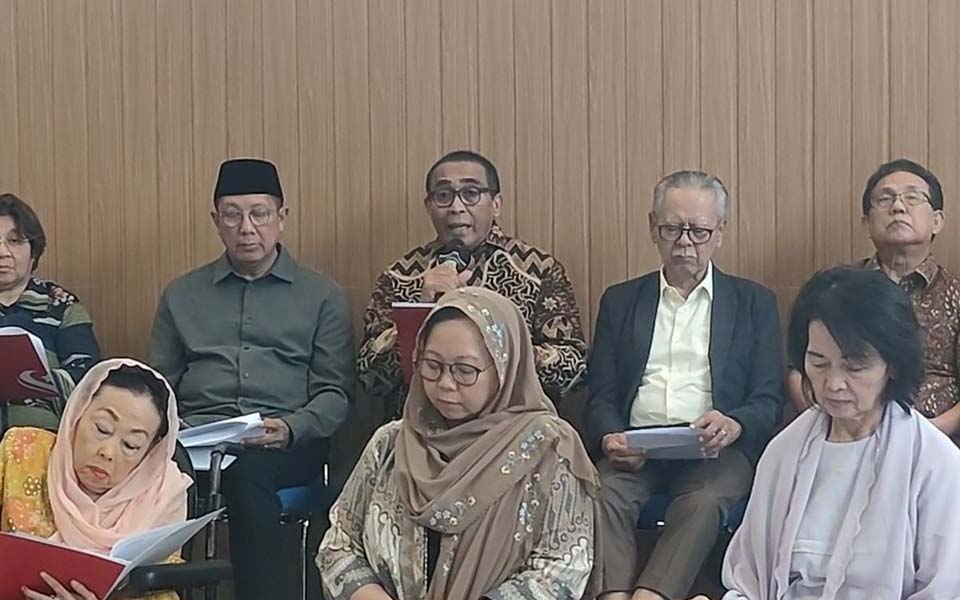
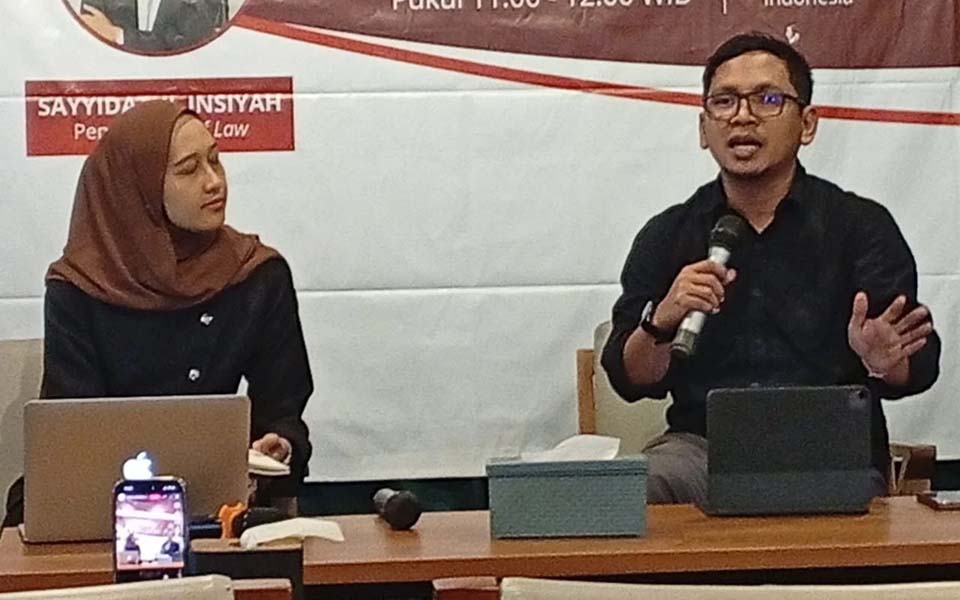
Despite the sudden cancellation, the Konsolnas KR proceeded online. Participants who had already arrived in Salemba were able to join in at a cafe in the Cikini area of Central Jakarta.
"The doors may be locked, but ideas cannot be restricted, and this space proves that no matter how limited we are, the spirit to spread good ideas for the republic cannot be restricted", said Republican Conference Committee Chairperson Sudirman Said on Sunday June 28.
Sudirman explained that the Konsolnas KR held in Jakarta was a continuation of the event held in Yogyakarta on May 30. In Yogyakarta, around 130 organisations took part, with around 600 participants and 40 speakers.
The three points formulated at the Konsolnas KR in Yogyakarta were the demand for the state to restore the sovereignty of civil society and a call to build a new republican formation to restore public trust. Because only by uniting can civil society and the republic be saved.
"Civil society has been advocating for improvements for years in various ways, from writing papers, holding public forums, some demonstrating, some meeting with policymakers. Ultimately discourse is not enough, we must begin to organise future steps. Hopefully we can reach an agreement so that this movement can be more organised", said Sudirman.
Jaleswari Pramodhawardani, who is also a member of the Konsolnas KR committee said that the Jakarta event was a follow up to the Yogyakarta meeting aiming towards an action plan, namely from a meeting to become a movement. Therefore, the event discussed the platform, design and management.
Jaleswari also outlined Indonesia's current problems, starting with the foundations of the republic, which consists of politics, political parties and the press, as well as the issues of citizens, rights and land, which are not yet at peace. Further issues concern the economic foundations and ecological boundaries, as well as national security and democratic control.
"Today, I think we agree that we are already at a precipice. Since we agree that the situation is not good, so we need to determine a mutually agreed-upon strategy that can be jointly agreed on to address this situation that is not good at all", said Jaleswari.
Saiful Mujani Research and Consulting founder of Saiful Mujani said that a study by the Varieties of Democracy (V-dem) Institute noted that at the beginning of the era of reformasi – the political reform process that began in 1998 – the indicators for freedom of expression, academic freedom, and freedom of men and women stood at 7. This score remained the same until around 2010.
However, this score has since dropped sharply. This year, the average score across all these aspects is below 5. This means that the space for freedom of expression, academic freedom and other freedoms, including political discourse, is very narrow.
"One thing that must be given attention now is the fear of discussing politics, the fear of arbitrary actions by state officials, the police, or the military, also the fear of what they witness regarding constitutional violations committed by public officials. This sense of fear must be resisted because we are now on the brink", said Saiful.
Legal expert and former Corruption Eradication Commission (KPK) deputy chairperson Chandra Hamzah emphasised that what the people want is a state of management, not a state of power. Therefore, the government is not the same as the state.
People's steward
Chandra likened a state to a neighbourhood association (RT). Taxes paid by citizens are not an obligation, but rather a contribution to ensure the state is properly run or managed. If state officials or RT officials manage things haphazardly, residents have the right to demand transparency from the RT head.
"Don't say the state is present. That's not the state. They're state administrators. Therefore, the ordinary people are actually sovereign, so the people should be able to dictate to state administrators or people's administrators", explained Chandra.
On that occasion, activist and film director Dandhy Dwi Laksono admitted that he had been waiting for such a consolidation since the administration of former president Joko "Jokowi" Widodo. In such a forum, it is important for each party to begin to eliminate suspicion or hesitation as a foundation for building political alliances without being based on prejudice.
Departing form the nation's history of ousting former president Suharto from power in 1998, all parties must be optimistic that such a momentum did once exit. One thing that must be began is the de-mythology or de-sacralisation of people's administrators.
Still from the experience of 1998, Dandhy said that all parties must learn that having momentum and the masses is not enough, but this must be complemented by actors. Meanwhile, during the 1998 reform era, there were other actors who hijacked the system through reformasi.
Dandhy also urged us to examine the sources of political power, namely power, position, the masses, religious authority and money. "Perhaps mass movements may be able to control momentum, but to rule, we clearly need organisation", said Dhandy.
During the discussion session, academic Yanuar Nugroho acted as a catalyst, directing the forum to discussions on the platform, design and management of the Konsolnas KR. Based on input from various parties, it was finally agreed that the platform of the Konsolnas KR would be a network.
The Konsolnas KR will consist of various autonomous institutions or civil society groups, including individuals, who already exist, are already angry, but have not been connected. The Konsolnas KR is tasked with bringing them all together based on the principle of transparency.
"We don't need a new, stronger civil society organisation. What we need is a movement infrastructure that brings these nodes together, my friends, and enables these various civil society groups to act together. The anger is already there, the aspirations are there, the energy is there", explained Yanuar.
Regarding the pioneering leadership, several names were put forward during the discussion, including one who offered to become a member of the board. At least 20 individuals were willing to join the formation team. Sudirman also emphasised that the platform and structure of the Konsolnas KR is something that can continue to be discussed or is open to dialogue.
Aside from this, Sudirman proposed three leadership models that must be developed together. First, institutional leadership that is not populist. Second, collective leadership that is not personal. Third, intrinsic leadership that is not solely based on authority, title or position. He also emphasised that at some point in the future organisation will be necessary because without this, such movements will continue to disintegrate.
[Translated by James Balowski. The original title of the article was "Konsolidasi Nasional Konferensi Republik Gagas Perbaikan Indonesia".]
Source: https://www.kompas.id/artikel/konsolidasi-nasional-konferensi-republik-gagas-perbaikan-indonesia