

Twenty-eight years after reformasi – the political reform process that began in 1998 – Indonesia is showing increasingly serious signs of democratic decline.
Reformasi, which were supposed to be a transitional path toward a democratic state that upholds civil and legal supremacy, limits on power and respects human rights, is now moving in the opposite direction: strengthening militarism (remilitarisation), shrinking civic space and the rise of repressive and anti-criticism practices.
The state of Indonesian democracy today demonstrates a tendency toward increasingly authoritarian state policy. The government is systematically cultivating fear among the public by creating an "imaginary enemy" to legitimise the silencing of critical civil society groups. One pattern employed is the rhetoric of labelling activists, academics, journalists, human rights defenders, and citizens who frequently criticise government policies as "foreign stooges." This narrative is not only a form of public misdirection but also part of a strategy to delegitimise criticism and narrow democratic space.
Several recent incidents have demonstrated the state's ruthless attitude toward criticism and dissent. The terror acid attack on human rights activist Andrie Yunus, the closing down of Pesta Babi (Pig Feast) film screenings, the intimidation of observers and critical groups, and the surveillance of public discussion spaces are evidence that the repressive patterns of former president Suharto's New Order are being revived. The practices of intimidation, silencing, and the use of the apparatus to suppress civil society remind the public of a time when critical voices were viewed as threats that had to be stopped my any means.
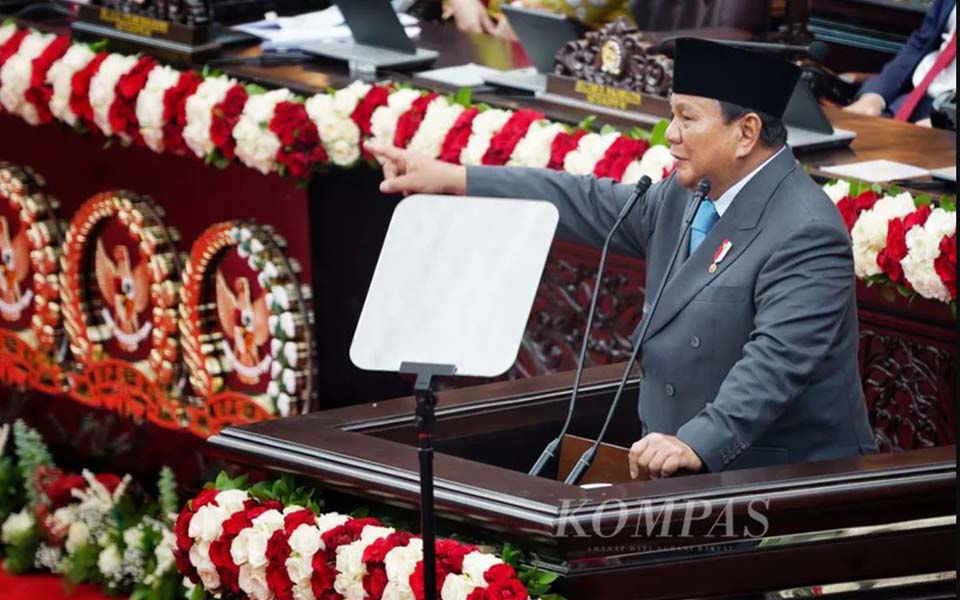
We believe that the remilitarisation occurring today is being implemented through various policies and regulations that pave the way for broader military involvement in civilian affairs. These include the revisions to the Indonesian Military (TNI) Law, the Draft Presidential Regulation on TNI Involvement in Counterterrorism and the Draft Presidential Regulation on TNI Duties. All of these regulations serve as political instruments that revive the military's dwi-fungsi (dual socio-political function). The state is consciously pulling the military out of its defence role and pushing it deeper into the social, political and civilian spheres of citizens' lives.
In concert with this, remilitarisation is also evident in the increasingly massive development of the TNI's territorial command structure, particularly the Army. The Territorial Command structure is a key legacy of the Indonesian Armed Forces' (ABRI as it was known) dual function during the New Order era, which should have been reformed after the 1998 reformasi. However, the opposite has occurred. The government has instead expanded the territorial command structure to resemble a civilian government structure. The government plans to expand the territorial command structure from 15 Regional Military Commands (Kodam) to 37 across all Indonesian provinces by establishing 22 new Kodam through Presidential Decree Number 20/2025. Furthermore, the government is establishing approximately 155 new Territorial Development Battalions (BTP) and is targeting the formation of up to 500 BTPs by 2029.
In this situation, civil society groups, activists, academics, journalists and critical organisations, which should be a vital part of democratic oversight mechanisms are being systematically silenced. This silencing is carried out not only through direct intimidation but also through the deliberate creation of fear to weaken the public's courage to voice criticism. Stigmatising narratives such as "foreign stooges" are then used as a legitimate basis to push for various repressive regulations, including the proposed Disinformation and Foreign Propaganda Bill, which has the potential to become a new instrument for restricting freedom of expression.
We believe that Indonesia's current situation no longer just shows signs of democratic regression toward autocracy, but has moved toward totalitarianism, which is seeking to control every aspect of civil life. One of the primary instruments used to reinforce this tendency is the law. In practice, legal instruments have been manipulated to further the regime's interests, rather than to ensure justice and protect citizens.
On the other hand, the strengthening of militarism also poses a serious threat to the national economy. No country dominated by a strong military can grow economically. Investors will not trust in a country where democratic space is narrowed and law enforcement is arbitrary. The current weakening of the rupiah against the dollar, economic instability and declining market confidence are inextricably linked to Indonesia's increasingly repressive and authoritarian political direction.
The economic policy direction of the administration of President Prabowo Subianto and Vice President Gibran Rakabuming Raka also demonstrates a tendency toward a militarism-based state capitalist model. The command economy model established by the government has the potential to pose serious risks to Indonesia's economic future. While the government builds on nationalist rhetoric and accuses critical groups of being "foreign stooges," its economic policies actually demonstrate subservience to foreign interests, such as the reciprocal trade agreement (ART) between Indonesia and the United States signed by the government not long ago. This situation highlights a fundamental contradiction in the current government's political and economic direction.
Therefore, reform in the defence and security sector must be re-positioned as an urgent, non-negotiable agenda. The TNI must be returned to its primary function as a national defence instrument and not be subsumed into the civilian sphere, which could weaken Indonesia's national defence and damage its reputation. A healthy democracy can only exist if the military is subject to democratic civilian control, the rule of law is upheld, and all branches of state power operate independently and exercise mutual oversight.
As emphasised by Indonesia's first Vice President Mohammad Hatta, a democratic republic can only stand strong if supported by a strong rule of law. Therefore, the momentum of the 28th anniversary of reformasi should serve as a reminder that the ideals of reformasi are far from being achieved. Indonesia needs the restoration of constitutional democracy, improvements in the fulfillment of human rights, limitations and oversight of state power, and an end to all militaristic practices that threaten the future of democracy and the welfare of the people.
Jakarta, May 21,2026
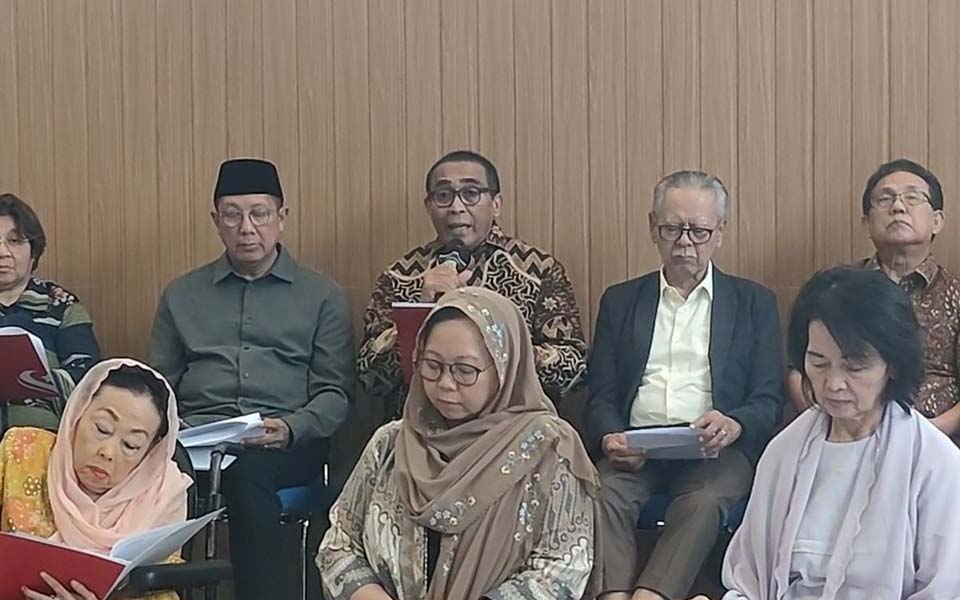
Civil Society Coalition for Security Sector Reform
Indonesian Human Rights Watch (Imparsial), the Centra Initiative, Amnesty International Indonesia, the Indonesian Legal Aid Foundation (YLBHI), Commission for Missing Persons and Victims of Violence (Commission for Missing Persons and Victims of Violence), the Indonesian Forum for the Environment (Walhi), the Indonesian Alliance of Independent Journalists (AJI), the Raksha Initiative, DeJure, the Indonesia Risk Centre (IRC), the Human Rights Working Group (HRWG), the Institute for Criminal Justice Reform (ICJR), the Institute for Public Research and Advocacy (ELSAM), the Jakarta Legal Aid Foundation (LBH Jakarta), the Legal Aid Institute for the Press (LBH Pers), the Community Legal Aid Foundation (LBH Masyarakat), AJI Jakarta, the Indonesian Legal Aid and Human Rights Association (PBHI), the Setara Institute for Peace and Democracy.
[Translated by James Balowski. The original title of the article was "Koalisi: 28 Tahun Reformasi, Bayang-bayang Militerisme di Tengah Ancaman Krisis Ekonomi".]