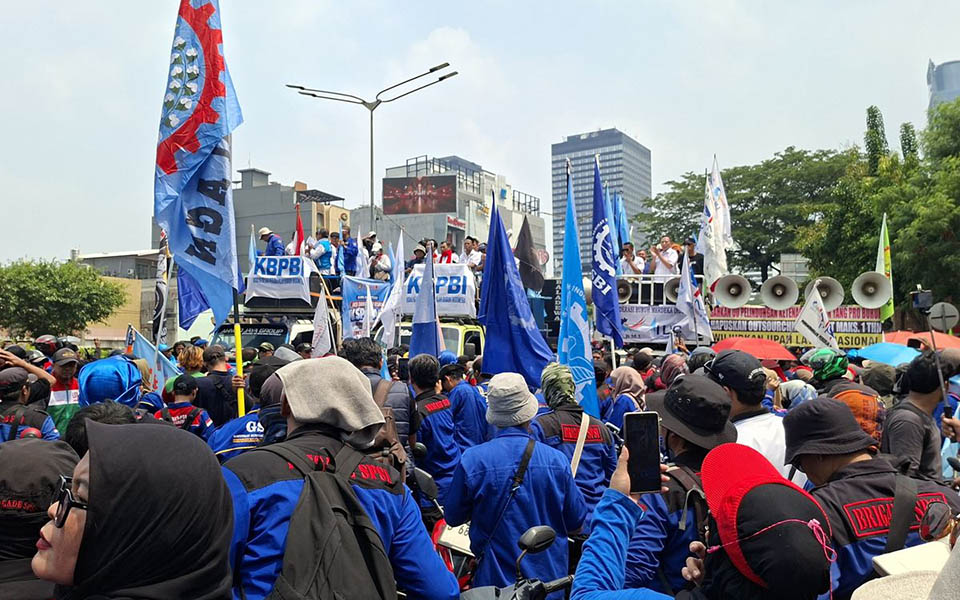


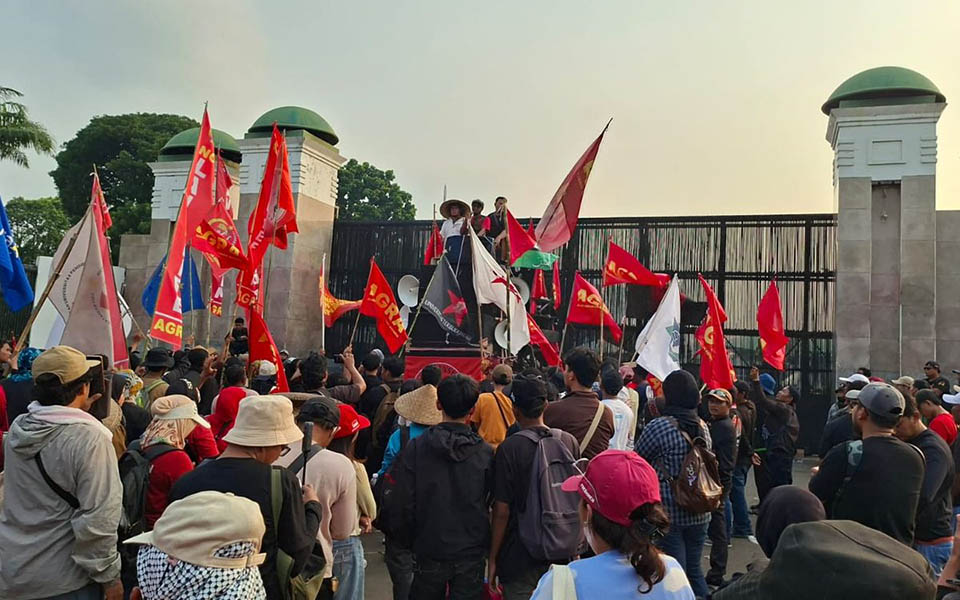
Ridho Danu Prasetyo, Tri Susanto Setiawan, Jakarta – Protesters from the Agrarian Reform Movement Alliance (AGRA) held a demonstration to commemorate National Farmers Day 2026 in front of the House of Representatives (DPR) building in Central Jakarta on Thursday afternoon September 24.
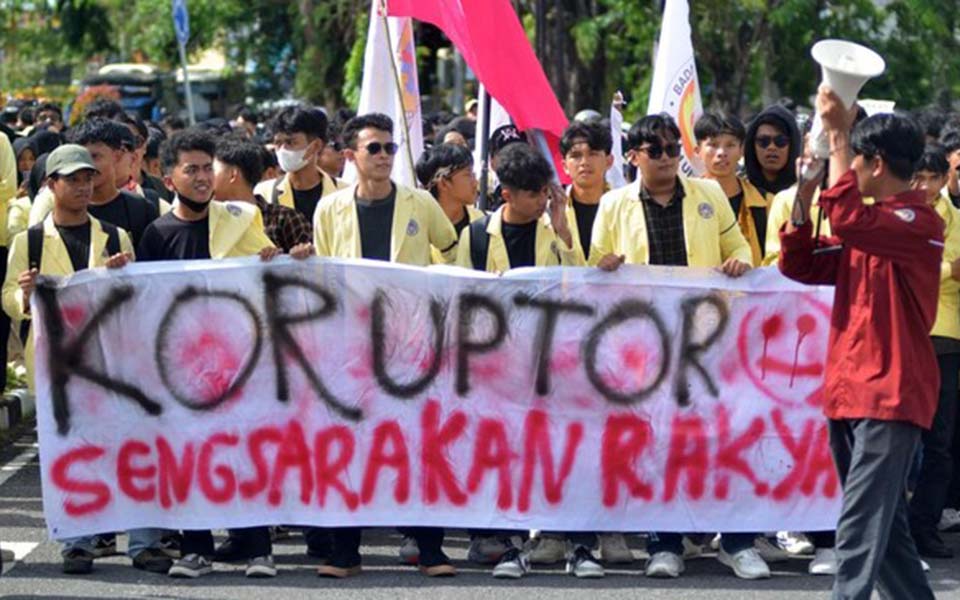
Observations by Kompas.com at the location revealed that various groups participated in the protest. They included university students and members of civil society from various citizens' alliances involved in agrarian conflicts.
One of the AGRA representatives, Aldo, said that the protest was held to convey criticisms of the Agrarian Reform Law, which had just been passed by the DPR on Tuesday September 22.
According to Aldo, the law fails to accommodate the needs and demands of civil society.
"We think the law should be able to address all kinds of issues, able to address all kinds of problems that are occurring in society today, particularly indigenous communities, people in remote areas, and those marginalised by this oppressive system", Aldo said on the sidelines of the protest on Thursday.
According to Aldo, the new Agrarian Reform Law was deliberated too hastily by the DPR and lacked meaningful public participation during the drafting process.
Therefore, the AGRA protesters reject the law that was enacted because it is considered inconsistent with the people's demands.
"Because there are still many controversial articles within it. And we suspect this agrarian reform law is merely being used as a populist jargon, because in the studies that are found in the law they only contain the distribution of land certificates as a solution", said Aldo.
Criticism of land certification
Aldo said that the DPR appears to view the issue of agrarian reform solely as a matter of lacking land ownership certificates which then trigger conflicts.
Yet, according to Aldo, agrarian conflicts frequently arise from the disregard for the rights of indigenous communities, who find themselves in a disadvantageous position due to power imbalances.
"There are more fundamental issues that need more attention not just land certificates. It's as if the distribution of certificates are a form of legalisation rather than land ownership for the Indonesian people and that in itself can resolve agrarian reform", he said.
Audience with the DPR
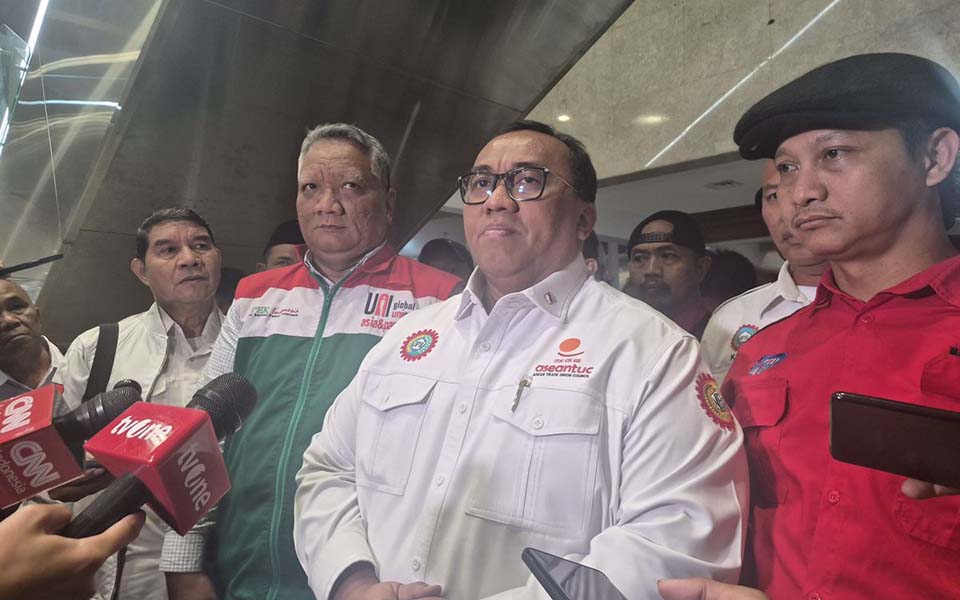
Aldo said that representatives from the protesters were invited into the DPR building to convey their concerns directly to lawmakers. During the audience, the protesters presented several demands related improvements to the Agrarian Reform Law.
Aldo however expressed disappointment with the DPR's response, which he felt was merely a formality. He said that the DPR accepted the demands, but had not yet provided assurances about revisions or amendments to the law.
"The outcome of the meeting earlier, indeed they [our demands] were accepted by the DPR, but the DPR's response was once again the standard template yeah, it just contained rhetoric because there was no concrete action, just promises without certainty", he said.
Aldo asserted that AGRA would continue to hold follow-up actions to monitor progress on their demands and hold the DPR accountable for its commitment to improving the Agrarian Reform Law.
"So from this we will continue to monitor it so that the Agrarian Reform Law can be implemented maximally and implemented concretely so sovereignty over their land owned by the ordinary people can be obtained justly", Aldo concluded.
AGRA's eight demands
Meanwhile the AGRA protesters demands during the action included:
1. Asserting that agrarian reform aims to end the monopoly over land ownership and agrarian resources.
2. Rejecting the narrowing and distortion of the meaning of agrarian reform into mere land certification, asset legalisation, agrarian conflict resolution or land management administration.
3. Demanding that the primary objects of agrarian reform be drawn from lands monopolised by major landlords, both state and private, under various forms of control.
4. Demanding that the primary subjects of agrarian reform be clearly defined as farm labourers, poor farmers and lower-middle-class farmers, including women farmers within this.
5. Asserting that agrarian reform must be implemented as an integrated whole including land redistribution, the organisation of production and the cooperative management of produce.
6. Demanding that National Agrarian Reform (BRAN) and all bodies responsible for implementing agrarian reform be predominantly composed of representatives from the subjects of agrarian reform themselves.
7. Asserting that the drafting of agrarian reform regulations must guarantee the active involvement of independent people's organisations as key stakeholders.
8. Advocating for the realisation of genuine agrarian reform as part of the struggle to achieve food sovereignty, rural democracy and independent national industrial development, as well as to liberate the Indonesian people from poverty, dependency and agrarian inequality.
"Thus, the ordinary Indonesian people are not just demanding land distribution, but rather are struggling for genuine agrarian reform as a national agenda to end land monopolies, improve the welfare of farmers, build a sovereign national economic foundation, as well as realise the ideal of social justice for all Indonesian people", Aldo concluded.
[Translated by James Balowski. The original title of the article was "Demo Hari Tani 2026 di Depan DPR, Massa Tuntut Perbaikan UU Reforma Agraria".]