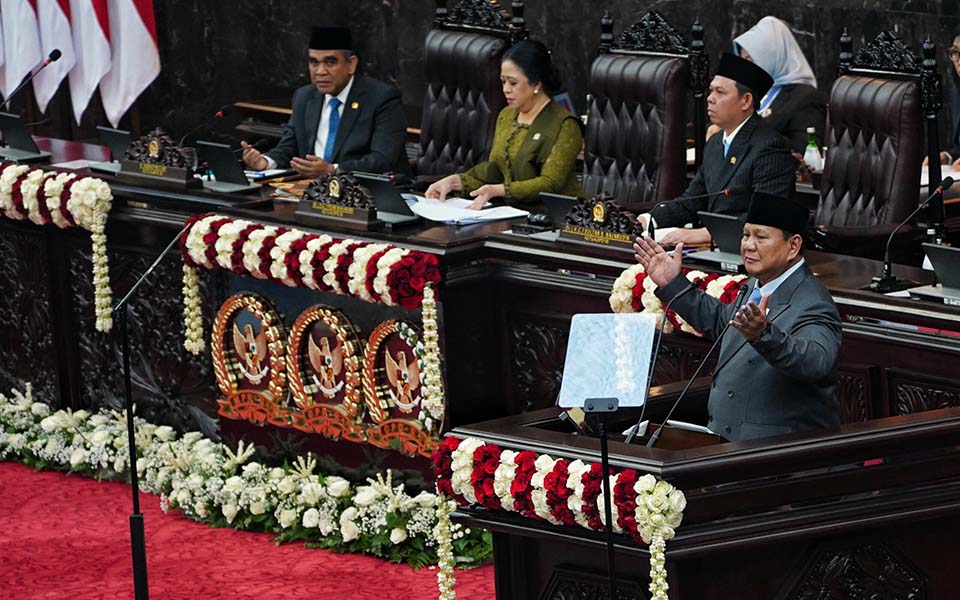


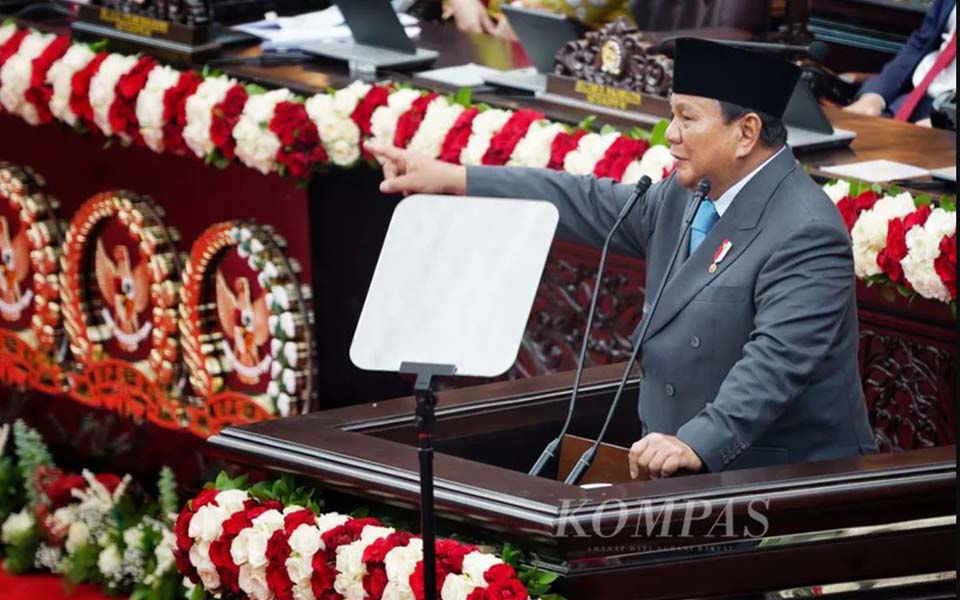
In his State of the Nation address before the People's Consultative Assembly (MPR), House of Representatives (DPR) and Regional Representatives Council (DPD) on August 14, President Prabowo Subianto stated that his administration had implemented 121 transformative policies in 21 months.
Economic growth, investment, food production, the Free Nutritious Meals (MBG) program and the Red and White Village/Sub-district Cooperatives (KDMP) program were presented as evidence that the country was moving toward independence and prosperity.
A State of the Nation address should serve as constitutional accountability for how power is exercised, the state apparatus is mobilised, the ordinary people's money used, the law enforced and citizens' rights are protected.
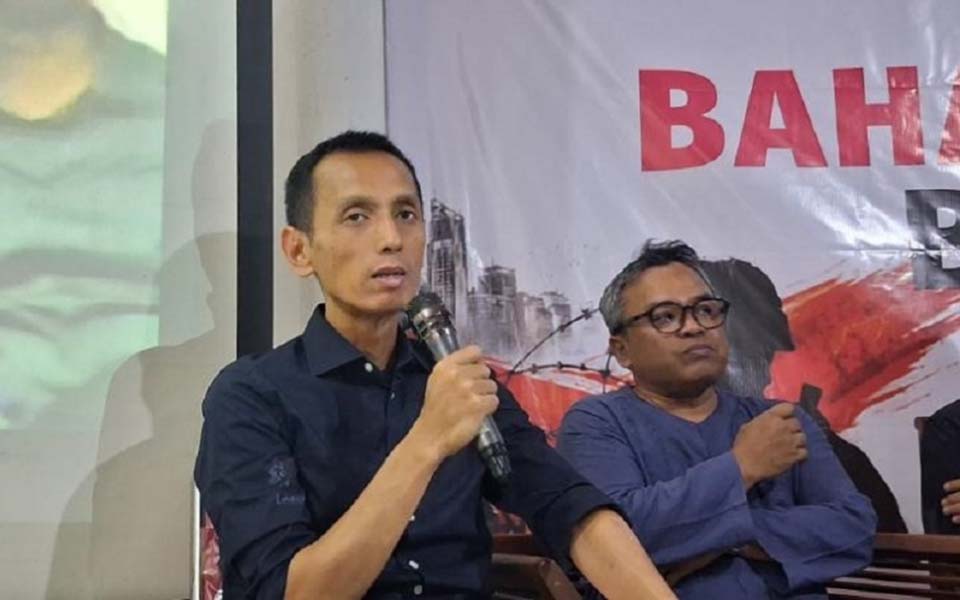
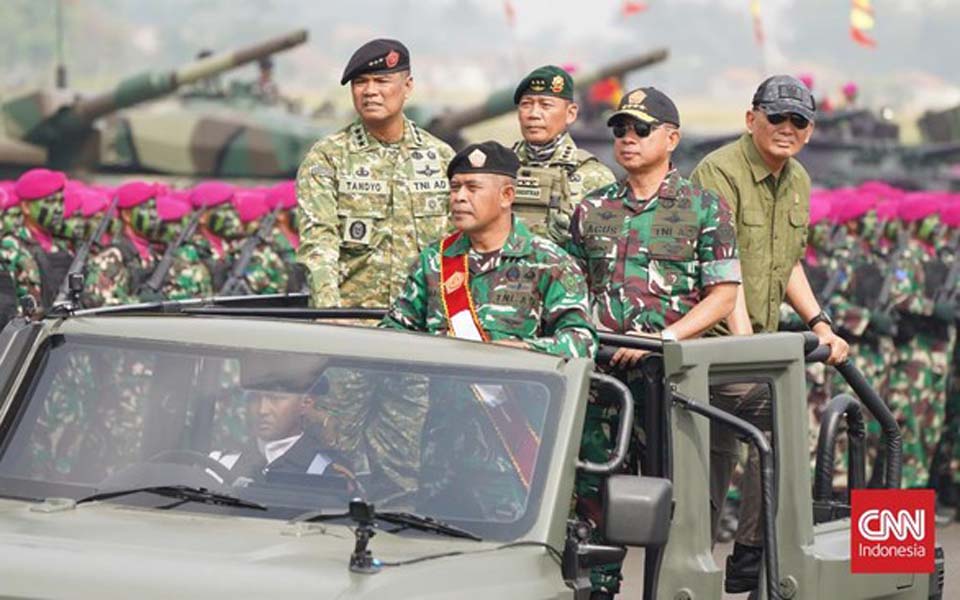
The Indonesian Legal Aid Foundation (YLBHI) has observed a worrying trend. State power is becoming increasingly centralised, the authority of the Indonesian Military (TNI) and the Indonesian Police (Polri) is expanding without limits, and the military is increasingly entering civilian life. At the same time, the DPR is losing its power of oversight, the judiciary is being weakened, court decisions are being ignored and space for criticism continues to shrink.
The question that must be answered is not simply how many policies have been implemented, but rather: transformation towards what kind of country is being built?
Power expanding, oversight lost
In the past two years, we have witnessed revisions to the TNI Law, the ratification of the new Criminal Procedure Code (KUHAP), the expansion of police authority through the Polri Law, the involvement of the TNI in protecting prosecutors offices, the deployment of the military in food and village cooperative programs and the development of new territorial command structures.
These changes demonstrate the consolidation of the state's coercive apparatus, while its oversight and accountability mechanisms have not been comparatively strengthened. The government has expanded the authority of the executive and civil servants, the DPR provides a rubber stamp for political and budgetary approval, while the judiciary is insufficient to stop the abuse of power and/or restore citizens' rights.
The DPR should be the place where government policies are tested, budget use is scrutinised and the actions of civil servants are held accountable. However, the dominance of parties supporting the government has blurred the boundaries between the government and parliament. In fact, parliament has nearly lost its constitutional function vis-a-vis the government.
In its legislative function, the DPR, along with the government, passed the TNI Law, the new KUHAP and the Polri Law through hasty, closed-door processes, ignoring public objections. These three laws expanded the authority of the civil apparatus without establishing equal judicial control and public oversight.
In its budgetary function, the DPR has not seriously examined the financing of the MBG program, the KDMP program, the construction of new Regional Military Commands and territorial battalions, the addition of personnel or national strategic projects (PSN). The budget is treated solely as a matter of targets and absorption, not a political choice that determines whose rights are fulfilled and whose are sacrificed.
In its oversight function, the DPR has been virtually silent as thousands of citizens have been arrested and criminalised, children have become victims of violence, torture continues, tens of thousands have experienced alleged MBG poisoning, communities have lost their land and the Papuan people have been displaced by armed conflict.
And the DPR has not just been passive. Through legislation and budget approval, it has provided the legal basis and resources for the expansion of the powers it is supposed to oversee. Yet, the DPR was elected as a representative of the ordinary people, not a House Representing Power.
Military and police regain control of civil space
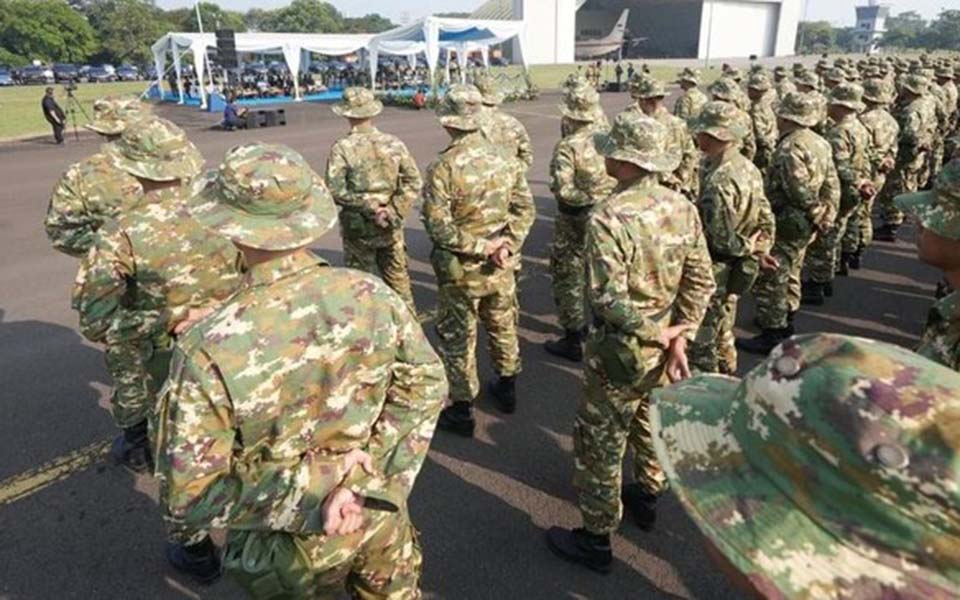
The government plans to expand the TNI's territorial command structure to 22 Regional Military Commands (Kodam) units by 2029. Six new Kodam units were inaugurated in 2025. Simultaneously, 100 territorial development battalions and production companies at the Kodim level and the involvement of Village Supervisory Non-Commissioned Officers (Babinsa) in economic, tax, and community administration affairs are being established.
These units are not only for defence. The TNI is involved in agriculture, animal husbandry, fisheries, health, the MBG program, food estates, food brigades, rice procurement, agricultural input distribution, the Red and White Cooperatives, security for civil institutions and local government programs.
This is no longer simply an addition to Military Operations Other Than War (OPSP). What is being developed is a multifunctional TNI: soldiers will serve as implementers of development, managers of economic activities, community supervisors and at the same time as a security force. This scope of this has the potential to be even broader than the dual (dwi-fungsi) function of the Indonesian Armed Forces (ABRI as it was called) during the New Order era of former president Suharto.
The addition of Kodam units, territorial battalions, production companies and military personnel will strengthen state oversight down to the villages. Villages are no longer treated as democratic living spaces for citizens, but as administrative and command operational areas.
The revisions to the Police Law also opens space for the police to enter civil society, both within ministries and institutions without restriction. The new KUHAP exacerbates the real threat of human rights violations, with the police's broad discretion and authority in law enforcement, as primary investigators wielding various coercive and investigative powers without adequate oversight.
Promises of police reform have been reneged on by the strengthening and expansion of their authority. The police are now involved in administering the MBG program, establishing and managing thousands of Nutrition Fulfilment Service Units (SPPG) and managing agriculture and plantations, all of which are inconsistent with their duties and functions. Ministerial and institutional positions are legalised for police officers, despite a recent Constitutional Court ruling clearly prohibiting concurrent positions.
Command policies over villages and children
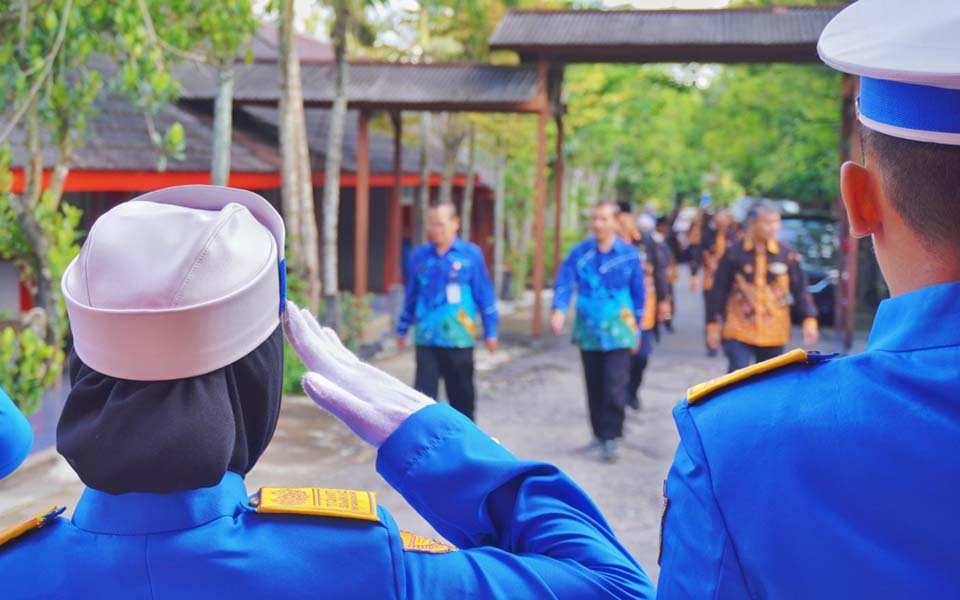
The Red and White Village/Sub-district Cooperatives are promoted as a means of reviving the people's economy. However, a cooperative does not become a cooperative simply because the government grants it a name and legal entity.
The targets, institutional forms, financing, locations, infrastructure and the time frame for establishing KDMPs are determined by the central government. The community is only brought together after the decision has been made. This pattern transforms cooperatives from member-owned economic organisations into state-owned distribution networks, disguised as cooperative legal entities. Villages must also bear the risks of asset use, land ownership, loans and long-term financial burdens.
The involvement of the TNI in data collection, store construction, supervision and management training further emphasises the command nature of this program. The recent deaths of five prospective KDMP management candidates during basic military training must be independently and thoroughly investigated. Cooperatives should not be built through barracks discipline, but through volunteerism, member democracy and the real needs of the community.
This character is also evident in the MBG program. The President uses the number of food portions as a measure of success, while tens of thousands of children are suspected of being poisoned. As of early August 2026, the Indonesian Education Monitoring Network (JPPI) recorded 40,759 suspected MBG poisoning victims since the program began in 2025. 12,656 of these occurred between January and early August 2026.
The growing number of victims demonstrates systemic failures in governance, food safety, oversight, data transparency and accountability. Children should not be treated as targets for mass production.
The Constitutional Court has also confirmed that the MBG program cannot be considered as part of the main component of education and must not be funded from the education budget. Therefore, the 2027 Draft State Budget (RAPBN) is a test for the President and the DPR: will they comply with the Constitutional Court's ruling or re-burden the education budget to fund the MBG. Meeting nutritional needs must not diminish children's rights to decent schools, prosperous teachers and quality education.
Democracy cannot be measured by order
Democracy is not measured by how calm the streets are or how little criticism is heard. Democracy is measured by the state's ability to accept corrections, protect dissent and limit the use of violence by the authorities.
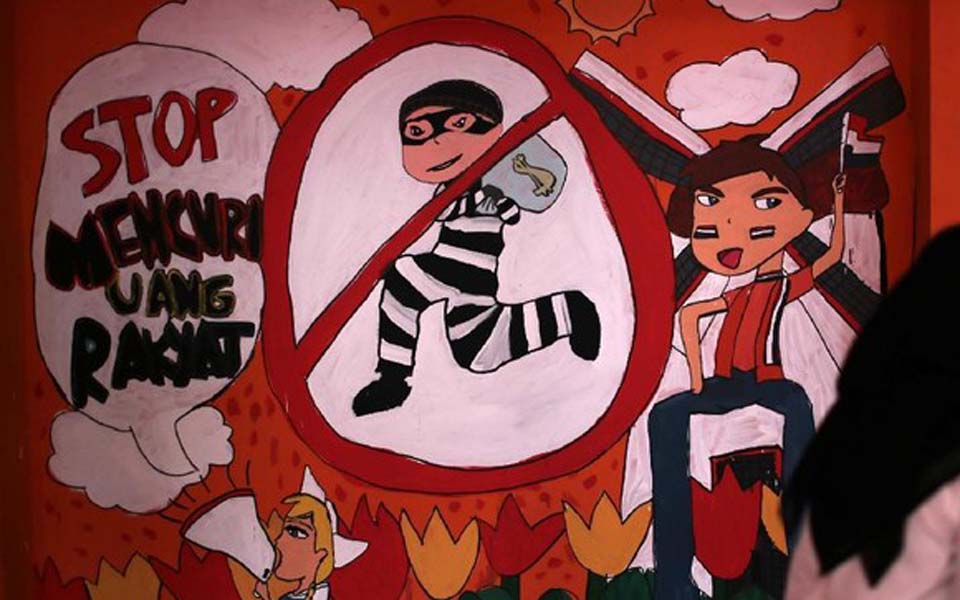
During the wave of demonstrations from August to September 2025, the Civil Society Fact-Finding Commission recorded at least 6,719 arrests, including 2,573 children. Thirteen people died. The Youth Movement Against Criminalisation also recorded at least 703 people categorised as political prisoners or subject to legal proceedings, and 506 of them have been sentenced.
The mass arrests, excessive use of force, torture, the hunt for activists, the inspection of communication devices, family intimidation and the criminalisation of political expression demonstrate that criticism is still treated as a security threat, not part of implementation the Constitution.
The reforms to the National Police demanded after the wave of police violence in August were not implemented independently and comprehensively. Instead, police powers were expanded through the new Police Law and the KUHAP, while external oversight and judicial control remained weak. The state protected impunity.
Throughout 2025, YLBHI and its network of legal aid foundations (LBH) recorded at least 105 incidents or allegations of torture. In a situation like this, expanding the authority of the authorities is not legal reform. It increases the risk of arbitrary arrests, fabricated cases, extortion, violence and torture.
The loss of judicial power
The crisis in judicial power cannot be resolved simply by increasing judges' salaries. Welfare is important, but it does not automatically produce judges who are independent, have integrity, adhere to human rights, and are brave enough to challenge the power of those in power.
The Constitutional Court was established to ensure that laws do not become tools of the tyranny of the political majority in the hands of the President and the DPR. However, the Constitutional Court's independence has been repeatedly shaken by conflicts of interest, ethical violations, political interference and judicial appointment mechanisms controlled by the branches of government that the Court is supposed to oversee.
The government and the DPR have also repeatedly delayed, narrowed or sought ways to circumvent Constitutional Court rulings. The prohibition on concurrent positions for active police officers, the mandate on the education budgets and other decisions should not be treated as suggestions. A government that ignores court rulings is placing itself above the law.
Problems also persist in the Supreme Court and its lower courts. Corruption, conflicts of interest, poor decision quality, secrecy and weak oversight continue to undermine public trust and place the institution in a position to legitimise power, rather than test it.
The selection process for Supreme Court justices, ad hoc human rights judges and ad hoc corruption judges in 2026 was conducted with rapid deliberation and limited public participation, while several candidates with questionable qualities or integrity were still passed. Afterwards, the candidates undergo a fit and proper test in DPR, which is vulnerable to being reduced to a selection process based on political interests.
The courts also lose their meaning if their decisions are not implemented. In various environmental, government administration and agrarian conflict cases, citizens have fought for years and won, but the government ignores the decisions. The law seems to bind the ordinary people, but it can be overridden by officials.
Judges' control over arrests, detentions, searches, seizures and other coercive measures also remain weak. At the same time, military personnel who commit common crimes can still be prosecuted through closed military courts, hindering victims' access and maintaining impunity. Ultimately, justice becomes distant for victims.
The judiciary must be a place where citizens can obtain redress, not just a verdict. Without an independent and effective judiciary, the law will be harsh on vulnerable citizens, but powerless against the government, the authorities and capitalists.
Weak legal aid guarantees
A constitutional state is also determined by the ability of the poor and vulnerable groups to defend themselves when confronted by those in power. Therefore, access to legal aid for citizens, especially the poor and vulnerable, must be ensured by the state. Without this, equality before the law will remain a fantasy. Legal aid is not a generous gift from the state. It is a prerequisite for equality before the law that does not end as a constitutional mantra.
In the period 2025-2027, there were only 777 accredited legal aid organizations to meet the needs of communities throughout Indonesia. Citizens still face legal costs, geographical distance, limited representation and rejection by paralegals and legal aid providers. Meanwhile, the state budget for legal aid remains very limited, with problematic budgeting schemes.
The state is obliged to guarantee legal aid from the moment a person first faces arrest, questioning, detention or other coercive measures. Without early assistance, defence often comes after violence, intimidation or fabricated cases have already occurred. The practice of obstructing access to legal aid and fabricating legal aid remains a persistent issue.
Growth, the seizure of living space and Papua
The President's speech positioned economic growth, investment, downstreaming, food security and strategic projects as indicators of progress. Growth figures however do not explain who benefits and who bears the costs.
In various LBH working areas, development is still driven by land grabbing, evictions, intimidation, criminalisation, violence by security forces and the destruction of livelihoods. Conflicts in Luwu, Rempang, Merauke, Halmahera, Kalimantan and other regions demonstrate that the government is more often present to secure projects than to protect indigenous peoples, farmers, fisherfolk, women, labourers and environmental defenders.
When communities are unable to reject projects, environmental defenders are criminalised and the security forces are used to secure corporate interests, environmental damage simultaneously leads to a breakdown of democracy and a violation of human rights.
A similar approach is taking place in Papua. The deployment of troops, territorial commands, military operations, restrictions on information and the acquisition of land for economic projects have exacerbated fear and displacement. Papua needs civilian protection, humanitarian access, accountability for violence and dignified political dialogue – not the expansion of security operations.
The government has also not provided a clear direction for resolving past gross human rights violations. These cannot be replaced by social assistance or administrative recognition without truth-telling, due process, victim reparations and guarantees of non-recurrence.
Human rights protection must extend to women, children, persons with disabilities, indigenous peoples, minority religious and faith groups, gender and sexual minorities, labourers, farmers, the poor and human rights defenders. Human rights are not a gift from the government, but rather a boundary that must not be crossed by any power.
Independence must free citizens from fear of the state
Eighty-one years after independence, threats to citizens come not only from poverty and inequality. These threats also come from a state that is gaining greater authority, infiltrating more deeply into people's lives, but also becoming increasingly difficult to hold accountable.
Development must not be a pretext for land grabbing. Stability must not be a pretext for silencing criticism. Food security must not be a reason to deploy troops to villages. Law enforcement must not be a justification for torture.
Democracy must not stop at elections, while parliament stops overseeing the government, the courts lose their power to control power and citizens who express criticisms are arrested.
Therefore, the YLBHI urges:
1. That President Prabowo Subianto's government ensures compliance with the principles of democracy, the constitution and human rights in every government program implemented, as sworn in and promised upon his inauguration as president. Ignoring these fundamental principles is a betrayal of the Constitution and the mandate of the people's sovereignty.
2. An end the multifunctional nature of the TNI and the National Police. For the President and the DPR to review the formation of new Kodam and territorial development battalions, discontinue production companies and withdraw the military from the food sector, the KDMP program, the MBG program, security for civilian institutions and all non-defence matters. This includes the practice of police holding dual positions in ministries/institutions and involving the police in matters outside their functions.
3. A review the TNI Law, the Polri Law and the KUHAP, which fail to limit the authority of officers, end dual positions, strengthen judicial control and implement comprehensive and independent police reform.
4. The DPR to carry out its oversight, legislative and budgetary functions independently and in the interests of the ordinary people, by ending closed legislation, auditing the budgets of officials and priority projects, and holding those responsible accountable for violence, torture, MBG poisoning cases, agrarian conflicts and human rights violations.
5. The government to comprehensively evaluate the KDMP and the MBG programs, end its militaristic approach, disclose the use of budgets and risks to village assets, rehabilitate victims of poisonings, and ensure that the MBG program does not burden the education budget.
6. The Supreme Court and other judicial institutions to maintain their independence and integrity, improve the selection and oversight of judges, strengthen control over coercive measures, eradicate the judicial mafia, ensure the implementation of court rulings and reform the military judiciary.
7. The state to expand access to legal aid and guarantee early assistance for the poor and vulnerable groups.
8. The government to stop criminalisation, land grabbing and violence against citizens, evaluate PSNs that destroy living spaces, stop the security approach in Papua, protect civilians and open a dignified political dialogue.
9. The government to resolve past gross human rights violations, strengthen human rights institutions, guarantee reparations for victims and establish comprehensive legal protection against discrimination.
The President's State of the Nation address should not simply explain what the government has done. It must address who is protected by power and who is sacrificed.
Progress cannot be measured by the number of projects, cooperative buildings, battalions, food portions or investment figures. Progress must be measured by the decreasing fear of the authorities among citizens, increasing freedom of speech, the greater ease with which people obtain justice, the greater protection of their living space and the increasing submission of power to the law.
Without the DPR to oversee the government, courts capable of controlling power and citizens free to express criticism, what is being built is not a welfare state, but a command state.
With respect
YLBHI Management
[Translated by James Balowski. The original title of the article was "Di Balik Pidato Capaian, Negara Komando sedang Dibangun".]
Source: https://ylbhi.or.id/informasi/siaran-pers/di-balik-pidato-capaian-negara-komando-sedang-dibangun/