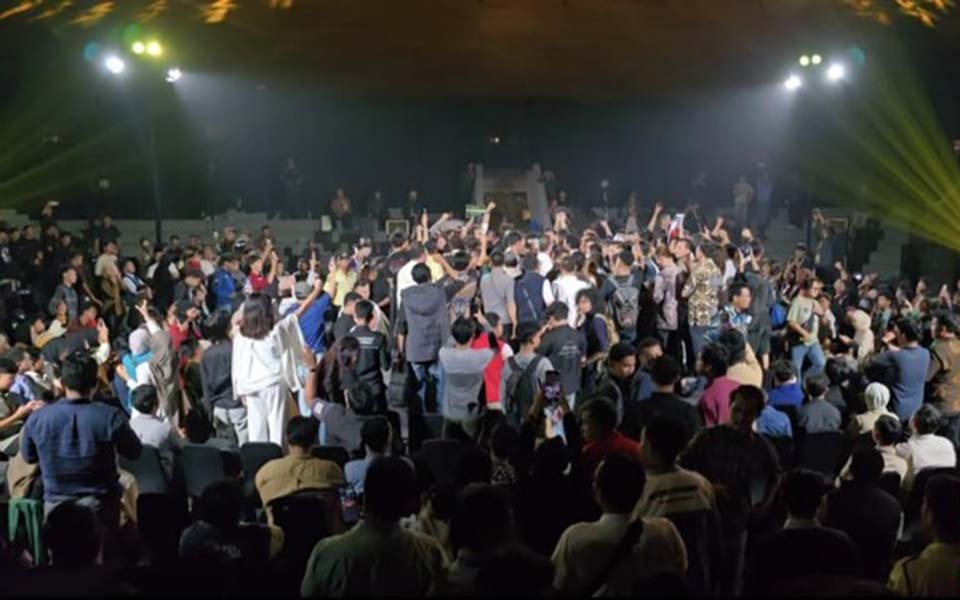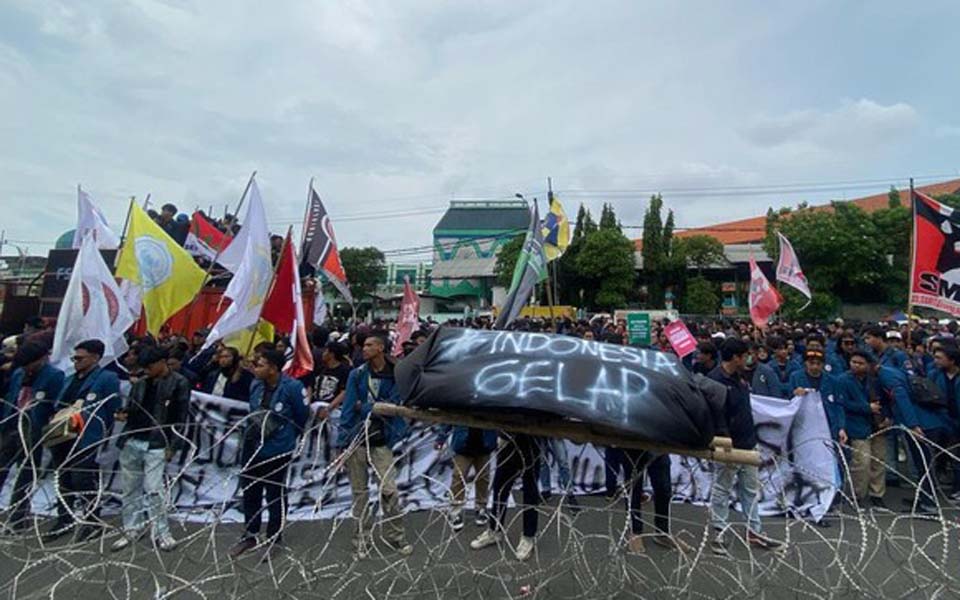


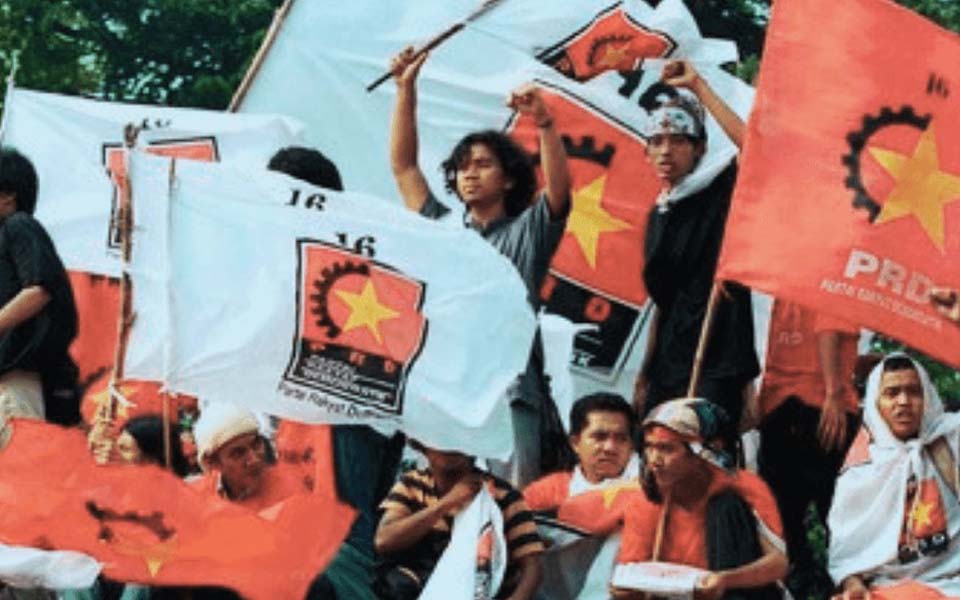
Dipo Negoro – On June 15, a discussion attended by Budiman Sudjatmiko at the Innovation and Creativity Centre at the Gadjah Mada University (UGM) in Yogyakarta was mobbed by students who climbed onto the stage and unfurled banners of opposition.
Eight days later, students from the Student Executive Board of Mulawarman University interrupted a public lecture by Deputy Minister of Human Rights Mugiyanto in Samarinda with a banner that read "Expel Mugiyanto, Traitor to Reformasi" – referring to the political reform process that began in 1998.
These two men were no ordinary figures. Both were former members of the People's Democratic Party (PRD), which had been attacked by former president Suharto'sNew Order military regime. Budiman Sudjatmiko was imprisoned on charges of subversion. Mugiyanto was abducted by the military and held captive. They were part of the generation that author Pramoedya Ananta Toer called the only one in the world to have successfully brought down a military regime without weapons. Now they are being met with student anger because they have long been associated with the very system they had once opposed.
The anger was legitimate, and the students who mobbed the two were correct. But anger alone doesn't explain anything. What determines the future of the movement is not how strongly we condemn the defectors, but how accurately we understand why the betrayal occurred. Because a mistaken understanding leads to a mistaken path.
It is here that an article by Moses Kabelen, which was published on Revolusioner.org, the mouthpiece of the Revolutionary Socialist Association (Perhimpunan Sosialis Revolusioner, PSR), becomes problematic. The title seems to defend Russian revolutionary leader Vladimir Lenin. The content turns Lenin upside down. The article uses the Budiman and Mugiyanto case as an entry point, then shifts its focus not to the traitors, but to the strategy of the democratic revolution itself.
It is this that must be answered. Not to defend the PRD, for the PRD has clear weaknesses that we will dissect without evasiveness, but to defend Lenin's perspective, which Kabelen intends to discard in Lenin's name.
What is true and where Kabelen started to slip up
We must be honest about the truth of Kabelen's article, because without this honesty, polemics will only be blind rebuttals.
Kabelen is right that the betrayal of former PRD cadres is not simply a matter of weak individual character. Budiman, Mugiyanto, Dita Indah Sari, Faisol Riza and Nezar Patria once displayed extraordinary courage when they were young.
That courage was real, and precisely because it was real, their decline cannot be explained simply by accusations of weak faith. There was something deeper at work and explaining it structurally is indeed correct. Kabelen is also right that the movement needs serious Marxist education and a party built on a revolutionary basis. This is not new, but it remains true and urgent.
The problem begins when Kabelen jumped from one truth to a completely unsubstantiated conclusion. He saw a series of PRD leaders defecting to bourgeois parties and concluded that the strategy of democratic revolution was the culprit. This leap was wrong, and to see how wrong it was, we need not look far.
Plekhanov, the father of Russian Marxism, the theoretical mentor of an entire generation of Russian Marxists, including Lenin himself, at the end of his life turned to the right, supporting imperialist war and opposing the October Revolution. Does this mean that Russian Marxism was rotten from its foundation? Of course not. The defection of a leader, even one as great as Plekhanov, demands an explanation, but that explanation is never simply "it means his theory is wrong". Equating the decline of a person with the decay of theory is a lazy way of thinking, one that replaces analysis with judgment.
The two-stage strategy was Lenin's, and young Trotsky opposed it
The essence of Kabelen's article is simple: the PRD never had a mature perspective on socialist revolution. From the beginning, there was a tendency to view the task of the Indonesian revolution solely as a national democratic revolution. And calls to complete the democratic revolution, Kabelen argued, were merely a cover for opportunism. He concluded with a statement that should not be misunderstood: all the talk about completing the democratic revolution, completing reforms and creating an unfinished nation is a perspective that leads to defeat and betrayal.
It is important to state the origins of this argument clearly, not to attack individuals, but to clarify what is truly at stake. The PSR is the Indonesian section of the International Marxist Tendency, an international movement that bills itself as the heir to the Fourth International and Trotsky's tradition. Kabelen's position, that true democracy can only be achieved through the victory of the socialist revolution and that a separate democratic stage is merely a trap, is at the heart of Trotsky's theory of permanent revolution. Trotsky in his formulation denies the existence of a democratic stage. This is the irony. Kabelen invokes Lenin's name to attack the two-stage strategy. Yet the two-stage strategy belonged to Lenin. It was the young Trotsky who opposed it. Kabelen is using Lenin to assassinate Lenin's own ideas.
Let's go back to the source, for this is where the whole matter is decided. In "Two Tactics of Social Democracy in the Democratic Revolution", written in 1905, Lenin defended the necessity of the democratic stage not as a concession to the bourgeoisie, but as a material necessity of the conditions faced. The unfinished democratic tasks, the feudal remnants, the oppressed peasantry, all of these were real and could not be skipped simply because we wanted socialism. But, and this is what separates Lenin from the Mensheviks, Lenin never handed over the leadership of the democratic stage to the bourgeoisie. Instead, he insisted that the working class must lead the democratic revolution alongside the peasantry, against a half-hearted liberal bourgeoisie whose betrayal, in Lenin's own estimation, could already be read in its class interests.
So what does "uninterrupted" mean, which is so often forgotten? Lenin asserted that from the democratic revolution, in accordance with the conscious and organised forces of the proletariat, the movement would soon begin to transition to the socialist revolution. We stand for uninterrupted revolution, he wrote, we will not stop halfway. Uninterrupted does not mean a pause and then a resumption. It means not surrendering the leadership of the working class, not relinquishing its organisational independence, and not taming the momentum of the struggle by a bourgeoisie satisfied with achieving its own goals. The working class leads the democratic stage precisely so that it can move to the socialist stage from a stronger position.
And most decisively, Lenin reaffirmed this framework after October 1917, when he was assessing what had actually happened, not when he was still theorising in exile. In "The Proletarian Revolution and the Renegade Kautsky", written in 1918, Lenin argued that the course of the revolution had vindicated the Bolshevik analysis. First, with the entire peasantry against the monarchy and the landlords, and to that extent the revolution remained bourgeois-democratic. Then, with the poor and semi-proletarian peasants against capitalism, and to that extent the revolution became socialist. Lenin warned that to attempt to erect an artificial wall between these two stages, separating them by anything other than the degree of preparedness of the proletariat and its degree of unity with the poor peasantry, would be to distort Marxism catastrophically and replace it with liberalism. A year later, in his report to the Eighth Congress of the party in 1919, Lenin stated that the October Revolution remained largely bourgeois until the formation of the Poor Peasants' Committees in the summer of 1918, and only then did the revolution become proletarian in reality, not merely in proclamations, promises and declarations.
This was Lenin after coming to power, asserting the uninterrupted two-stage strategy as the true picture of the revolution he led. So when Kabelen calls the two-stage strategy a source of inherent opportunism, he is calling Lenin a source of opportunism. Go ahead and debate Lenin, but have the courage to do so openly, not by hiding behind Lenin's name and stabbing him in the back.
Lenin's conditions and the test of 1998
Kabelen's accusation must be tested by the proper standard, namely the conditions Lenin himself set. Lenin never allowed the transition between stages to be a matter of taste or timing. He formulated it explicitly, and it is this formulation that we will use to test 1998.
To complete the democratic stage, Lenin set several conditions. First, leadership must be in the hands of the proletariat, not the bourgeoisie. And what Lenin meant was not simply the proletariat "at the forefront" of ordinary bourgeois democratic struggles. He meant the revolutionary democratic dictatorship of workers and peasants as a form of power qualitatively different from the bourgeois democratic republic. This is a revolutionary power that completely destroys the machinery of old power, not simply changing the faces at the top. The proletariat completes the democratic revolution by binding the masses of the peasantry to itself to destroy the resistance of the old power and paralysing the vacillations of the bourgeoisie.
Second, the alliance at this stage is between the proletariat and the entire peasantry, because only the proletariat can be relied upon to fight to the end, having gone far beyond a mere democratic revolution. Third, the proletariat must stand in its own firm class party, precisely because the peasantry contains semi-proletarian and petty-bourgeois elements that make it unstable. Fourth, and this is the most frequently violated, Lenin strongly criticised the logic of holding back democratic demands in order to keep the bourgeoisie from withdrawing from the revolution. For him, fear of causing the bourgeoisie to withdraw was tantamount to handing over the leadership of the revolution to the bourgeoisie and placing the proletariat under its guardianship. On the contrary, Lenin emphasised that the revolution reaches its greatest extent when the bourgeoisie withdraws from it and the masses of the peasantry emerge as active revolutionaries alongside the proletariat.
To transition to the socialist stage the prerequisites are even deeper. The measure is not time, but rather class strength. The transition, said Lenin, occurs according to the strength of the class-conscious and organised proletariat. The alliance changes, from the proletariat with the entire peasantry in the democratic stage to the proletariat with semi-proletarian elements to crush bourgeois resistance in the socialist stage. This is what Lenin signalled with the formation of the Poor Peasants' Committees in 1918. Above all, Lenin emphasised one absolute prerequisite, that the emancipation of the working class must be won by the working class itself, and that a socialist revolution is impossible unless the masses become class-conscious, organised and educated in open class struggle. He even added a warning about how little the working masses, at that time, understood the goals of socialism and how to achieve them.
Now test these conditions against the 1998 reformasi, and Kabelen's accusations fall apart. Measured by the conditions for completing the democratic stage, 1998 was clearly incomplete, because the first condition was not met: those leading it were not a conscious working class with its own class party, but rather a spontaneous movement whose leadership was ultimately seized by the bourgeois-reformist elite. The bourgeoisie retreated, exactly as Lenin predicted, once its narrow interest in ousting Suharto was met and the remnants of the old forces were not destroyed. Measured by the conditions for the transition to the socialist stage, the gap was even greater, because the masses who mobilised in 1998, especially the semi-proletariat and urban poor, as Australian Indonesianist and author Max Lane himself notes, had not yet imagined seizing power, establishing their own power and defending it from counter-revolution. This was precisely the condition Lenin described as a masses that did not yet understand the goal of socialism.
Therefore, the call to "complete the democratic revolution" was not opportunism. It was a correct reading of the objective conditions Lenin himself set. And here lies one thing we will continue to hold on to. The incompleteness of the democratic stage is no reason to postpone socialism to the distant future, because the same conditions that complete the democratic stage, namely an independently led and organised working class, are the same conditions that pave the way for an uninterrupted transition to socialism. Building that power is one and the same job, not two separate tasks separated by a wall.
PRD: No need to glorify, no faking
So, is it true, as Kabelen says, that the PRD never had a mature socialist revolutionary perspective from the start? This claim does not stand up to documentary scrutiny.
The PRD Manifesto of July 22, 1996, positioned workers as the most likely foundation for organising in the democratic struggle, citing the economic goal of social ownership of vital enterprises and defining students as the primary source of awareness and instigator of political action among workers. Positioning workers as the leading class and students as the source of awareness, not the other way around, was a position that consciously followed Lenin.
Lane, who knew the PRD from its inception and wrote a doctoral dissertation on the Indonesian mass movement, confirmed that Lenin's Two Tactics was one of the most central readings in the education of PRD cadres. The party's newspaper Pembebasan (Liberation) repeatedly affirmed this. In an August 2000 theoretical column titled "Bourgeois Democrats: They Always Betray", the PRD stated that people's power must remain independent of the bourgeoisie, must exist within its own organisation with its own program and tactical strategy, and that merging into the grip of the bourgeoisie is a mistake. This is not a party that cedes leadership to the bourgeoisie. This is a party that, on paper and in its education, consciously understands the principle of uninterruptedness.
So on this factual point, Kabelen is wrong, and his error is no small one, because his entire argument rests on the claim that the PRD was never Leninist from its roots.
However here we must pause and resist the temptation of turning to glorifying the PRD in order to win a polemic. The PRD is not a Bolshevik party that descended from the heavens. It is a product of the development of objective conditions and movements of its time. The study circles since the early 1980s, the long debate between those who prioritise theory and those who prioritise action, exposure to the experiences of revolutionary movements in neighbouring countries, contacts with socialists in Australia and readings of Lenin, all converged and crystallised into the PRD. From that meeting point, the PRD held on to several key things: the necessity of party building, a political strategy of mass mobilisation as the central point and an uninterrupted two-stage revolution. The fact that these markers originated from different sources is not a birth defect to be judged, but rather a historical reality that explains what subsequently occurred.
Why the betrayals happened
If not a two-stage strategy, what explains the degeneration of the PRD? The answer is that it was not one single thing. And it must be honestly examined.
The first and most decisive factor is the complete change in objective conditions. The PRD was formed by a very unique situation: the repression of the New Order military regime, which forced it to work underground, with one clear enemy and one central mission: toppling Suharto. The entire character of the organisation was shaped for this situation. Then, those conditions vanished almost overnight. Suharto resigned, democratic space opened wide and a suddenly a complex political landscape replaced the old, black-and-white terrain. An organisation whose entire instinct was forged for underground resistance was forced to shift gears into completely unfamiliar terrain.
Second, exacerbating the situation, was that PRD cadres were very young with very little political experience. Almost all were in their twenties, and half of those present in 1998 had only joined after 1996, meaning they had only about two years of political experience when the biggest test came. The tools to navigate and respond to such profound changes were indeed thin. This is where the question of ideological depth comes in, not as an accusation of negligence on the part of the PRD, but as a limitation determined by objective conditions. Building ideological depth and breadth among a sufficiently broad layer of cadres requires a long time, and time was precisely what history did not give the PRD. The PRD's extraordinary mass mobilisation and maximal intervention in the radicalisation in 1997-1998 were the right actions, just as the Bolsheviks did in 1905 and 1917. What was lacking was not the mobilisation, but the time to instil a deep awareness of the new wave that was entering so rapidly.
Third, and this is often misunderstood, is the question of actual chronology. The majority of cadres who we later know for crossing over to the ruling camp had already left the PRD long before establishing careers there. Nezar Patria has been inactive since being abducted by the military in 1998, and then pursued a career in journalism. Budiman disappeared from his leadership group during the overthrow of Indonesia's 4th President Abdurrahman "Gus Dur" Wahid in 2001, then studied in England and only later joined the Indonesian Democratic Party of Struggle (PDI-P). Mugiyanto and Faisol Riza were active until around 2001 before going their separate ways through non-government organisations (NGOs) and political parties. This means they didn't betray their roots while leading the democratic struggle within the party. They left first, and the new social environment, whether NGOs, journalism or elite parties, shaped a new social consciousness. The environment determines consciousness. Once someone is uprooted from the people's movement and immersed in elite circles, their way of thinking slowly adapts to their new environment.
And fourth is the only path where betrayal truly infected the PRD as an institution, and this deserves to be emphasised precisely because it is an exception. Agus Jabo Priyono, one of the longest-serving cadres, didn't leave. He persevered, rose to become chairperson, and from within, steered the PRD to the right, culminating in a change in its foundations from people's social democracy to the state ideology of Pancasila at the party's 2010 Congress, which ultimately led to the formation of the People's Justice and Prosperity Party (PRIMA). The distortion known as the deviation of the "top strategy," from the original agitation-propaganda that supported grassroots mobilisation to the logic of an alliance with the ruling class, crystallised on this path, through the failure of the National Liberation Party of Unity (Papernas) electoral project which was subordinated to a bourgeois party in 2009.
The true picture is far from Kabelen's accusations. It wasn't the two-stage strategy that dragged the PRD to the right. What occurred was an objective change that severed all old foundations, impacting an organisation with very young cadres that hadn't had time to mature. So much so that some were uprooted and reshaped by elite circles, while the one leadership path that persisted actually distorted the party's principles. And what needs to be emphasised is that Kabelen generalises this as if the entire PRD decayed, while the majority of PRD activists did not turn to the right. From that PRD tradition also emerged those who continue the work of building a revolutionary party to this day. Discarding the two-stage strategy doesn't address a single link in the true causal chain.
Why Kabelen's recipe is materially dangerous
Just accept Kabelen's recipe. Discard the democratic revolution. Then there would be no need to lead the struggle against militarism, no need to lead the struggle for genuine agrarian reform, no need to lead the struggle for democracy that has not yet been completed, because all of it would be labelled a trap.
But in Indonesia, these tasks are not a thing of the past. The remnants of the old forces have not been destroyed. The armed capitalist faction, namely the military, still controls business, still controls the political sphere, and still places its personnel in strategic positions. True agrarian reform has not yet occurred, and millions of peasants are still losing their land to state-protected corporations. The Papuan people's right to self-determination has not yet been realised. As we have already tested using Lenin's criteria, all of this confirms that the democratic stage is indeed incomplete, not because we choose to postpone it, but because the conscious and guided working class strength required to complete it has not yet been established. These two sides are one. Precisely for this reason, the solution is not to hand over democratic tasks to the bourgeoisie, but rather for the working class to lead them itself and, without stopping, proceed directly to socialist tasks.
Lenin warned of the dangers of Kabelen's position. Those who view the democratic struggle as a waste of time appear more revolutionary, but precisely because of this, they isolate themselves from the masses. Because the struggle for land, against militarism, for democracy, for Papua, is what binds the working class to the peasantry, the semi-proletariat, and the oppressed people as a whole. A working class that only speaks of socialism in the abstract and cedes the field of democratic struggle to the bourgeois democrats will be cut off from the very allies that will determine its victory. That is not true radicalism, but rather a radicalism ungrounded in material reality. Ironically, by abandoning the democratic revolution, Kabelen undermines the material basis for the socialist revolution he envisioned.
The real lesson
The PRD is worth studying, not idolising, or discarding. The best of the PRD must be preserved and developed. Its courage in the face of repression, its precision in intervening at points of radicalisation, its mass mobilisation methods that could mobilise tens of thousands of people around a single issue in multiple cities on the same day, its clear democratic program, and its awareness that socialism is the ultimate goal. All of these were real achievements under extraordinarily difficult conditions, and few organisations in the world could match them.
But the most valuable lesson lies in how we understand its downfall. Because if the root cause was objective change that broke all old foundations and affected immature cadres, then today's primary task becomes clear: building the foundation that the PRD lacked. That foundation is a deep ideological one embedded widely, not just in its core cadres, so that when conditions change drastically, the movement does not lose its direction. And that provision is built through patient and long work, through an ideological machine that unites and guides, through a party newspaper that is not merely a tool of agitation but a source of consciousness and a bond of organisation, precisely as Lenin emphasised in "What Is To Be Done?". This is what distinguishes today's task, which cannot be hastily skipped over.
Therefore, building cadres who truly master Lenin, not simply citing him in titles to refute him, is the most fundamental task today. The movement needs Lenin not as a glorified name, but as a method of thinking that lives in the daily practice of struggle.
The students who expelled Budiman at the Gadjah Mada University and the students at Mulawarman University who rejected Mugiyanto have taken the right step by rejecting betrayal. But the next step, understanding why that betrayal occurred so that it will not be repeated, demands more than just anger. It demands clarity about revolutionary strategy, about the role of the working class, and about the true meaning of uninterruptedness. Because Budiman and Mugiyanto did not fall because they once led the democratic struggle. They fell because they stopped leading it as a working class, gave up class independence and allowed themselves to be reshaped by the association of elites. What failed was not the path. Those who fail are those who abandon the path.
Lenin's path was not the path of betrayal. Lenin's path is a path that demands constructive patience, unwavering ideological clarity and class independence that is firmly maintained even in the most difficult conditions. The PRD stepped on that path and slipped, not because the path was wrong, but because history did not give it enough time to prepare what was needed to take it to the end. Our task is not to discard the path and follow Kabelen's call, but to follow it with more advanced provisions than the PRD had.
– Dipo Negoro is a leading member of the Socialist Union (Perserikatan Sosialis, PS)
[Translated by James Balowski. The original title of the article was "Jalan Lenin Bukan Jalan Pengkhianatan: Menjawab Distorsi atas Pelajaran PRD".]