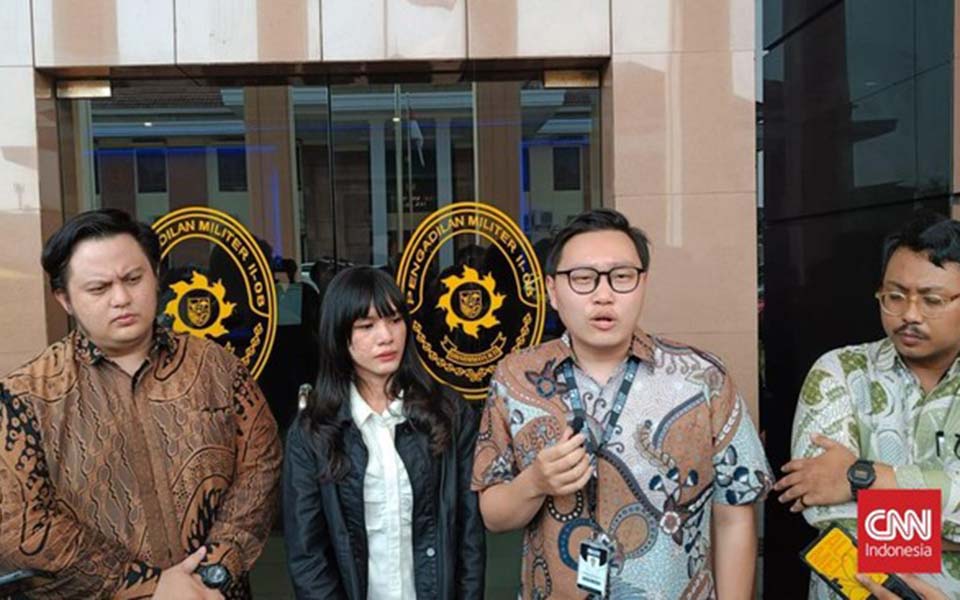


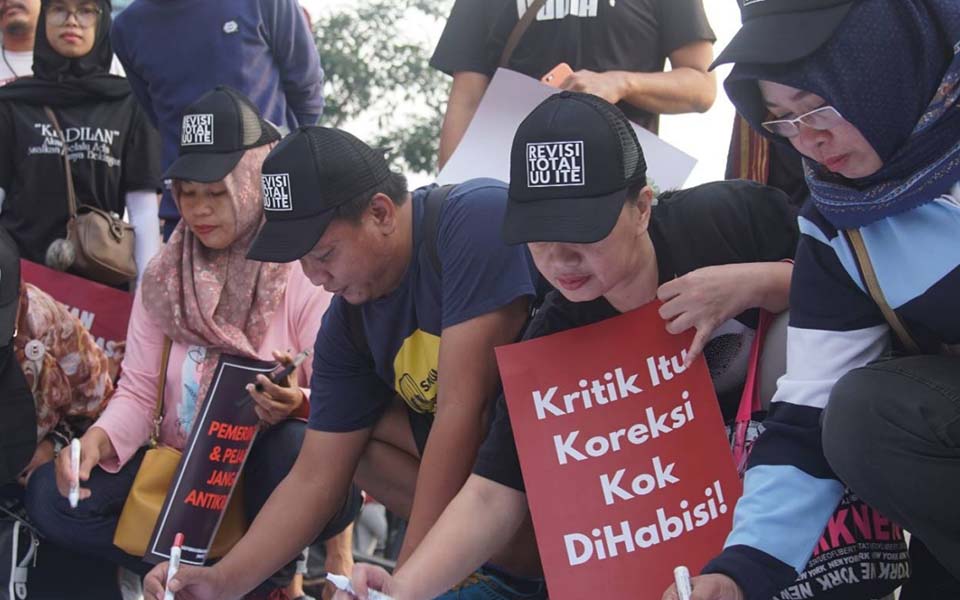
Responding to the arrest of two people because of social media posts and comments related to the President's statement on Iran's nuclear program, Amnesty International Indonesia Executive Director Usman Hamid said:
"The state has made another blunder. The state's repressive pattern has appeared again with the arrest and prosecution of two people in West Java on charges of incitement for their posts and comments related to the President's statement on Iran.
Rather than arresting citizens, why doesn't the government simply straighten out the president's sensitive speech on Iran's nuclear program? This police's actions exacerbates the narrowing of civil space in Indonesia. Furthermore, without evidence, the president's statement is clearly problematic. Therefore, it is understandable that many citizens have criticised it.
Statements in public and private spaces, no matter how unpleasant they may sound, are part of the freedom of expression guaranteed by international law and the Constitution. Verbal expressions of anger are not a crime as long as they are not accompanied by violence.
The police's argument that their comments 'threaten the integrity of the nation and state' and 'create a commotion' is baseless and contradicts last year's Constitutional Court ruling, which stated that disturbances/riots in digital space are not criminal offenses under the Electronic Information and Transactions (ITE) Law.
The Constitutional Court's ruling also exempts government agencies, institutions, including the President, and corporations from filing defamation complaints. So, on what basis are the police following up on a report by someone identified as FSS, who feels aggrieved by a post that was not actually directed at them?
The Constitutional Court's ruling also emphasises the limitation that the ITE Law may no longer be used to criminalise citizens deemed to be criticising the government online.
This pattern of repression was also seen in Jakarta, when the Jakarta Metropolitan Police (Polda Metro Jaya) recently detained a netizen in Ciamis on charges of spreading hoaxes related to calls for demonstrations ahead of Independence Day on August 17. Criminalisation is not the solution to the rampant spread of fake news on social media. The government must provide education on social media literacy.
Freedom of expression is a right protected by both international and national human rights law, including the 1945 Constitution. While this freedom can be restricted to protect the reputation of others, international human rights standards recommend that this not be done through criminalisation.
State institutions themselves, including the President, are not an entity whose reputation is protected by human rights law. This kind of criminalisation of the space for expression will only create a climate of fear in society and is a repressive tactic to silence criticism in the public sphere.
Citizens' criticisms, no matter how harsh and sharp, of state officials, including the President, are a legitimate form of expression of disappointment as long as it is not accompanied by physical violence. Criminalisation should not be used to silence citizens' voices on social media.
The government and the House of Representatives (DPR) must also immediately evaluate and revise problematic articles in the ITE Law and the new Criminal Code (KUHP), which are continually misused to suppress citizens' constitutional rights to assembly, opinion and expression.
The police must immediately and unconditionally release all citizens who are criminalised simply for speaking out on social media. Cyberspace should be a safe platform for expressing expression and differing opinions. Stop the criminalisation of freedom of expression on social media."
Background
According to media reports, the West Java Regional Police (Polda Jabar) have arrested two netizens in Cimahi, AYP and AF, in a case of incitement on social media related to President Prabowo Subianto's statement on July 31 that Iran possesses nuclear weapons.
AYP was named a suspect for allegedly creating, editing and transmitting content discussing the president's statement on Iran's nuclear weapons program on the social media platform Threads.
Meanwhile, AF is suspected of uploading provocative comments in the post. The West Java Regional Police stated that they will not only take action against the post's creator but also against comments deemed to contain incitement.
The case was reported on August 4 by an individual with the initials FSS, which was immediately followed up with an investigation by the West Java Regional Police's Cyber Investigation Directorate the next day. The West Java Regional Police told the media that the reporter felt aggrieved and considered the post to be a threat to the integrity of the nation and state, thus potentially creating unrest.
The two suspects have been charged under Article 35 in conjunction with Article 51 and/or Article 29 in conjunction with Article 45B of Law Number 1/2024 on the ITE Law, as well as Article 243, Article 246, Article 247 and Article 248 paragraph (1) of Law Number 1/2023 on the KUHP. They face a maximum prison sentence of four years and a maximum fine of 200 million rupiah.
[Translated by James Balowski. The original title of the article was "Bebaskan warga yang ditangkap atas konten pidato Presiden".]