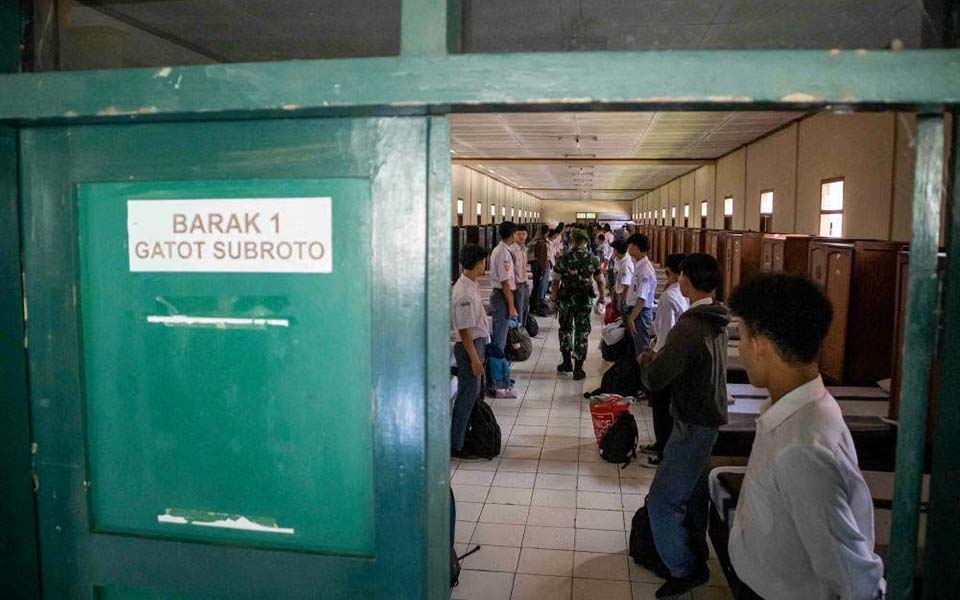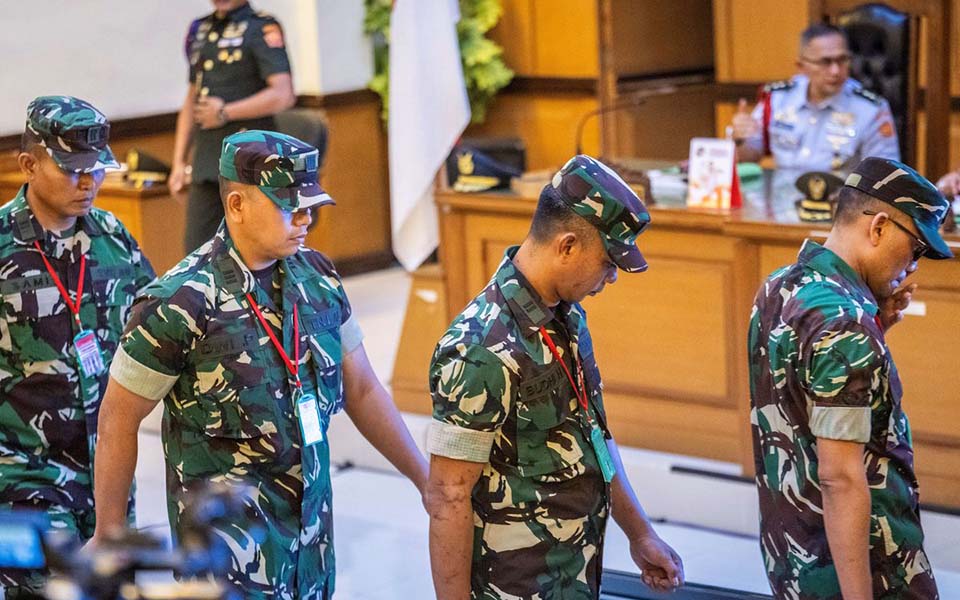


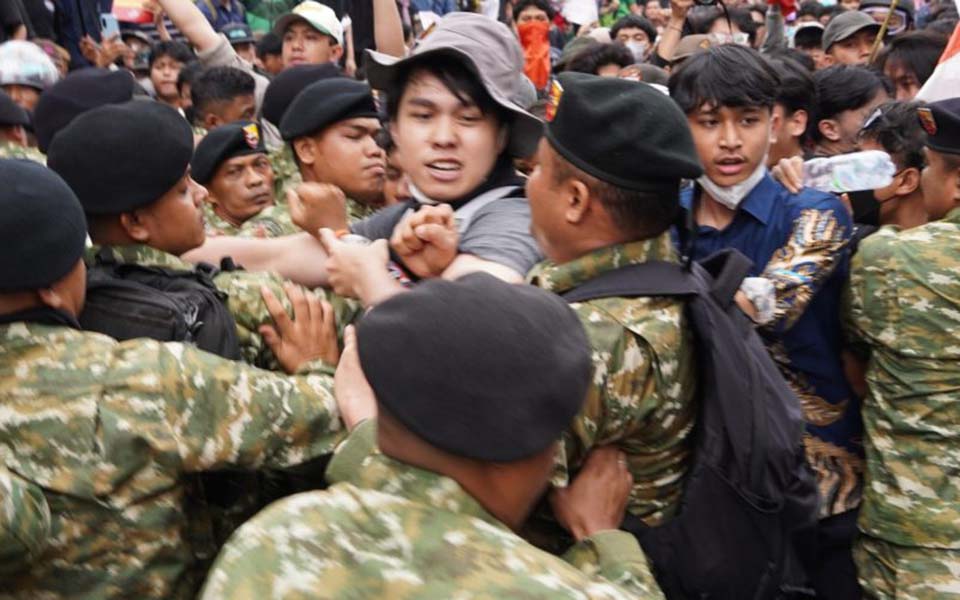
On October 28, Indonesian Military (TNI) soldiers were observed stationed at a number of action points around the Hotel Indonesia (HI) traffic circle, alleys and several demonstration points in Jakarta.
The placement of TNI soldiers in the midst of public expressions of opinion has raised concerns about the increasingly blurred boundaries between the functions of national defence and internal security. The presence of military officers in civil spaces, especially in situations of expressing opinions and critical aspirations in public, risks creating intimidation and narrowing the space for civil liberties.
The Coalition for Security Sector Reform is of the view that the involvement of the TNI in securing demonstrations is contrary to Law Number 34/2004 on the TNI as amended by Law Number 3/2025. The TNI's task is to organise national defence, not to secure demonstrations or confront protesters expressing their aspirations in public. The deployment of soldiers to confront demonstrators blurs the boundaries between defence and internal security functions and opens up space for the use of a militaristic approach in dealing with civilian problems.
Furthermore, the deployment of TNI soldiers to secure demonstrations is contrary to the TNI's function as a tool of national defence. Peaceful demonstrations are not a military threat that requires the deployment of troops. The 1945 Constitution differentiates the functions of the TNI in the field of defence and the National Police (Polri) in maintaining security, public order and enforcing the law. This separation was one of the important achievements of the 1998 reformasi (the political reform process that began in 1998) to end ABRI's (the Armed Forces as they were then known) dual function (dwi-fungsi) and upholding civilian supremacy.
In line with this, Article 28E paragraph (3) of the 1945 Constitution guarantees freedom of association, assembly and expression of opinions. These guarantees are also confirmed through Law Number 9/1998 on the Freedom to Express Opinions in Public. Therefore, security for demonstrations must be carried out by respecting civil liberties and not treating citizens who express criticism or aspirations as military threats.
It is important to remember that the military must not become a tool to silence critical voices, as happened during the New Order regime of former president Suharto, when the military had a broad role in civil and political life. The 1998 reformasi brought a mandate to end this practice and reaffirmed the boundaries between the defence functions carried out by the TNI and the security and law enforcement functions carried out by the National Police. The return of military involvement in securing demonstrations is clearly a step backwards for Indonesian democracy. This practice opens up space for intimidation of citizens who express criticism, and revives a militaristic approach in matters of citizen freedom.
Based on this, the Civil Society Coalition for Security Sector Reform urges the TNI to immediately withdraw soldiers from protecting security for mass actions and not to use armed force to confront demonstrators.
Jakarta, October 28, 2026
Civil Society Coalition for Security Sector Reform
The Indonesian Legal Aid Foundation (YLBHI), Indonesian Human Rights Watch (Imparsial), the Commission for Missing Persons and Victims of Violence (Kontras), Amnesty International Indonesia, the Human Rights Working Group (HRWG), the Indonesian Forum for the Environment (Walhi), thje Centra Initiative, the Raksha Initiative, the Indonesia Risk Centre, Indonesian Corruption Watch (ICW), the Jakarta Legal Aid Foundation (LBH Jakarta), the Setara Institute for Peace and Democracy, the Legal Aid Institute for the Press (LBH Pers)(, DeJure, the Community Legal Aid Institute (LBH Masyarakat), the Democratic Alliance for Papua (ALDP), Public Virtue, the Institute for Criminal Justice Reform (ICJR), the Institute for Public Research and Advocacy (ELSAM), the Indonesian Legal Aid and Human Rights Association (PBHI), the Jakarta Alliance of Independent Journalists (AJI Jakarta), the Women's Legal Aid Foundation for Justice (LBH APIK), the Indonesian Women's Coalition (KPI), the Medan Legal Aid Foundation (LBH Medan), the Indonesian Alliance of Independent Journalists (AJI Indonesia).
Contact persons:
1. Muhammad Isnur (YLBHI)
2. Ardi Manto Adiputra (Impartial)
3. Jane Rosalina (Kontras)
4. Usman Hamid (Amnesty International)
5. Daniel Awigra (HRWG)
6. Nany Afriada (AJI Indonesia)
7. Kahar Muamalsyah (PBHI)
8. Hafiz M (Centra Initiative)
9. M. Fadhil Alfathan (LBH Jakarta)
[Translated by James Balowski. The original title of the article was "Tarik mundur tentara dalam menghadang aksi massa".]
Source: https://ylbhi.or.id/informasi/siaran-pers/tarik-mundur-tentara-dalam-menghadang-aksi-massa/